We all know that “sitting is the new smoking.” Sounds good, right? But the truth is that there is more truth there than we want to admit. Think about it: long commutes, desk jobs, and Netflix binges. Every day. It’s like putting your life on hold.
Your health suffers when you sit still for eight hours or more. It’s not just feeling stiff; it’s a real danger. If you don’t exercise much, your risk of dying young goes up, just like if you smoke or are overweight. Moving around more and sitting less? That’s the answer.
Okay, but what if you do exercise?
Here’s the thing. There is still some hope. It makes me feel strong.
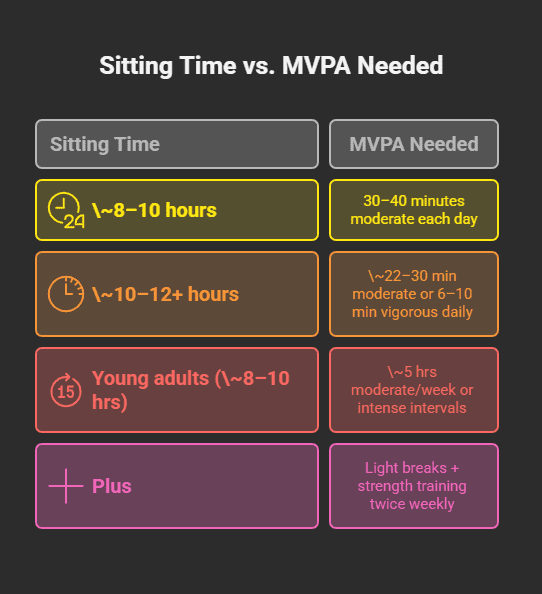
This is what a lot of studies that use fitness tracker data show: doing moderate to vigorous exercise for 30 to 40 minutes a day can cancel out the risk of sitting for about 10 hours. Moderate to strong? Think of things that get your heart and breath going, like fast walks, cycling, gardening, dancing, and more.
And yes, gardening is one of them. Who would have thought that cutting back roses would save lives?
If you look more closely, you’ll see that 20 to 25 minutes a day can do the same thing, especially for people over 50. About 22 minutes of that Mid-level Intensity movement will get rid of the risks of sitting, even if you sit for more than 12 hours.
So, is it 20 or 40 minutes? It depends. Some people study different things. But one thing is clear: the answer is to move around regularly, at least moderately to vigorously.
The intensity of conversation: light, moderate, vigorous
Let’s break it down:
Light activity: standing breaks, leisurely walking, light chores. Not bad, but only helpful if you’re super sedentary. Swapping even 30–60 minutes of sitting for gentle movement helps, but it isn’t enough alone.
Moderate activity: brisk walking (~2.5 mph), casual cycling, doubles tennis. This is your bread and butter.
Vigorous activity: running, fast cycling, swimming laps, jumping rope. Believe it or not, one study suggests that just 6 minutes per day of vigorous movement can offset most of that sitting-related mortality risk. Six minutes. Wow, huh?
In practical terms, don’t want a long workout session every day? Try a short high‑intensity burst (interval sprints, jump‑ropes, stair climbs). Or go longer and steadier. Your call.
What major health bodies recommend
International & national guidelines
The World Health Organization (WHO) endorses 150–300 minutes per week of moderate activity or 75–150 minutes per week of vigorous movement. That breaks down to about 22–43 minutes daily of moderate effort.
The American Heart Association (AHA) aligns: 150 minutes of moderate or 75 minutes of vigorous weekly activity, plus strength training twice a week. They also stress that even light movements, standing, small walks, provide benefits when breaking up sitting.
The UK NHS echoes the 150-minute moderate/week guidance, adding that breaking up long sitting bouts, even with light activity, is important.
Practical translation
Sitting ~10 hrs/day? Aim for 30–40 mins of moderate activity daily, or
Sitting ~12 hrs/day? Roughly 22 mins moderate or 6–10 mins vigorous daily.
Sprinkle in light movement breaks, stand, stretch, walk every 30–60 minutes.
Intensity vs duration: which matters more?
Two truths:
Duration of moderate-to-vigorous activity matters. Hitting 22+ minutes a day gives strong protection, even if you’re sitting a lot.
Intensity packs a punch: six minutes of vigorous activity daily can deliver similar results. Condensed, but powerful.
So, no time for 30–40 minutes? Go for a 6-minute intense session. Or chunk moderate activity throughout your day. And yes, don’t skip strength training twice weekly. Vital for bones and muscles.
Sitting plus low activity = double trouble
A sobering note: sitting a lot and not exercising? That combo spikes risk more than sitting without movement or exercising without sitting.
To fight back, you need both: reduce sitting AND get enough MVPA, regular walking, or more intense activity is your protective shield.
Younger folks vs older adults: is it different?
It turns out younger adults aren’t exempt. Studies on people in their 20s to 40s reveal that sitting 8+ hours boosts BMI and messes with cholesterol, even for those who met the 150-minute/week guideline.
They needed more: about 5 hours of moderate/week or 2.5 hours of vigorous/week. Or interval bursts networked through long sitting periods. So, sitting isn’t harmless at any age.
Strategies to make it work IRL
Here’s where we get real. Here are options that fit into human lives, busy calendars, travel days, and lazy Sundays.
1. “Activity snacks”
Short bursts: 5–10 minute walks, stair climbs, quick dancing between Zoom calls. It adds up. Every move counts.
2. Stand up regularly
Set a timer, every 30–60 minutes, stand up, stretch, and wander a bit. Light movement, yes, but better than zip.
3. Make commute cardio
Park farther out, walk/bus/bike part of the commute. Even 20 minutes each way stacks nicely.
4. Sneak bursts of vigor
A full workout sucks time. But a 6–10‑minute high‑intensity session? Doable: sprints, stair runs, jump rope. Boom, goal met.
5. Weekend longer sessions
Short on weekdays? Stack time on weekends, 90‑minute hikes, long bike rides, and active playdays. Weekend MVP.
6. Strength days
Twice weekly, lift weights or do resistance moves. Builds strength and balance, and protects bones and muscles, too.
What does that mean for *you*, a personal take
So if you’re already working out occasionally… good on ya. But maybe you’re unsure how much more is needed. Suggested:
Aim for 30 minutes of moderate‑vigorous activity, either midday or evening.
OR 20 minutes brisk walk morning and evening.
OR carve out six minutes of intense movement during the day.
PLUS: stand and move every 45–60 minutes if you desk a lot.
That covers your bases, duration, intensity, and movement breaks.
But sometimes life gets real.
Travel, deadlines, sickness, all that. Don’t stress about perfection.
Both the WHO and AHA say that any activity is better than none. Even standing more is progress. If zero movement today, you can still change course, stretch, stand, and walk around. Baby steps win long term.
Common questions answered
Q: “Can’t I just stand all day?”
Standing helps metabolism and posture, but it doesn’t neutralize mortality risk as MVPA does. You need to exercise.
Q: “What if I split my 30 minutes?”
Perfectly fine. Studies show multiple shorter sessions work just as well as one solid chunk.
Q: “Is brisk walking enough?”
Yes, if you do enough. Go moderate for 20–40 minutes per day. If you go faster, fewer minutes work.
Q: “I’m older or diabetic, does it change?”
Not really. As long as you meet 150+ minutes of moderate/vigorous weekly, sitting risk fades, even for chronic health conditions.
Quick cheat sheet
Sitting Time/Day MVPA Needed to Offset Risk
Bottom line
Sitting all day? Not great, especially without exercise.
Exercise, especially moderate‑vigorous, for ~20–40 min daily is your shield.
Intensity counts, and short, intense bursts are legit.
Light activity and standing? Helpful, but not enough alone.
Split sessions? Totally cool.
Strength work? Don’t skip it.
In final words, human rhythm is included
This is the thing. Life has its ups and downs. Some days, you really get a good workout. What else? You hardly ever get up from the couch to get food.
That’s what people do. That’s fine. What matters is what you mean. Get moving today. Get up again tomorrow. Do something. Because even imperfect movement helps fight the risks of sitting.
Try it out. Set a timer for 25 minutes. Walk quickly. Maybe bounce up and down. It’s not about being perfect; it’s about being there.
Is it because you get a little boost of energy after just five minutes of moving? Your body is saying “thank you.” And it doesn’t take much to make a difference.
Water Makes Your Body Sing. Ever really think about water?
Really, give it some thought. Not just that clear stuff you swill down after working out or reluctantly take a sip when you start to get a headache. But as the unsung, silent hero of your life. A Swiss watch would appear to be a child’s toy in comparison to the master conductor of a symphony, so intricate and complex.
It’s only water. Correct? water. Easy.
To be honest, though, that simplicity is incredibly misleading. Your body’s water story is far from straightforward. It’s a vast, epic tale of physics, chemistry, and unadulterated biological magic. It’s the key component that enables you to be who you are.
Now, let’s reveal the truth. With each sip, let’s take a close look at what’s going on inside of you. Take a break from the dry, textbook explanations. This is the tour behind the scenes. The VIP pass to your internal operations.
And trust me, you won’t want to miss this show.
The Original Superhighway: Your Blood, Powered by Water
Picture this: a bustling, chaotic city. Millions of microscopic vehicles, red blood cells, scurrying around, each carrying a precious cargo of oxygen. Other trucks haul away garbage (hello, carbon dioxide), while delivery vans rush vital packages of nutrients and hormones to every last address in the metropolis that is your body.
Now, what’s the one thing this city absolutely cannot function without?
The roads. The highways, the boulevards, the tiny little back alleys.
And in your body? That superhighway system is your bloodstream. The kicker? Your blood is about 92% water.
Mind-blowing, isn’t it?
Without that high water content, your blood would be less like a free-flowing river and more like…well, sludge. A thick, gooey mess that would bring that bustling city to a grinding, catastrophic halt. Your heart, the city’s central pump, would have to work impossibly hard, straining against the friction, just to move that sludge an inch. Talk about being stuck in traffic.
But with enough water, everything just flows.
It’s this flow that allows for the almost instantaneous delivery of oxygen from your lungs to your big toe. It’s what lets those powerful hormones, the messengers that control your mood, your energy, your everything, zip from a gland in your brain to your adrenal glands in the blink of an eye. When your blood is properly hydrated, it’s a marvel of efficiency. A perfectly optimized delivery network, ensuring every single one of your trillions of cells gets exactly what it needs, right when it needs it.
Think about that next time you feel that afternoon slump. That foggy-headed, ca n’t-quite-focus feeling. It might not be a lack of caffeine. It could just be that your internal superhighway has a few traffic jams. A little gridlock in the system. A glass of water can, quite literally, get things moving again. It’s like calling in the traffic cops to clear the congestion. Suddenly, the flow is restored. The city breathes a collective sigh of relief. And you? You feel it. The energy returns. The fog lifts.
All because of water. Simple, brilliant water.
The Ultimate Climate Control System
You know that feeling. The sun was beating down on a sweltering summer day. The intense, heart-pounding heat of a spin class. Your internal temperature starts to climb, and if left unchecked, things could get dangerous. Dangerous.
So what does your body do? It sweats.
It’s one of those things we just accept, maybe even complain about. But sweating is one of the most elegant and effective feats of thermal engineering in the natural world. (And yes, you’ll love this part).
Here’s how it works: Your body, sensing the rise in your core temperature, pushes water, mixed with a few salts and electrolytes, out through tiny pores in your skin. Now, this is where the magic happens. As that water sits on your skin, it begins to evaporate. It turns from a liquid into a gas.
And that process, evaporation, requires energy. Specifically, it requires heat energy. Where does it get that heat?
From you.
It pulls the heat away from your skin, cooling you down from the outside in. It’s your own personal, built-in air conditioning unit. And the fuel for this AC? You guessed it. Water.
But it’s not just about cooling you down. Water is also a fantastic insulator. The water held within your cells (and your entire body is about 60% water, by the way) acts as a buffer. It can absorb a whole lot of heat before its temperature starts to rise significantly. This is called a high specific heat capacity, for the science nerds out there. This property helps protect you from sudden, drastic changes in external temperatures, keeping your internal environment stable and safe. It’s like a thermal blanket wrapped around your delicate organs.
So, when you’re dehydrated, you’re essentially turning down the power on your personal AC unit and throwing off your insulating blanket. Your body can’t sweat as efficiently, putting you at a much higher risk of overheating and heatstroke. A condition that is no joke.
Staying hydrated, then, isn’t just about feeling comfortable. It’s a critical safety measure. It’s giving your body the raw material it needs to maintain that perfect, life-sustaining internal thermostat. Who knew a glass of water was a masterclass in thermodynamics?
The Great Digestive Dance (and the Cleanup Crew)
Let’s talk about food. The glorious, wonderful journey it takes from your plate to, well, you know.
That whole process, from start to finish, is utterly dependent on water. It’s not just a bit player; it’s the stage manager, the lighting crew, and the cleanup crew all rolled into one.
It starts the moment food hits your mouth. Saliva, which is mostly water, begins the process of breaking down carbohydrates, making food softer and easier to swallow. A dry mouth isn’t just uncomfortable; it’s the first sign that your digestive system is already working with one hand tied behind its back.
Then, as that food travels down into your stomach and intestines, water is there every step of the way. It helps dissolve the nutrients, the vitamins, the minerals, the good stuff, so that your intestinal walls can absorb them. Think of it like making a cup of tea. You can’t get the flavor out of the tea bag without the hot water to dissolve it. Same principle. No water, no nutrient absorption. You could be eating the healthiest diet in the world, but without enough water, a lot of that goodness is just passing right on through. A total waste.
And here’s something most people don’t think about: fiber. We’re all told to eat more fiber, right? For regularity. For gut health. But here’s the kicker: without water, fiber can make things worse.
Fiber works by absorbing water in your large intestine, which adds bulk and softness to your stool, making it easier to pass. It’s a beautiful partnership. But if you’re dehydrated, there’s no spare water for the fiber to soak up. So instead of becoming soft and bulky, it just sits there. Hard. Dense. Leading to constipation, bloating, and a whole lot of discomfort. It’s a classic case of a good intention gone wrong, all for the lack of a few extra glasses of water.
And what about the cleanup? After your body has taken all the nutrients it needs, what’s left over has to go somewhere. Your kidneys are the master filtration plants of your body, and they are water-guzzling machines. They work tirelessly to filter waste products and excess ions out of your blood, creating urine.
If you’re well-hydrated, this process is a breeze. Your urine is a pale, straw-like color, and your kidneys are happy. But when you’re dehydrated, your body goes into conservation mode. It tells the kidneys, “Whoa, hold on! We can’t afford to lose this much water!” In response, your kidneys concentrate the urine as much as possible, reabsorbing more water back into the body. This is why your pee turns that dark, ominous yellow. It’s a desperate attempt by your body to hold onto every last drop. It’s also incredibly stressful for your kidneys and, over the long term, can contribute to nasty problems like kidney stones.
So, drinking water isn’t just about quenching thirst. It’s about lubricating the entire digestive dance and then making sure the cleanup crew has everything it needs to take out the trash.
The Brain’s Best Friend: Clarity in a Glass
Ever had one of those days where your brain just feels…like mush? You can’t string a thought together, simple decisions feel monumental, and your memory is on vacation.
You might be reaching for another coffee, but what you probably need is a tall glass of water.
Your brain, the command center of your entire being, is about 75% water. And it is exquisitely sensitive to its hydration status. Even a mild level of dehydration, we’re talking as little as a 2% drop in your body’s water content, can have a noticeable impact on your cognitive function.
Funny thing is, you might not even feel thirsty at that point. But the effects are already setting in.
Your focus wavers. Your short-term memory gets a bit fuzzy. You might feel more irritable or anxious. Why? Because the intricate electrical signaling that constitutes your thoughts relies on a delicate balance of electrolytes and, you guessed it, water. When that balance is off, the signals don’t fire as cleanly. The connections aren’t as sharp. It’s like trying to have a clear phone conversation with a bad signal. Full of static and dropped words.
Dehydration can also temporarily shrink your brain tissue. No, really. It pulls away from the skull. This physical change is thought to be one of the reasons we get those pounding dehydration headaches. The brain doesn’t like being cramped.
But here’s the beautiful part. This is all completely, wonderfully reversible.
Studies have shown that rehydrating can restore cognitive performance in a remarkably short amount of time. That feeling of clarity that washes over you after drinking water when you’re parched? It’s not your imagination. You are giving your brain the fluid it needs to plump back up, to restore its delicate chemical balance, and to get those electrical signals firing on all cylinders again.
So next time you’re facing a big project, a tough exam, or just need to be on your A-game, don’t just think about your preparation or your mindset. Think about your hydration. It might just be the most important and easiest thing you can do to ensure your brain is functioning optimally. Give it a try. Before you do anything else, just drink a full glass of water. See what happens.
It’s the ultimate brain food. And it costs next to nothing.
More Than Just the Big Stuff: The Silent, Everyday Miracles
The large, life-sustaining jobs have been discussed. The sweeping, grand functions. However, there are more incredible ways that water benefits your body. By no means. In ways you may not have thought of, they are interwoven into the very fabric of your everyday existence.
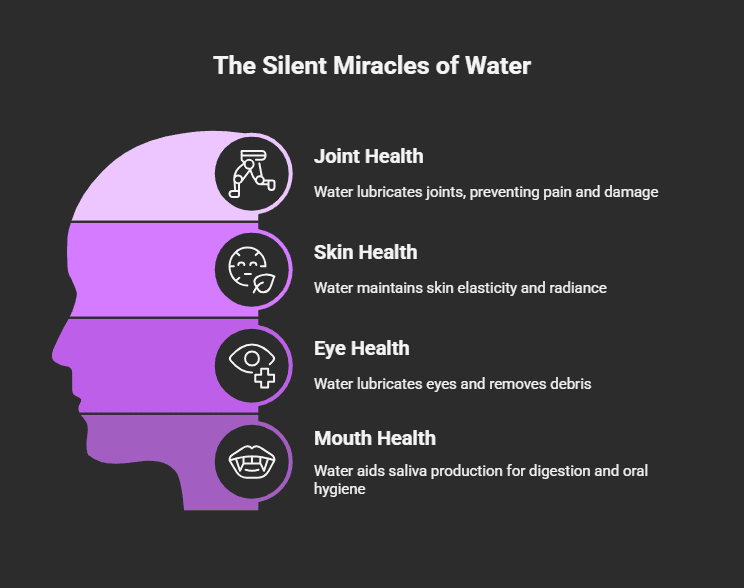
Consider your joints. About 80% of the smooth, rubbery cartilage that prevents your bones from grinding against one another is made up of water. This includes the cartilage in your knees, hips, and shoulders. It serves as a natural lubricant and shock absorber. That cartilage may become less spongy when you’re dehydrated. It loses some of its ability to absorb shock. Joint pain may result from this, which may eventually lead to more serious problems. Maintaining proper hydration is similar to changing the oil in your joints. It keeps everything pain-free, silent, and in motion.
What about your skin? That lovely shield against the world? Its elasticity and plumpness are preserved from the inside out when properly hydrated. Water is the foundation of true skin health, even though moisturizers only address the surface. Your skin is one of the first areas to show signs of dehydration, becoming lifeless, parched, and more prone to fine lines. No cream can fully replace the healthy, glowing glow that comes from drinking enough water, which also helps to improve blood flow to the skin and flush out toxins. It’s the original secret to beauty.
Even your eyes and mouth need it. Water is a key component of your tears, which lubricate your eyes and wash away debris, and your saliva, which, as we saw, does so much more than just wet your whistle.
It’s everywhere. Doing everything. All the time.
This silent, tireless work is the foundation of optimal function. It’s not about grand gestures or quick fixes. It’s about consistency. It’s about providing your body with its most fundamental, most essential resource, day in and day out.
So, here’s the thing. We live in a world obsessed with optimization. Biohacking. Performance-enhancing supplements. Complicated diets. And yet, we so often overlook the simplest, most powerful tool at our disposal.
Water
It’s not trendy. It’s not expensive. It doesn’t come in a fancy bottle with a long list of unpronounceable ingredients (or at least, it shouldn’t).
But its effects are profound. Transformative, even. It’s the baseline. The foundation upon which all other aspects of your health are built. Before you worry about anything else, ask yourself a simple question:
Because you’re attempting to construct a skyscraper on sand if the answer is no. It simply cannot withstand it.
Give your body what it needs. What it required to play that amazing, unseen symphony of life? Pay attention to its signals. The exhaustion, the thirst, the cloudy thinking. These aren’t bothersome things. They’re messages. A request for its most important resource from your inner city.
Respect that request. Lift a glass. And sip from your very own water-powered marvel. It’s helping you more than you could ever know. And a sip is where it all begins.
The numbers might have been slightly off during a routine check-up. Or perhaps you are all too familiar with the tale of waking up to a big toe that is throbbing, irate, and unable to bear the weight of a bedsheet. You wouldn’t want your worst enemy to experience such a beautiful and fiery pain. That’s the hallmark of gout, the most well-known and excruciating side effect of uric acid, my friend.
You’re here for whatever reason. You’ve been instructed to monitor your levels, and your plate should be the first thing you check. And perhaps you’re a little bitter about having to give up some of your favorite foods because you’re feeling a little overwhelmed? Breathe deeply. You’re in the proper location.
Because this isn’t just another list of “eat this, not that” that is sterile and dull. Not at all. This is a genuine discussion about food, lifestyle, and regaining control. It’s not just about preventing a flare-up; it’s about living well. Without making you feel as though you are facing a life sentence of boring, uninteresting meals, we will delve into the specifics, the whys, and the hows.
It may surprise you to learn that controlling your uric acid can be empowering. It’s an opportunity to become more aware of your body and learn what triggers its reactions. Are you prepared to begin? Let’s get started.
What’s the Big Deal with Uric Acid, Anyway?
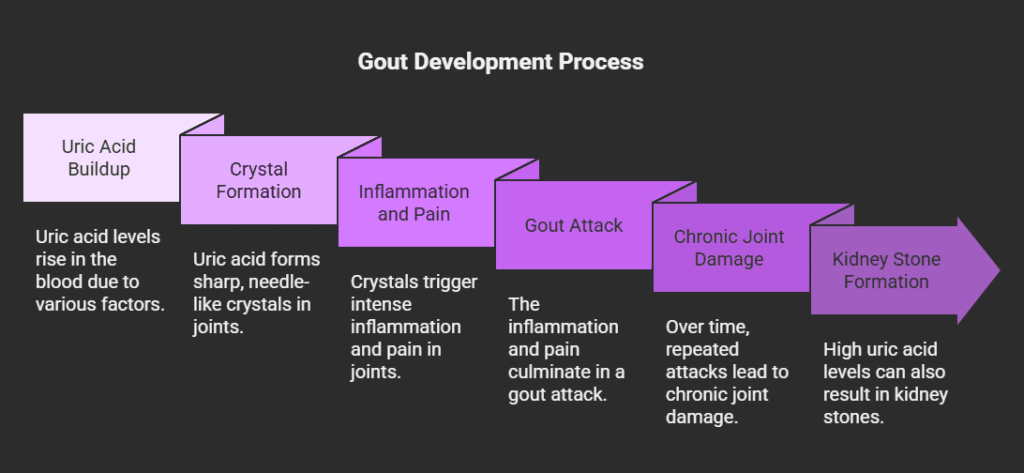
Before we start ransacking your pantry, let’s get one thing straight. Uric acid isn’t some evil villain. It’s a normal, naturally occurring substance in your blood. Your body produces it when it breaks down chemicals called purines.
Think of it like this: your body is a busy workshop, constantly building and repairing. Purines are like the raw materials, the sawdust and leftover scraps from all that work. Your kidneys are the cleanup crew, filtering this “sawdust” (uric acid) out of your blood and sending it out of your body via your urine. It’s a pretty slick system, most of the time.
The problem starts when the system gets out of whack.
Either your body starts producing way too much sawdust, maybe you’re feeding it a ton of purine-rich materials, or your cleanup crew (the kidneys) gets a bit sluggish and can’t sweep it all away efficiently. When that happens, the uric acid builds up in your blood. It has nowhere to go. So it travels around your body, looking for a place to settle, and it has a particular fondness for cooler spots, like your joints.
And when will it settle? It forms tiny, sharp, needle-like crystals. Ouch. That’s not a metaphor; that’s literally what’s happening. Those urate crystals are what trigger the intense inflammation and agonizing pain of a gout attack. It’s not just a pain; it’s a fire. A full-on, five-alarm blaze in your joint. And over time, this can lead to not just more frequent attacks, but also chronic joint damage and even kidney stones.
Scary stuff, right? But here’s the kicker: you have way more control over this than you think. And it starts with the fuel you put in your body.
The Game-Changer: Your Plate
When it comes to managing uric acid, your diet is, without a doubt, the single biggest lever you can pull. It’s the game-changer. It’s how you go from being a victim of your symptoms to the master of your well-being.
The core principle is simple: manage your purine intake. Now, this doesn’t mean you have to eliminate every single purine from your life. That’s practically impossible, and frankly, it wouldn’t be healthy. Lots of very nutritious foods contain purines. The key isn’t elimination; it’s strategy. It’s about knowing which foods are packed to the gills with purines and which ones are safe to enjoy freely.
It’s time to know your friends from your foes.
The ‘Green Light’ List: Foods to Embrace and Enjoy
Let’s start with the good news. The great news. The list of foods you can and should be eating is long, vibrant, and delicious. This is about abundance, not deprivation. Get ready to pile your plate high.
Fruits: Nature’s Candy and Your New Best Friend
If there’s one food group to fall head over heels for, this is it. Most fruits are wonderfully low in purines and packed with things that actively help your cause.
Cherries, Cherries, Cherries! Okay, let’s just get this one out of the way. Cherries are the undisputed heavyweight champion in the fight against uric acid. They are legendary. They contain powerful antioxidants called anthocyanins, the stuff that gives them that gorgeous, deep red color, which have incredible anti-inflammatory properties. Some studies suggest that eating cherries or drinking tart cherry juice can lower uric acid levels and slash the risk of a gout attack. So, yes, believe the hype. A cup a day might just keep the doctor away. Seriously.
Vitamin C Powerhouses: Your body loves Vitamin C. And you know what else loves it? Your kidneys. Vitamin C has been shown to help the kidneys excrete more uric acid. So, load up! Think oranges, grapefruits, kiwi, and strawberries. A simple orange for a snack? That’s not just a snack; that’s a strategy.
Apples & Bananas: The humble apple contains malic acid, which is thought to help neutralize uric acid. Bananas are low in purines and a great source of potassium, which helps prevent uric acid from crystallizing. Easy, portable, and effective. What’s not to love?
Vegetables: A Rainbow of Goodness
Now, vegetables can feel like a bit of a minefield because of some old, outdated advice. The truth? Plant-based purines just don’t seem to affect your body in the same way animal-based ones do. So, while some veggies are higher in purines than others, the consensus now is that the benefits of eating a wide variety of vegetables far, far outweigh any potential risk.
The All-Stars: Cucumbers, bell peppers (all colors!), carrots, broccoli, squash, and potatoes are all low-purine heroes. They are hydrating and full of fiber and vitamins. Roast them, steam them, eat them raw in a giant salad. Go crazy.
What About Spinach and Asparagus? Ah, the age-old question. Yes, foods like spinach, asparagus, mushrooms, and cauliflower have a moderate amount of purines. For years, they were on the “avoid” list. Funny thing is, recent research has thrown that into question. Studies have failed to show a link between eating these vegetables and an increased risk of gout attacks. So, unless you find they are a personal trigger, there’s no need to banish them. Just don’t eat a whole pound of asparagus in one sitting. Common sense, you know?
Dairy: The Unexpected Secret Weapon
Here’s a fun surprise. Low-fat dairy is not just safe; it’s actively beneficial. Believe it or not, dairy products seem to have a special power; they promote the excretion of uric acid through your urine.
Milk & Yogurt: A glass of skim milk or a bowl of low-fat yogurt can literally help flush the bad stuff out. We’re talking a measurable effect here. Greek yogurt, in particular, is a fantastic, protein-packed option for breakfast or a snack. Just make sure you’re choosing the low-fat or non-fat versions, as high-fat dairy doesn’t seem to have the same protective effect.
Grains & Starches: Choose Your Carbs Wisely
Carbohydrates are your friend, but the type of carbohydrate matters.
Go for Whole Grains: Think brown rice, whole wheat bread, quinoa, and oats. These are complex carbohydrates that are good for your overall health, help with satiety, and are generally low in purines.
Ditch the White Stuff: Highly processed, refined carbohydrates, white bread, white rice, sugary cereals, cakes, cookies are another story. They can spike insulin levels, which in turn can reduce how much uric acid your kidneys get rid of. It’s a sneaky backdoor effect that many people miss.
Beverages: Hydrate, Hydrate, and Caffeinate?
Water is Your Superpower: If cherries are the champion, water is the god-tier superpower. You need to drink it. Lots of it. All day. Think of your body as a system of pipes. Water is what flushes those pipes clean, clearing out all the excess uric acid before it has a chance to set up camp in your joints. Aim for at least 8-10 glasses a day, maybe more if you’re exercising or it’s hot out. Carry a bottle with you everywhere. This is non-negotiable.
Coffee Lovers, Rejoice! Here’s the best news you might hear all day. Multiple large-scale studies have shown that regular coffee consumption is associated with lower uric acid levels. Yes, you read that right. The effect is seen with both regular and decaf coffee, which suggests it’s not just the caffeine but other compounds in the coffee that are helping out. So, that morning cup (or three)? It’s probably helping.
Green Tea: Not a coffee person? Green tea is another excellent choice, loaded with antioxidants and beneficial compounds.
The ‘Yellow Light’ List: Proceed with Caution
Life is about balance, right? Not everything is a hard yes or a hard no. This is the zone of moderation. These are foods that aren’t necessarily off-limits forever, but you need to be smart about them. It’s about portion size and frequency.
Lean Meats: We’ll get to the big, bad red meats in a moment, but what about chicken? A small, palm-sized portion of chicken or turkey breast, a couple of times a week, is generally considered okay for most people. The key is lean and small. A giant fried chicken dinner? That’s venturing into the red zone. But a simple grilled chicken salad for lunch is a different story entirely.
Oatmeal: Oatmeal is fantastic for you, full of soluble fiber. It does have a moderate level of purines, though. Is this a problem? For most people, no. The benefits are too great to ignore. Just don’t make it your only food source. Having a bowl for breakfast is a world away from having it for every meal.
Lentils and Legumes: Beans, lentils, and peas are a wonderful source of plant-based protein and fiber. They also carry a moderate purine load. Like the controversial veggies, they used to be on the “no” list, but a new school of thought sees them as a much, much safer bet than animal protein. They are a fantastic substitute for red meat.
Some Fish: This is a tricky one. We know that some seafood is disastrous for uric acid (more on that below). But what about the others? Fish like salmon, while having more purines than, say, a carrot, are also packed with anti-inflammatory omega-3 fatty acids. For many, a small serving of a lower-purine fish like salmon or trout once in a while might be a reasonable trade-off. This is where you have to listen to your body.
The ‘Red Light’ District: Foods to Seriously Avoid
Okay, time for some tough love. Some foods are just, if I’m being honest, purine-delivery systems. They are so high in these compounds that they can send your uric acid levels soaring and trigger a flare-up with shocking speed. These are the foods to either eliminate or save for the rarest of rare, special occasions.
Organ Meats: This is the absolute top of the list. Liver, kidneys, sweetbreads, pâté. These are purine bombs. No way around it. They are incredibly dense in purines because of their metabolic function in the animal. Sorry, but these have to go. End of story.
Red Meat: Beef, lamb, pork, and game meats like venison are all very high in purines. This is often the hardest one for people to swallow, but cutting way back on red meat can make a monumental difference. Think of it as a “once in a blue moon” food rather than a weekly staple.
Certain Seafood: While some fish are on the yellow list, others are squarely in the red. Anchovies, sardines, herring, mussels, scallops, and mackerel are notoriously high in purines. If you see anchovies on a pizza menu, just walk away.
Alcohol, Especially Beer: Ah, alcohol. This is a double-whammy. Or rather, a triple-whammy.
Beer is the worst offender. Why? It’s made from brewer’s yeast, which is fantastically high in purines. It directly adds fuel to the fire.
Alcohol itself speeds up purine production in the liver. So it’s making your body produce more of the bad stuff internally.
Alcohol dehydrates you and forces your kidneys to work overtime processing the alcohol, which means they do a much worse job of filtering out and excreting uric acid. So, beer delivers purines and makes your body produce more uric acid and making it harder to get rid of it. It’s the perfect storm for a gout attack. Hard liquor is also problematic. Wine, in very strict moderation (like one small glass), seems to be less of a threat, but honestly, the safest bet is to dramatically reduce your intake across the board.
The Hidden Villain: High-Fructose Corn Syrup (HFCS): This is the one that surprises everyone. It’s the secret enemy. HFCS contains no purines at all, yet it is one of the worst things you can consume for your uric acid levels. Here’s how it works: your body burns through a lot of energy to process fructose, and this process stimulates the production of uric acid like crazy. It revs up the “sawdust” machine in your workshop to a terrifying degree. Where do you find it? Sugary drinks. Sodas, sweetened iced teas, many fruit juices (yes, even the ones that seem healthy!), and countless processed foods and snacks. You must become a label detective. Cutting out sugary beverages is as important, if not more important, than cutting out red meat.
Beyond the Plate: Lifestyle Tweaks That Make a World of Difference
Your diet is the cornerstone, but a few other lifestyle changes can support your efforts and make you feel a whole lot better.
Weight Management: This is a delicate subject, but it’s crucial. Carrying extra weight puts more strain on your joints, but it also increases your body’s production of uric acid, making it harder for your kidneys to eliminate it. Losing even a small amount of weight, such as 5-10% of your body weight, can have a significant impact on your uric acid levels and the frequency of gout attacks. Frame it not as a punishment, but as an act of kindness to your body. It’s not about looking a certain way; it’s about taking a burden off your system so it can function better.
Gentle Movement: Regular exercise is fantastic for your overall health, weight management, and stress levels. But you need to be smart. High-impact, joint-jarring exercise can be a bad idea, especially if your joints are already sensitive. Think gently. Walking is amazing. Swimming is even better; it’s zero-impact and works your whole body. Cycling and yoga are also wonderful choices. The key is consistency.
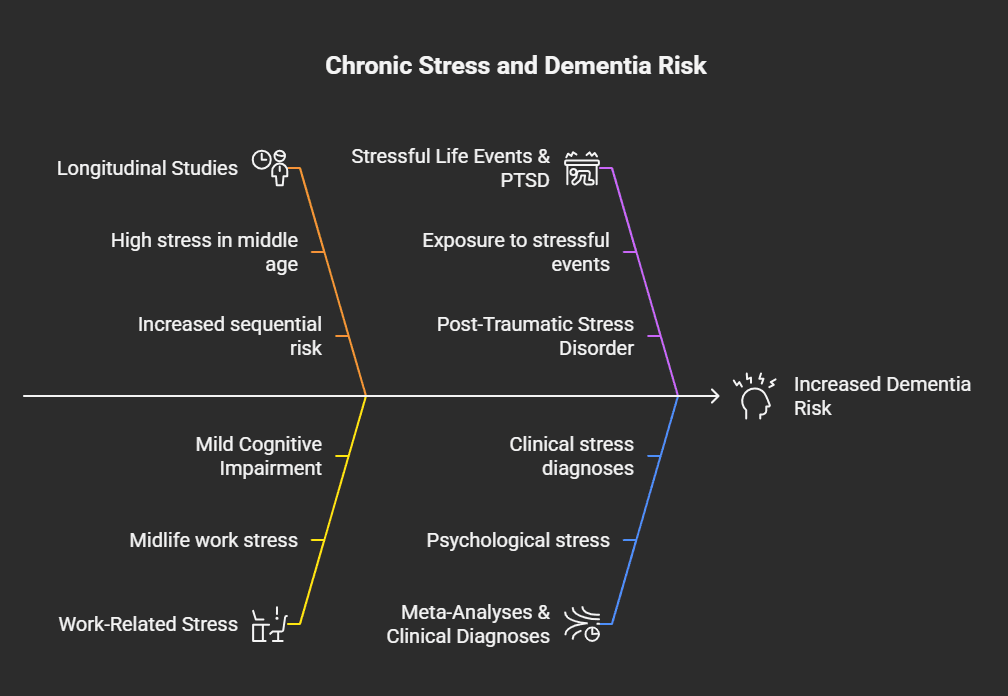
Stress Less, Seriously: Who doesn’t have stress? But chronic stress can contribute to inflammation throughout your body. Finding ways to manage it can only help. It doesn’t have to be complicated. Five minutes of deep breathing, a short walk in the middle of the day, and listening to some music; these small acts can make a big difference in your overall state of well-being.
You’ve Got This. Really.
This is a lot of information, I realize. It may seem as though your life has been completely redesigned. However, don’t treat it like a mountain that you must climb all at once. Consider it a single step.
Begin modestly. Make one change this week. Perhaps it’s switching to sparkling water with a squeeze of lemon instead of your usual soda. Perhaps it’s packing a large salad for lunch. Or perhaps it’s simply committing to always have a water bottle on hand.
This is a process rather than a final destination. You will occasionally get a piece of pizza. Cake will be served at the birthday celebrations. It’s alright. That is what it means to be human. Progress, not perfection, is the aim. It’s about feeling better, having more energy, and not having to worry about that next painful, unexpected attack.
Now you know. You are familiar with the low-fat yogurt, the water, the cherries, and the heroes. The villains, beer, organ meats, and sugary drinks are all familiar to you. You’re not in the dark anymore.
So, go ahead. Enter your kitchen. Consider it a pharmacy rather than a minefield. A healing place. A position of authority. One tasty, wise, and filling meal at a time, regain your health. Your joints in particular will appreciate it. You’re capable.
Let’s be honest, there are moments when fitness advice seems like a snooze fest. bland bullet points. Dry. However, getting in shape doesn’t have to be a lecture, despite popular belief. The bottom line is to squat deeply, take a deep breath, and focus.
Warm Up, No, Seriously
Have you ever jumped right into a workout? A bad idea. Absolutely. Even a quick stroll or a few jumping jacks can help rouse sluggish muscles. Get them to wake up and relax. You’re betting on injury if you skip warm-ups. And that isn’t cool.
Form Over Ego Lifts
Believe me-lifting weights without proper form? A surefire way to fail. Maintain a stacked spine. Line up your knees and brace your core as if you were going to be punched. Stop when something doesn’t feel right. Reduce your load or move to a new location.
Ironically, doing less but correctly is always preferable to heaving weights.
Cardio Wisdom (Not Just Sweat and Regret)
You don’t need to run marathons, unless you want to. But cardio isn’t just for the pros; it’s like a full-body tune-up.
Consistency over intensity, at first. 30 minutes most days? Stellar. One killer 90-minute session? You’ll pay the next day.
Mix it up. Jog, cycle, swim, dance in your living room, who cares? As long as your heart’s pumping.
Low impact is underrated. Walking? Gold. Keeps joints happy, still gets the job done. rapidphysiocare.com
Track your progress, not to beat yourself up, but so when you look back, you go: damn, I’m doing this
Strength Training, Foundations First
Whether you’ve got dumbbells or soup cans, strength training is the secret weapon.
Start simple: bodyweight moves like push-ups, squats, lunges, they work wonders. Kettlebells and bands later.
Find your fatigue sweet spot: 12–15 reps, where your muscles feel it, that’s gold.
Mind your rest days. Those muscles don’t grow during lifts; they grow while you recover. So alternate muscle groups, or take a day off.
Technique matters. If form falters, either slow down or lighten the load. Hiring a trainer can be worth it.
Hydration & Fuel, The Silent Partners
No one preaches this enough, but hydration is a hero. Be a water ninja: sip often, especially in workouts. And eat enough, your muscles need fuel. Ignoring food and water? Not cool.
Recovery, Not Optional
Stretch. Foam roll if you’re into that. Sleep, those 7–9 hours aren’t optional. That’s when your body rebuilds. Recovery is as gym‑worthy as your workout.
Don’t compare yourself to gym bros or internet models. You do you?
Don’t overtrain. More isn’t always better. You need rest.
Don’t ignore technique. Proper form = long-term fitness.
Putting It All Together, One Week Plan
Here’s a mid-breakdown of how to structure a balanced week. Keep it loose, adapt as you need:
Monday
Warm-up
Strength (legs/core)
Cool down + stretch
Tuesday
Brisk 30‑minute cardio (walk/jog/cycle)
Hydrate like it’s your side hustle
Wednesday
Rest or active light day (yoga, stretching)
Thursday
Strength (upper body/core)
Stretch + foam roll
Friday
Cardio: pick your fav
Walk it out afterwards
Saturday
Combined session: light strength + walk
Focus on mobility
Sunday
Rest day
Sleep in. Take a chill walk. Plan next week.
Mindset & Motivation
Fitness isn’t just physical, it’s mental too. Celebrate tiny wins: laundry, weight, reps, even showing up counts. If yesterday sucked? Doesn’t matter. Today’s a fresh page. When motivation dips, revisit your why. Health? Mood? Kids? Kick butt at life? That’s why it matters.
Listen to Your Body (For Real)
Feeling sharp stabs or weird pains? Stop.
Feeling flat or sluggish? Take it down a notch or rest more.
Feeling unstoppable? Ride that wave, but don’t crash from overdoing it.
FAQs, Quick Hits
Q: How often do I strength train? Aim twice a week for all major muscle groups. One set can do the trick, 12–15 reps till fatigue. webmd.commayoclinic.org
Q: Best cardio frequency? Shoot for 150 mins of moderate intensity weekly, or 75 mins vigorous. Split across days.
Q: Can I lose weight just with cardio? You need strength, too. It’s the muscle that burns resting calories. Pair it.
Q: What about supplements? They’re optional. Focus on whole foods, hydration, sleep, and recovery.
Q: I’m older, what changes? Focus on balance, slower movements, strength work to keep bones strong, and stay energy-smart.
The Break‑it‑All‑Down Summary
Here’s your digestible dose:
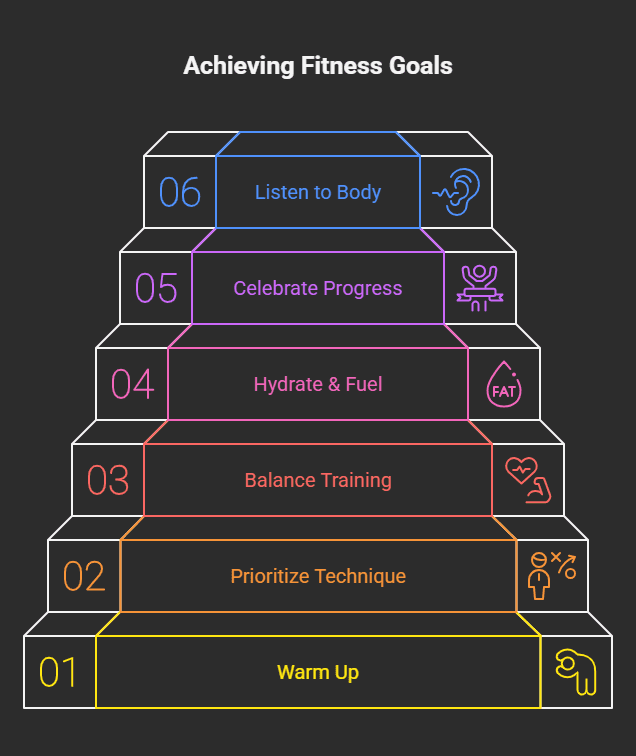
Warm up.
Prioritize technique.
Train smart, balance strength + cardio + rest.
Hydrate, fuel, and recover big time.
Celebrate progress, even the small wins.
Listen to your body, respect its signals.
Final Word, Your Fitness, Your Narrative
Who doesn’t enjoy a good metamorphosis? The shocking thing is that the true transformation takes place long before the muscles are visible. It’s in the routines, the mental adjustments, the little things, like saying, “Okay, I’m two reps away from quitting…but I’ll finish this set.” That time? Gold.
Give it a try. Go for one more rep. Walk that extra block. Choose water over soda one more time. Less about perfection, more about persistence. Over time, they compound.
Unexpected? Perhaps. but straightforward as well. Actual. Human.
It’s not necessary to have a dramatic fitness story. Just be truthful. Continue. I’m cheering for you.
It’s morning. The light is just beginning to slant through the blinds, painting stripes on the kitchen floor. The house is quiet, holding its breath before the day truly begins. And you, you’re standing there, in front of your coffee maker, about to perform a ritual as sacred as any. The smell of the beans, the gurgle of the machine… It’s a symphony of anticipation.
But then comes the moment of truth. The real decision.
Do you reach for the carton of milk, the sugar bowl, the fancy flavored syrup that tastes vaguely of French vanilla and existential comfort? Or… do you just pour that dark, steaming, unadulterated liquid straight into your mug and call it a day?
It seems like such a small thing, doesn’t it? A simple matter of taste. A blip on the radar of your daily choices.
Well, buckle up, buttercup. Because a massive new study just dropped, and it’s suggesting that this tiny, seemingly insignificant choice… it might just be saying more about you, and your future, than you could ever imagine. It’s a peek into your personality, your health, and your very approach to life. And honestly? It’s kind of blowing my mind.
What Scientists Found at the Bottom of the Cup
Alright, let’s get right to it. No beating around the bush.
Researchers, some seriously smart folks over at Tufts University, by the way, embarked on a massive undertaking. This wasn’t some flimsy weekend survey. We’re talking about a deep dive into the lives of over 46,000 people, tracked over decades. They looked at their habits, their health, and yes, their coffee orders. And they found something that made them lean in a little closer.
Here’s the kicker: People who consistently drank their coffee black, one to three cups a day, had a significantly lower risk of, well, dying. From anything.
Let that sink in for a second.
A 14% to 17% lower risk of all-cause mortality. That’s science-speak for a lower chance of kicking the bucket from pretty much any major cause, especially cardiovascular disease. It’s not just a caffeine buzz; it’s a statistical shield. Your simple, no-fuss cup of joe might be a secret weapon for a longer, healthier life.
It’s the kind of finding that feels both unexpected and, once you think about it, strangely… right. It’s a quiet validation for every person who ever grimaced while a friend drowned their coffee in a tidal wave of cream and sugar. A little nod from the universe that says, “Yeah, you were onto something.”
But why? What’s the magic in that dark, bitter brew? And what happens the second you add a splash of milk or a spoonful of sugar? Ah, my friend. That’s where the story gets really interesting.
Here’s the Twist: It’s Only Magic If You Don’t Mess With It
This is the part of the story that changes everything. The pivot upon which the whole discovery turns.
The study’s most profound finding wasn’t just that coffee is good for you; we’ve heard whispers of that for years, right? The real headline, the game-changing revelation, was that the benefits are almost exclusively linked to black coffee.
The moment you start adding a bunch of sugar, and especially saturated fats (hello, heavy cream and whole milk), those life-extending benefits… they start to fade. Fast. They can evaporate completely, leaving you with just a sweet, creamy beverage that’s doing you no particular favors in the long-term health department.
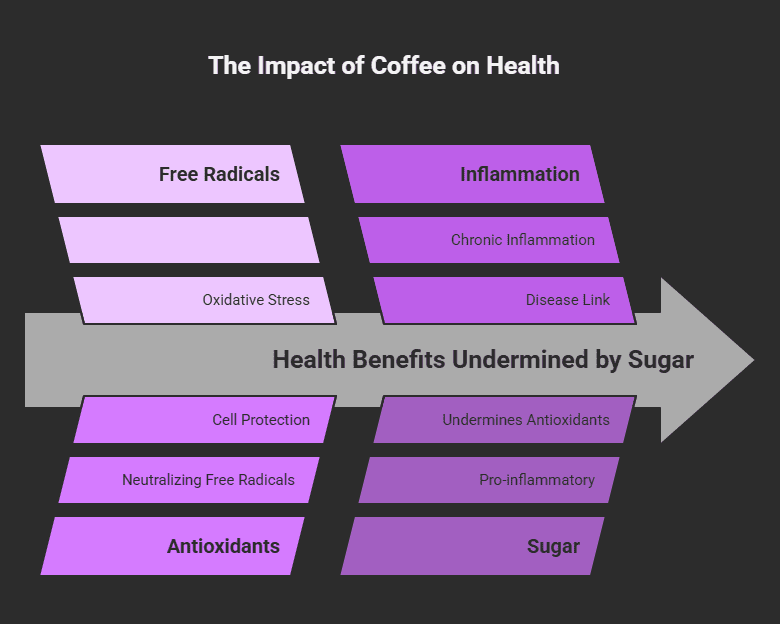
Think of it this way. The coffee itself is like a superhero, packed with these amazing things called bioactive compounds and antioxidants. We’ll get to those guys in a minute. They’re your body’s personal Avengers, fighting off inflammation and cellular bad guys.
But sugar? Sugar is like kryptonite. It swoops in and ties the superhero’s cape in knots. It promotes the very inflammation that the coffee is trying to fight. So you’re essentially sending in a hero and a villain at the same time and expecting a good outcome. It’s a biological stalemate.
It’s like buying a state-of-the-art treadmill and then using it exclusively to hang your laundry. You have this incredible tool for health right in front of you, but you’re burying its power under a pile of… well, laundry. Or in this case, caramel syrup.
This finding forces us to ask a different, more personal question. It’s not just “Do you drink coffee?” but “How do you drink your coffee?” And from there, the rabbit hole just gets deeper and deeper. Who are these people who choose to face the unadulterated, bitter truth of a black coffee every single morning?
A Tale of Two Drinkers: The Purist and The Alchemist
Let’s have a little fun with this. If coffee choice is a window into the soul, what do we see when we peek through? We essentially see two kinds of people standing at the great coffee crossroads of life.
On one side, we have The Purist.
You know this person. Maybe you are this person. The Purist’s life is an exercise in elegant simplicity. Their desk is probably tidy. Their inbox is probably at or near zero. They own one good coat instead of five mediocre ones. They don’t have time for fluff, for pretense, for anything that gets in the way of the thing itself.
And their coffee? It’s a reflection of that ethos. It’s black. At night. As the void.
For The Purist, coffee isn’t a dessert. It’s a tool. It’s a ritual. It’s about the pure, unadulterated essence of the bean. They want to taste the notes of the roast, the soil it grew in, and the journey it took to get to their cup. Adding milk or sugar would be like spray-painting a masterpiece. A sacrilege.
They’re not masochists; they genuinely enjoy the bitter, complex taste. It’s a flavor that feels earned, adult, serious. It’s the taste of focus. Of clarity. Of getting things done. By the time the sun is fully up, after they’ve had that first powerful cup, their mind feels sharp, clean, and ready for whatever the world throws at it. They aren’t just drinking coffee; they’re calibrating their entire system for optimal performance. It’s a small, daily declaration of intent: “I am here. I am ready. And I don’t need any sugar-coating.”
And on the other side? We have The Alchemist.
The Alchemist views a cup of coffee not as a finished product, but as a blank canvas. A starting point. A beautiful, steaming opportunity for transformation.
Their life is often a vibrant, wonderful, and perhaps slightly chaotic tapestry of experiences. Their workspace might be a collage of inspiring images, half-finished projects, and mugs in various states of use. They believe that more can be more. More flavor, more texture, more joy.
When The Alchemist approaches the coffee pot, they see potential. That dark liquid is just begging for a little… magic. A splash of oat milk to give it a creamy body. A swirl of honey for a touch of natural sweetness. Maybe a dash of cinnamon, because who doesn’t love a good surprise? Their coffee is a concoction, a potion, a personal masterpiece tweaked to perfection. It’s less about the stark reality of the bean and more about creating a moment of pure, unadulterated comfort.
Their coffee is a hug in a mug. It’s a cozy blanket on a chilly morning. It’s a sweet treat that says, “The world can be a tough place, so let’s make this moment as delightful as humanly possible.” They aren’t just seeking focus; they’re seeking solace. They’re not just starting their engine; they’re warming their soul.
Funny thing is, neither approach is right or wrong. They’re just… different. But this new study suggests that The Purist, in their quest for authenticity, might be accidentally stumbling upon a profound health benefit that The Alchemist, in their quest for comfort, is unintentionally leaving on the table.
The Science Made Simple (Promise!)
So what are these magical “bioactive compounds” we mentioned earlier? Let’s break it down without putting on a lab coat.
Imagine your body is a bustling city. Every day, it faces threats. One of the biggest threats is a gang of troublemakers called “free radicals.” These are unstable molecules that zoom around, damaging cells, causing aging, and generally making a mess of things. This process of damage is called oxidative stress.
Now, your body has a police force to deal with these thugs, but it can get overwhelmed. That’s where antioxidants come in. Antioxidants, which are abundant in black coffee, are like a team of highly trained, cell-protecting superheroes. They swoop in, neutralize the free radicals, and keep the city (your body) safe. They are the guardians of your cellular peace.
Another problem our city faces is chronic inflammation. It’s like a constant, low-level state of emergency, a fire alarm that’s always ringing softly in the background. It’s linked to nearly every major modern disease, including heart disease. The compounds in coffee are fantastic anti-inflammatories. They help calm things down, turn off the alarm, and restore order.
So, when you drink black coffee, you’re essentially flooding your system with cellular bodyguards and peacemakers.
But when you pour in sugar? Sugar is an agent of chaos. It’s pro-inflammatory. It’s like sending in a crew of hooligans to party with the free radicals, completely undermining the work of your superhero antioxidant team. It’s a biological civil war, and your health is caught in the crossfire.
That’s the simple, beautiful, and slightly tragic truth of it. The very thing many of us add to make coffee more palatable is the very thing that undoes its deepest, most profound magic.
So, What Do We Do With All This Information?
Okay. Let’s pause and take a breath.
If you’re currently stirring three sugars and a generous glug of creamer into your coffee, you might be feeling a little… called out. Please, don’t. That’s not what this is about. Who among us doesn’t love a sweet, comforting drink?
This isn’t about creating a new form of coffee-based guilt. It’s about illumination. It’s about understanding the incredible potential hiding in your morning mug and making a more informed choice.
Maybe you’re not ready to go full Purist tomorrow. That’s okay! This isn’t an all-or-nothing game. What if, tomorrow, you just used a little less sugar? Or switched from cream to a lower-fat milk?
Give it a try! You could start a small experiment. For one week, try reducing the additives. See how you feel. You might find that your palate adjusts surprisingly quickly. You might start to notice the subtle, complex flavors of the coffee itself, the chocolatey notes of a dark roast, the bright, fruity tang of a light one. It can be a journey of discovery.
Believe it or not, your taste buds can be retrained. They’ve been conditioned to expect a certain level of sweetness, but they can learn a new normal. And who knows? You might just find that you prefer the clean, powerful taste of coffee in its unadorned state. You might find that you feel a little sharper, a little more energetic, without the sugar crash that often follows a sweet drink.
The Final Sip: A Ritual Reimagined
After all, drinking coffee every day is more than just a habit. It’s customary. It’s a peaceful moment you set aside for yourself before the day’s obligations overwhelm you. It’s a tiny creative act.
We’re only now starting to realize the power that this ritual possesses, according to this intriguing new research. Not only is that dark, fragrant liquid a pleasant way to wake up, but it’s also a health-promoting elixir, a potion that prolongs life, and a covert weapon.
As always, the decision is yours. to either accept or tame the bitterness. to make a soothing mixture or to connect with the bean’s potent, unadulterated spirit.
You now understand the stakes, though. With each sip, you are aware of what is occurring at the cellular level. The beverage industry’s little black dress It turns out to be extremely intelligent in addition to being effortlessly stylish. And to be honest, that’s the kind of revelation that gives the morning routine a deeper sense of purpose than it has ever had. At the very least, it altered my perspective on my coffee maker for tomorrow.
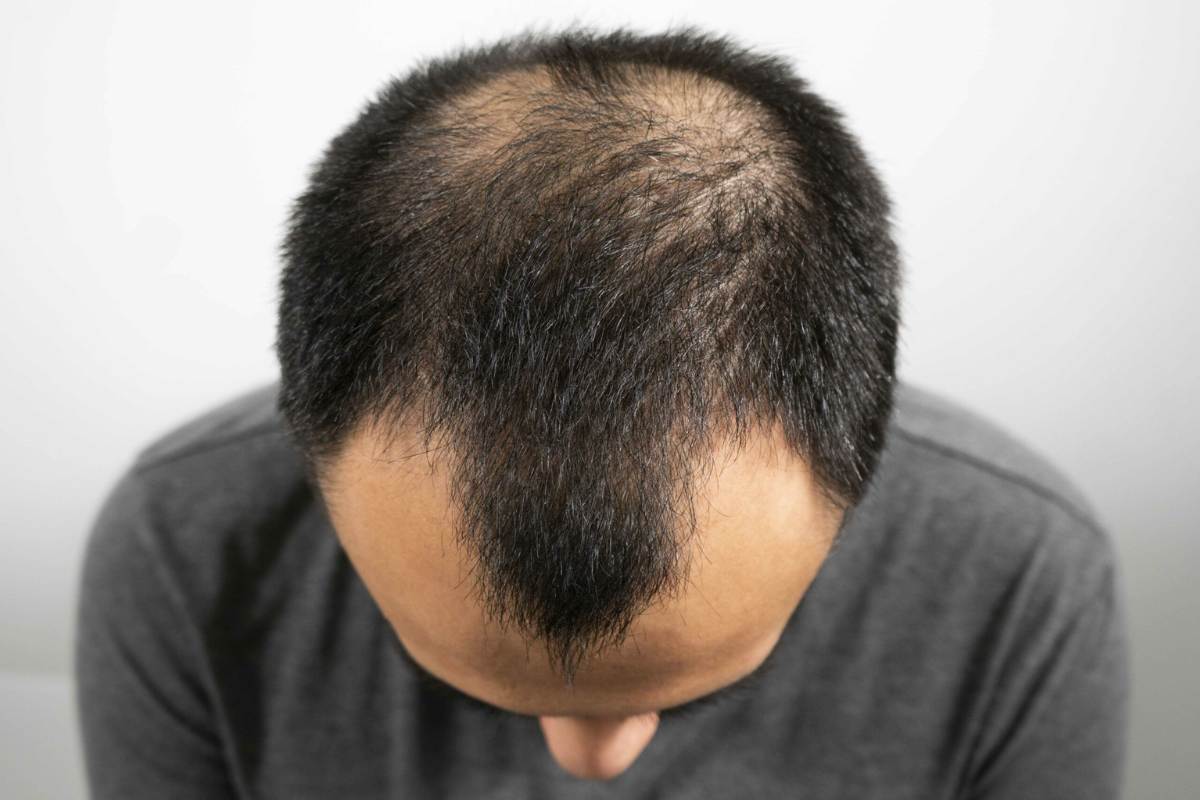
Have you ever looked in the mirror and seen your hairline moving back? Or maybe you saw a part that was getting bigger that wasn’t there before. It’s not just your mind playing tricks on you; you might have androgenetic alopecia, which is also known as pattern hair loss. And let’s be honest: it hurts your confidence in a way that’s hard to put into words if you haven’t been through it.
But before you start to panic, take a deep breath. Your follicles won’t die because of this. It’s more like a light on your dashboard that tells you to be careful. And yes, there are things you can do about it (more on that in a minute).
Let’s make it all clear.
What Exactly Is Androgenetic Alopecia?
Think of it as your hair’s “genetic timer.”
Androgenetic alopecia is a hereditary condition. That means it runs in families, so if your dad or mom had it, there’s a good chance you might too. It affects both men and women, just differently.
It’s all about your hormones, specifically androgens like DHT (dihydrotestosterone). These little guys bind to your hair follicles and slowly shrink them. The result? Thinner, shorter, weaker hair… until one day, the follicle taps out completely.
Now, here’s the twist: this doesn’t happen overnight. It sneaks up on you. Slowly. Quietly. Until boom, you’re suddenly Googling “how to regrow hair” at 2 a.m. (We’ve all been there.)
Men vs. Women: Different Patterns, Same Heartache
For Men: The Classic “M” and the Bald Spot Saga
Men usually notice a receding hairline first, which often forms a shape that looks like the letter “M.” Then comes the crown (that dreaded bald spot at the back). Eventually, those two zones may join forces, leaving a horseshoe-shaped ring of hair.
Not exactly the look most guys are going for.
For Women: The Widening Part and the Volume Vanish
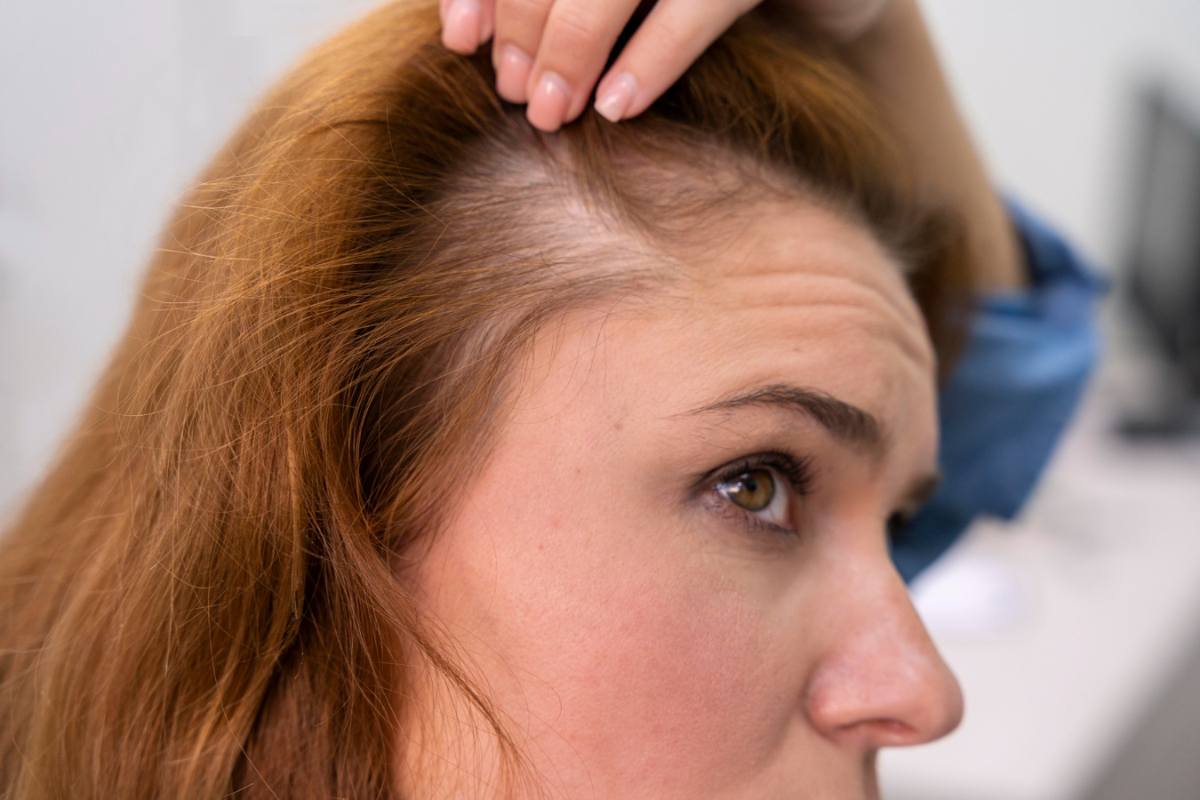
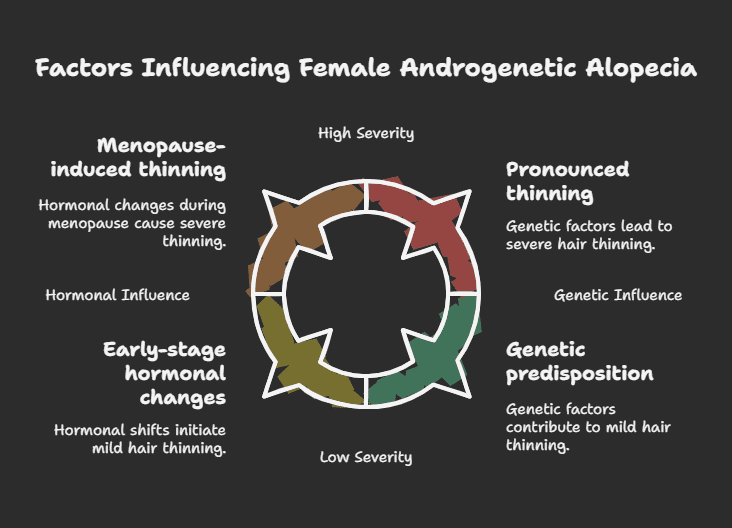
Women, on the other hand, rarely go completely bald from androgenetic alopecia. Instead, they experience a diffuse thinning, mostly on the top and crown. The center part widens, volume disappears, and the ponytail gets skinnier by the month.
And the emotional toll? Massive. Because hair isn’t just hair, it’s identity, femininity, control.
Funny how those little strands carry so much weight, isn’t it?
What Triggers It?
Okay, so genetics plays the starring role here. But they’re not the only culprit. Sometimes, it’s like the perfect storm of internal and external chaos.
Hormonal fluctuations, like those during menopause, pregnancy, or thyroid disorders.
Stress – yep, chronic stress can send your hair into a tailspin.
Nutrition gaps – lack of iron, protein, or biotin? Your scalp notices.
Age – the older we get, the less active our follicles become.
Medications – some drugs have hair loss as a side effect.
Point is, it’s not always a simple “blame your parents” story. There are layers to this.
The Emotional Fallout (Because It’s Not Just About Hair)
This is the part no one talks about enough.
The panic you feel when you see a clump in the shower drain. The awkward attempts to hide thinning spots with a clever combover or messy bun. The constant, exhausting math of “how many strands did I lose today?”
It’s draining. And isolating. And downright unfair.
Especially because most people brush it off. “It’s just hair,” they say. But it’s never just hair.
So if you’re reading this and nodding through tears or frustration, know this: your feelings are valid. You’re not vain. You’re human.
Diagnosis: Don’t Just Guess, Get It Checked
Before you assume it’s androgenetic alopecia, here’s a tip: get a proper diagnosis. Because other conditions, like alopecia areata, telogen effluvium, or even scalp infections, can mimic the symptoms.
Dermatologists usually do a combo of:
Scalp examination
Medical history review
Hair pull test
Sometimes a biopsy (don’t worry, it’s not as scary as it sounds)
Bottom line? Don’t self-diagnose on Instagram. Let the pros do their thing.
Treatment: The Sooner You Start, The Better the Odds
Here’s the silver lining: hair loss from androgenetic alopecia can be managed. Not always reversed, but slowed, sometimes even improved.
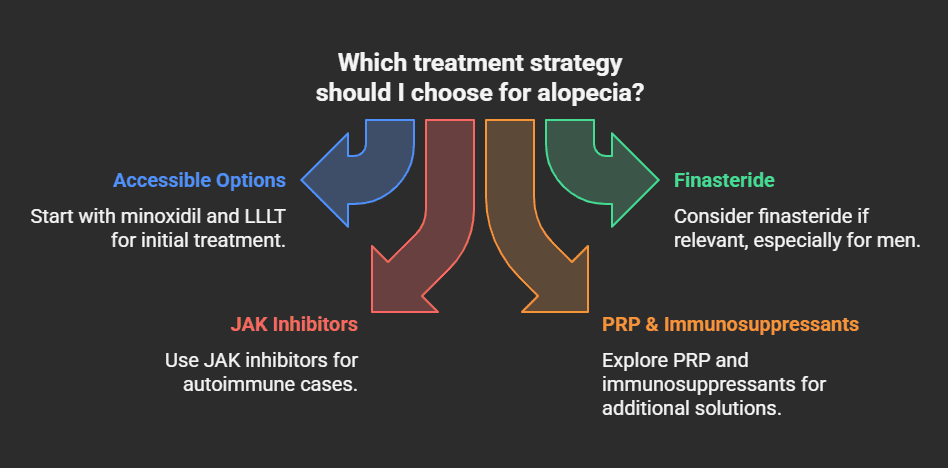
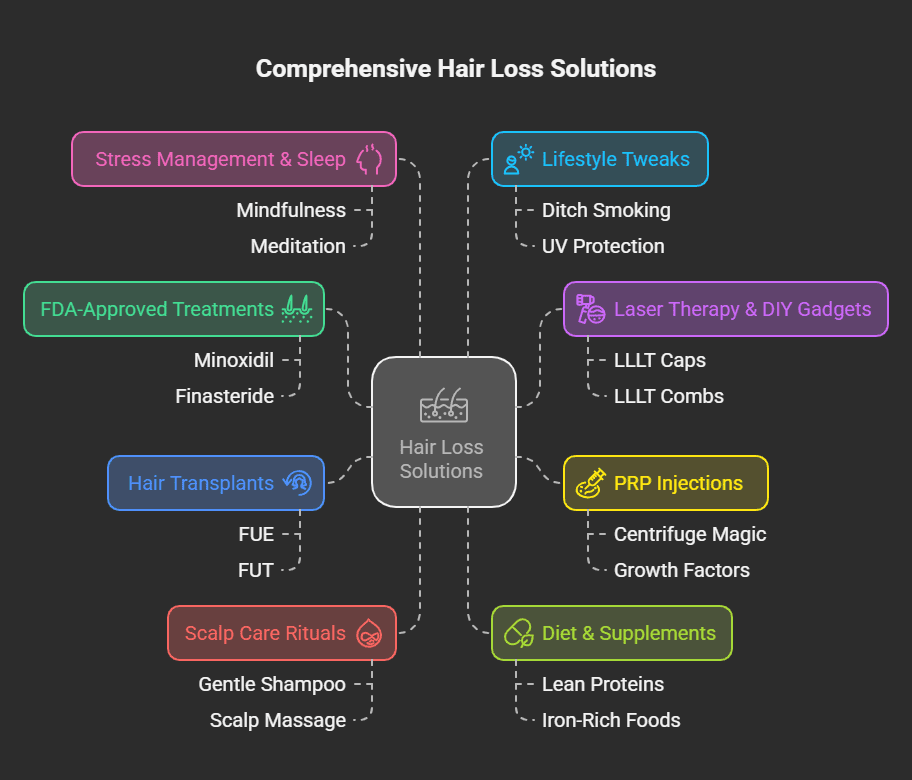
Topical Minoxidil (Rogaine):
A cult favorite for a reason. Available over the counter. It works by improving blood flow to hair follicles and extending the growth phase. But patience is key; it takes months to show results.
Finasteride (Propecia):
Only for men (usually). It blocks DHT, the bad guy in this story. It’s taken orally and can help halt progression, sometimes even regrow hair. Side effects? Yeah, a few. Talk to your doctor.
Low-Level Laser Therapy (LLLT):
Think of it as red light therapy for your scalp. Painless. Some people swear by it. Others don’t see much change. Jury’s still out, but it’s worth exploring.
Platelet-Rich Plasma (PRP) Injections:
Here’s where science meets sci-fi. Your blood is drawn, spun to concentrate growth factors, and then injected into your scalp. Expensive? Very. But promising for many.
Hair Transplant Surgery:
The big guns. It’s permanent (if done right), natural-looking (if done really right), and pricey. But for those who’ve tried everything else, it can be life-changing.
Supplements & Nutrition:
Think iron, zinc, biotin, and omega-3s. But here’s the thing, they’re supportive, not a cure. So don’t expect miracles from a gummy.
Can Lifestyle Help? (Short Answer: Absolutely)
Your daily habits impact your follicles more than you think.
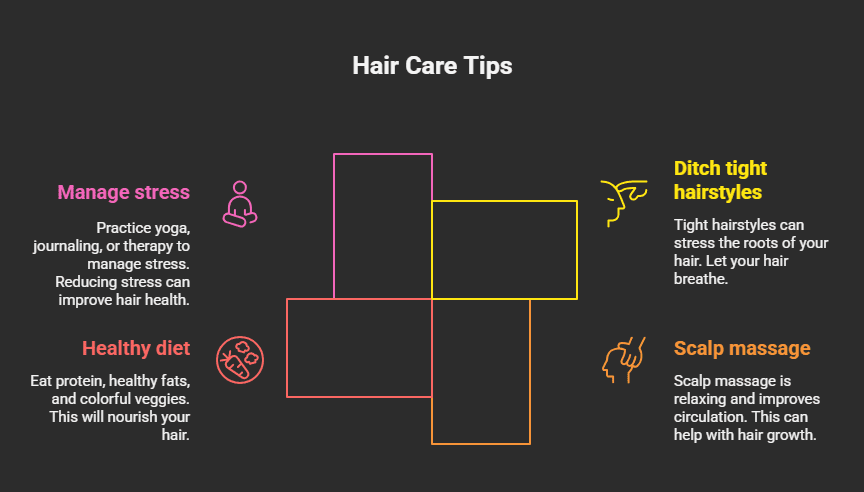
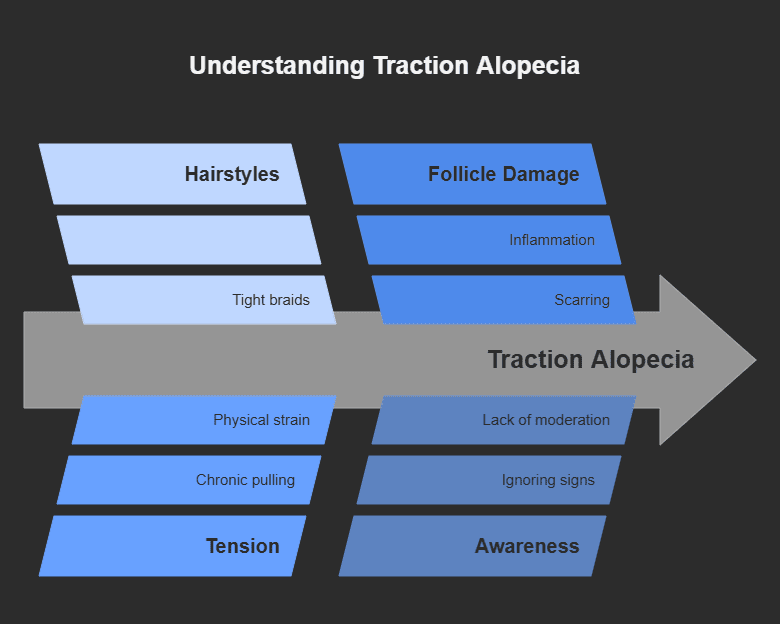
Ditch tight hairstyles – they stress the roots. Let it breathe.
Scalp massage – weirdly relaxing and improves circulation.
Eat like you love your hair – protein, healthy fats, colorful veggies.
Manage stress – yoga, journaling, therapy… whatever works for you.
Tiny changes, but over time? They matter. A lot.
The Myth Busting Moment
Let’s kill a few myths, shall we?
“Wearing hats causes baldness.” Nope.
“Shaving makes hair grow back thicker.” Total nonsense.
“Only old people go bald.” Not even close, early 20s cases are super common.
“It’s just cosmetic.” Tell that to someone who’s been avoiding mirrors for months.
So don’t let these lies mess with your head (or your healing).
You’re Not Alone, And You’re Not Powerless
This journey? It’s tough. Frustrating. Sometimes even humiliating. But there’s hope.
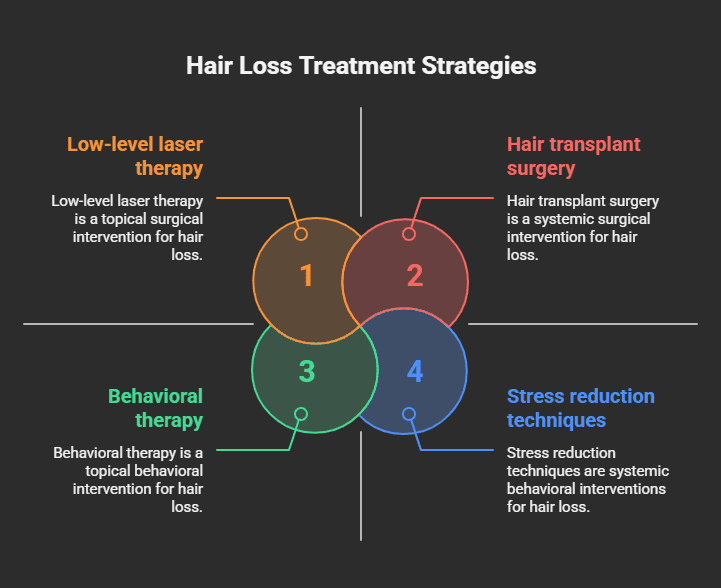
Modern science, new treatments, and support communities are changing the game. Whether you choose meds, laser caps, wigs, or just radical self-acceptance, there’s no wrong way to deal with hair loss.
You do what makes you feel like you again.
And hey, if no one’s told you this today: you’re not defined by your hairline. You’re still strong. Still beautiful. Still you.
Even if your strands have other plans.
One Last Thought
It’s okay to grieve. To cry over the brush. To feel the sting when someone says, “You’re losing hair.” But don’t let it break you.
Let it rebuild you, wiser, kinder, more resilient. Because healing doesn’t always mean getting every strand back. Sometimes, it means learning to love the reflection that’s changing… and owning it anyway.
Now go, flip that part, toss on that cap, or schedule that consultation. Whatever you do, just don’t give up.
Yes, it’s more than just a strange chemistry word your doctor uses. It’s a tiny molecule that can cause a lot of problems if you don’t pay attention to it. Are you ready to jump in? Okay. Let’s go.
What Even Is Uric Acid?
Purines are small molecules that are found in DNA and many foods. Uric acid is the end product of purines. Your liver uses the enzyme xanthine oxidase to turn purines into uric acid. After that, your kidneys clean up by getting rid of about two-thirds of the waste through urine and the rest through stool. In most cases, it’s a waste product that happens behind the scenes. But what about the messy backstage? Then things go wrong.
Why It Gets Messy: Causes of High Uric Acid
Your uric acid levels can spike for a few key reasons, sometimes in clusters, like bad party guests who won’t leave.
Overproduction
Eating purine‑rich fare, red meat, organ meats, shellfish, and beer? Your body runs on fizz.
Rapid cell breakdown (like during chemotherapy) floods your system with purines.
Under‑Excretion
Kidneys are not pulling their weight, common in kidney disease or from hypertension.
Certain meds (diuretics, aspirin, niacin) can hamper uric acid clearance.
High-fructose diets, those sodas, sugary syrups, they jam the exit.
Combo of Both
Usually, it’s diet plus genetics, or kidney stress paired with meds. Add obesity, diabetes, or high blood pressure to the mix, and you’re deep in hyperuricemia territory.
The Consequences: Why You Should Care
Gout
That sudden, excruciating pain, often in the big toe, hits at night.
Caused by needle‑like crystals settling in joints, the immune system freaks, and inflammation ensues.
Repeated episodes can scar joints and form tophi (hard crystal deposits).
Kidney Stones & Damage
Uric acid can crystallize in your urinary tract, causing severe pain, blood in the urine, and maybe nausea.
Prolonged high levels can impair the kidneys, leading to a feedback loop of worsening excretion.
Metabolic & Heart Risks
Hyperuricemia often tags along with insulin resistance, fatty liver, hypertension, and heart disease.
While uric acid is an antioxidant in moderate amounts, once excessive, its role flips.
Signs It’s Becoming a Problem
Many people stroll into trouble with zero warning. But some signs might tip you off:
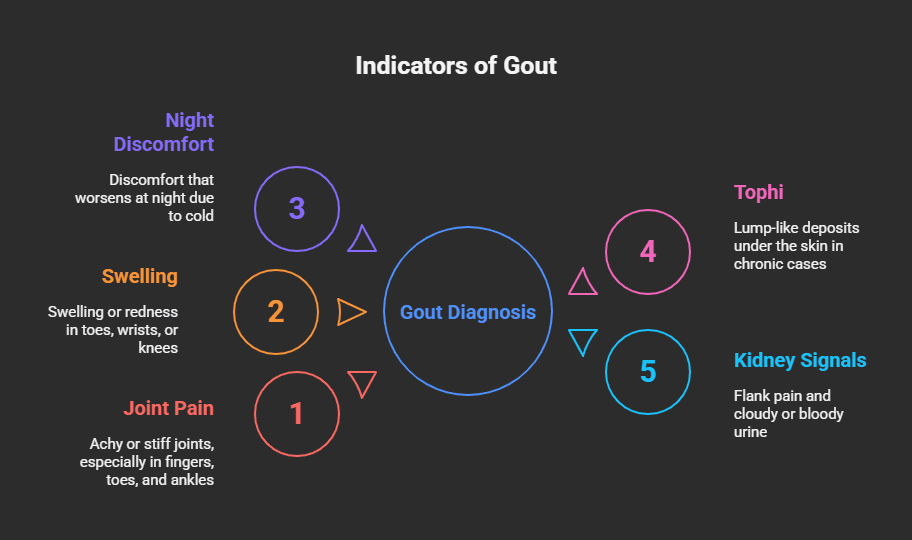
Achy or stiff joints, especially fingers, toes, and ankles.
Swelling or redness (toe, wrist, knee…).
Night‑time discomfort, crystals love cold.
Lump-like tophi under the skin (in chronic cases).
Kidney‑related signals, flank pain, cloudy or bloody urine.
What’s Happening Inside: Your Body’s Balancing Act
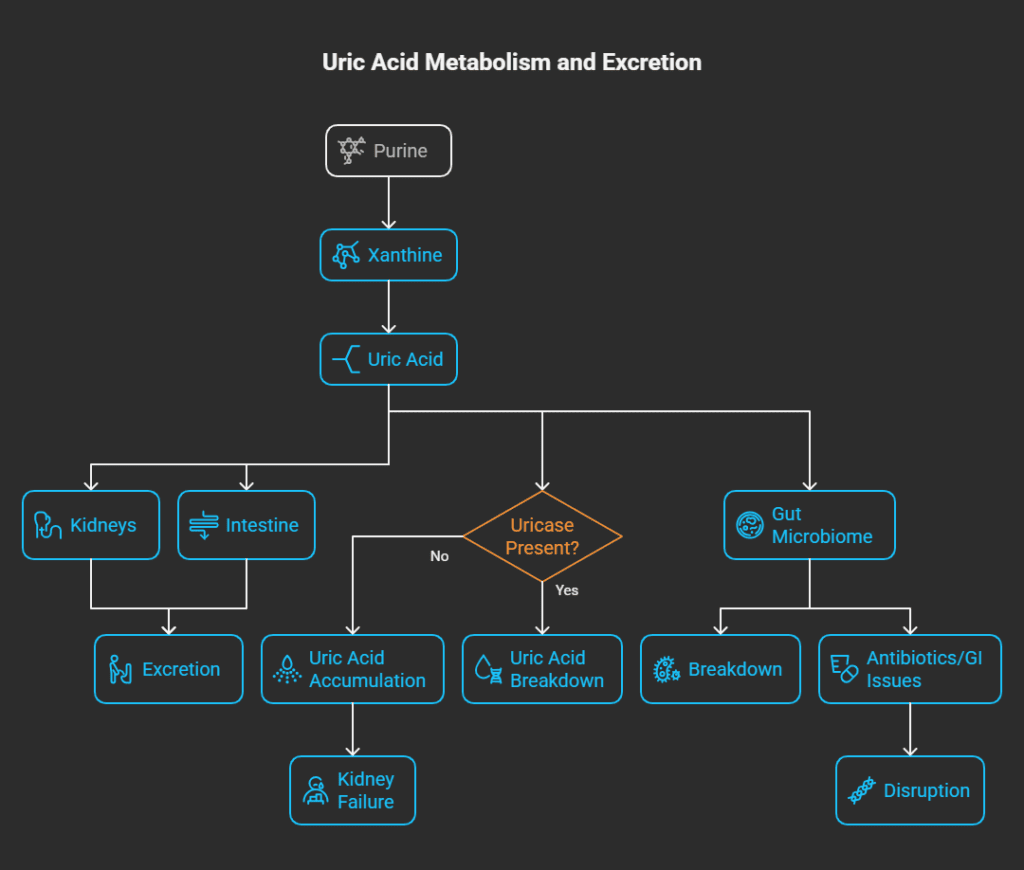
Purine → Xanthine → Uric Acid via xanthine oxidase in your liver.
Exit routes: kidneys (~66%) and intestine (~33%).
No uricase in humans, unlike many other mammals, so we can’t convert uric acid into a more soluble form.
When kidneys fail, uric acid piles up.
A healthy gut microbiome helps break it down; antibiotics or GI issues can disrupt that.
How Doctors Diagnose It
Blood test: Anything over ~6.8 mg/dL is flagged; under 6 mg/dL is ideal for managing gout.
24‑hour urine test: Checks uric acid clearance.
Joint fluid analysis: Crystal confirmation during flares.
Imaging (ultrasound/CT/X‑ray): Reveals crystals, tophi, and damage.
Fix It (Yes, You Can!)
Lifestyle Wins
Cut back on meat, shellfish, sugary drinks, and alcohol.
Hydrate, stay ahead of crystal formation.
Drop excess weight; each kg counts.
Stick with gentle exercise, walking, swimming, and cycling.
Helpful Foods & Drinks
Low‑fat dairy, vitamin C, coffee, and cherries show promising clearance benefits.
Skip organ meats, fatty dairy, refined carbs, sweet drinks, and booze.
Big tophi or stones: Surgery or specialty meds like rasburicase (in tumor lysis).
Kidney stones may require urine alkalinization.
Final Thoughts
Uric acid isn’t just about painful flare-ups; it’s a window into your metabolic and renal health. Keep levels in check, and you can avoid joint damage, kidney stones, and broader metabolic risks.
What You Can Do Today:
Get tested; a simple blood draw shows a lot.
Track triggers, note what you eat, and how you feel.
Make smart swaps, water instead of soda, lean protein over red meat, and daily walks.
Chat with your doctor, especially if you’re dealing with flares, lumps, stones, or chronic conditions.
Many folks manage their uric acid by transforming their lifestyle, not relying on meds forever. And when medication is needed, it’s part of a plan that keeps everything balanced.
Rapid Snapshot
Origins: Purine breakdown in the liver.
Exit: Kidneys and gut.
High levels = gout, stones, metabolic issues.
Fix: Diet, hydration, weight management, meds when needed.
A Friendly Close
So, the next time you grab a soda, a plate of shrimp, or a lot of fast food, take a break. Your body is doing its job, even if you don’t notice it. And what about keeping uric acid cool? It’s not just about your toes hurting. It’s about your future, healthier joints, stronger kidneys, and a better metabolic profile. You can do this.
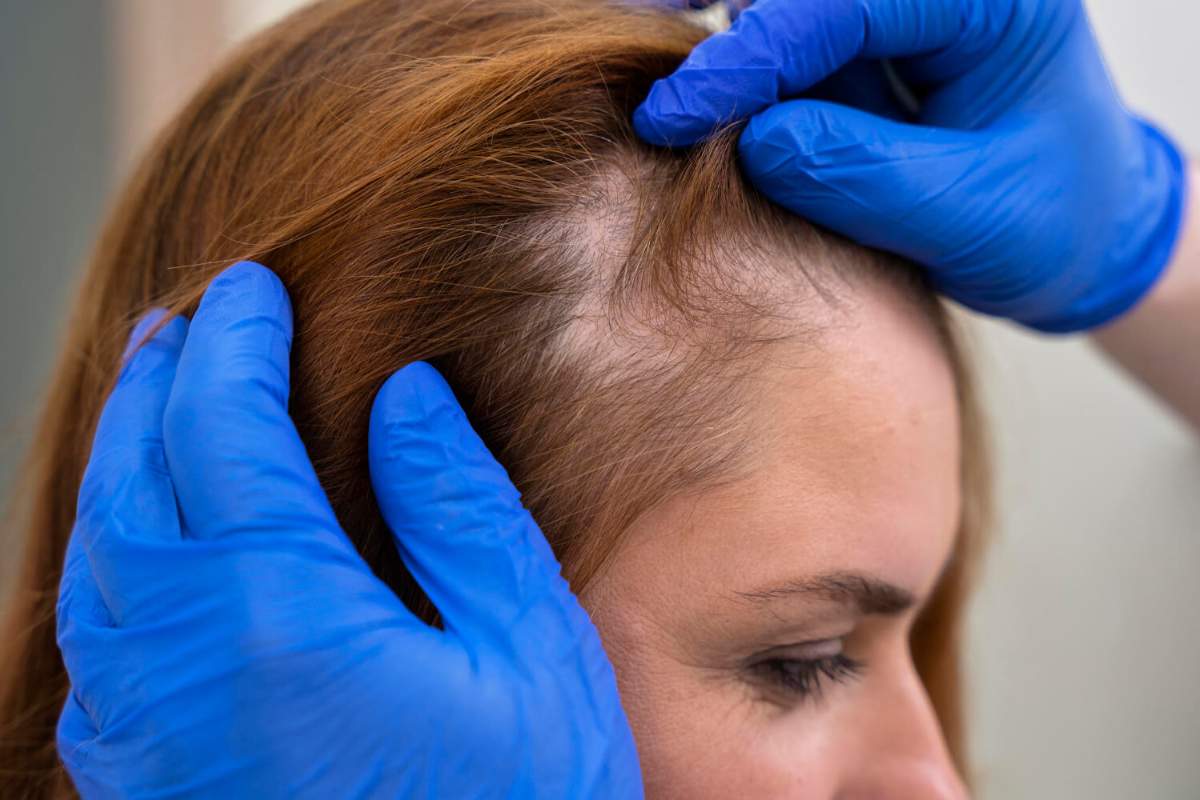
It starts out slowly. A few more strands in the brush. A part that is a little wider. Then one day, in the bright light of the bathroom, you see a spot. A patch. A thinning that wasn’t there before.
And the world sort of stops.
That cold, quiet dread that settles in your stomach is something that a lot of us know all too well. It’s not just about losing hair. It has to do with who we are, how we feel about ourselves, and how we deal with the world. Or how we think the world is treating us. It can feel like your body is betraying you and you have lost control. You do what anyone would do: you look for answers. You go down the late-night internet rabbit hole, scrolling past clinical-looking sites and ads for miracle cures until your eyes hurt.
The conventional route is there, of course. Steroid shots, creams that go on the skin, and drugs… and for a lot of people, they are a necessary and helpful part of the journey. But what if you want something else? Something that feels less like a fight and more like… making something. Creating a strong base of health from the inside out.
That’s the question we need to ask. Can the decisions we make every day, like what we eat, how we deal with stress, and how we live our lives, really have an effect? Can we work with our bodies to stop hair loss?
Let’s talk about it. Not in cold, clinical terms, but like people. People who’ve stared at their reflection and wondered, “What now?”
Because there is a “what now?” And it’s more hopeful than you might think.
First Things First: What Are We Even Dealing With?
Before we get started, let’s all agree on something. The medical term for hair loss is “alopecia.” But it doesn’t work for everyone.
Alopecia Areata is what most people think of. It’s an autoimmune disease that makes your immune system attack your hair follicles. It looks like those smooth, round patches of hair loss that are so common. Sometimes it can be worse, causing hair loss all over the body (Alopecia Universalis) or just on the scalp (Alopecia Totalis). This kind is known for being hard to predict. A real wild card.
Androgenetic Alopecia is another type of hair loss that affects both men and women. This one has more to do with hormones and genes. Over time, it gets thinner at a slower, more predictable rate.
And don’t forget about Telogen Effluvium, which is when your hair suddenly falls out all over your body after a big shock to your system, like giving birth, having major surgery, going through a lot of stress, or being sick.
What does this mean? Because knowing what you’re up against helps you plan your approach. Hormonal thinning might not work as well on an autoimmune trigger as other treatments. But here’s the catch: a lot of the basic, natural methods we’re going to look at next? They help all of them. Because they’re not just about hair. They are about bringing the body into balance.
The Elephant in the Room: Can You Really ‘Cure’ Hair Loss with Food?
Okay, let’s be brutally honest. Is there a magic salad that will make your hair grow back overnight? No. Of course not. And anyone who tells you otherwise is probably selling something.
But to dismiss diet and lifestyle is to miss the entire point.
Think of your body as a garden. If the soil is depleted, lacking nutrients, and overrun with pests (hello, inflammation and stress), how can you expect anything beautiful to grow? You can’t just sprinkle some “hair growth” seeds on top and hope for the best. You have to tend to the soil. You have to nourish it, protect it, and give it what it needs to thrive.
The food you eat, the air you breathe, the stress you carry… that’s your soil. And your hair follicles are the seeds. So, let’s get our hands dirty and start tending to that garden.
The Anti-Inflammatory Kitchen: Your First Line of Defense
Inflammation is a word we hear all the time. But what is it? In the short term, it’s your body’s heroic response to injury or infection. A good thing. But when it becomes chronic, a low-grade, simmering fire that never goes out, it can lead to all sorts of trouble. And for those with autoimmune conditions like alopecia areata, that fire is a major, major problem.
Your mission, should you choose to accept it, is to become a firefighter. And your tools are in your kitchen.
Go Green. And Red. And Orange. Think of colors. Deep, vibrant colors. Dark leafy greens like spinach and kale are packed with antioxidants. Berries, blueberries, raspberries, and strawberries are little antioxidant powerhouses that fight off cellular damage. Sweet potatoes, carrots, bell peppers… eat the rainbow. Seriously. It’s not just a cute saying; it’s a strategy.
Embrace Healthy Fats. Not all fats are created equal. The fat in a greasy takeaway burger is not the same as the fat in an avocado or a handful of walnuts. You’re after Omega-3 fatty acids, the ultimate inflammation-busters. Find them in fatty fish like salmon, mackerel, and sardines. If you’re plant-based, flaxseeds, chia seeds, and walnuts are your best friends. These fats don’t just cool inflammation; they are part of the structure of your cell membranes. They’re foundational.
Spice Up Your Life. Certain spices are ridiculously potent anti-inflammatories. Turmeric is the king here, with its active compound curcumin. (Pro tip: always have it with a pinch of black pepper, which dramatically increases its absorption). Ginger is another giant, great for calming the gut and the immune system. Sprinkle them into your cooking, sip them in teas… get creative!
The Gut-Hair Connection… No, Really.
If you’d told someone 20 years ago that the bacteria in their gut could affect the hair on their head, they’d have laughed you out of the room. But believe it or not, this is one of the most exciting frontiers in health research.
Your gut is home to trillions of microorganisms, your microbiome. This internal ecosystem is like a command center for your immune system. About 70-80% of your immune cells live in your gut. When your gut microbiome is out of whack (a state called “dysbiosis”), your immune system can get confused. It can become overactive and trigger-happy. And for someone with a predisposition to alopecia areata, that’s like pouring gasoline on a fire.
So, how do you cultivate a healthy gut garden?
Probiotics Are Your Pals. These are the good guys, the beneficial bacteria. You’ll find them in fermented foods like plain yogurt, kefir (a fermented milk drink that’s even more potent than yogurt), sauerkraut, kimchi, and kombucha. Introducing these foods helps to repopulate your gut with friendly microbes.
Feed the Good Guys with Prebiotics. Probiotics need to eat, too. Their favorite food is fiber, specifically, prebiotic fiber. Think of it as fertilizer for your inner garden. Amazing sources include garlic, onions, leeks, asparagus, bananas, and oats.
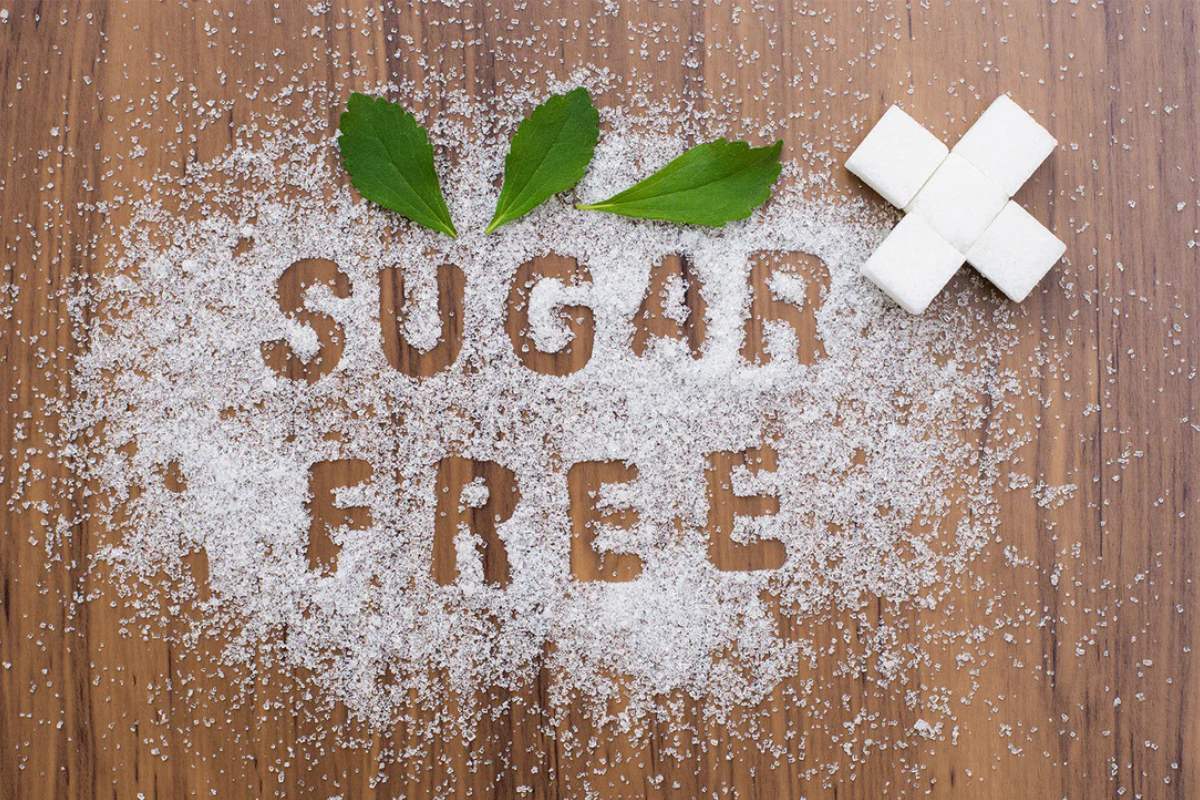
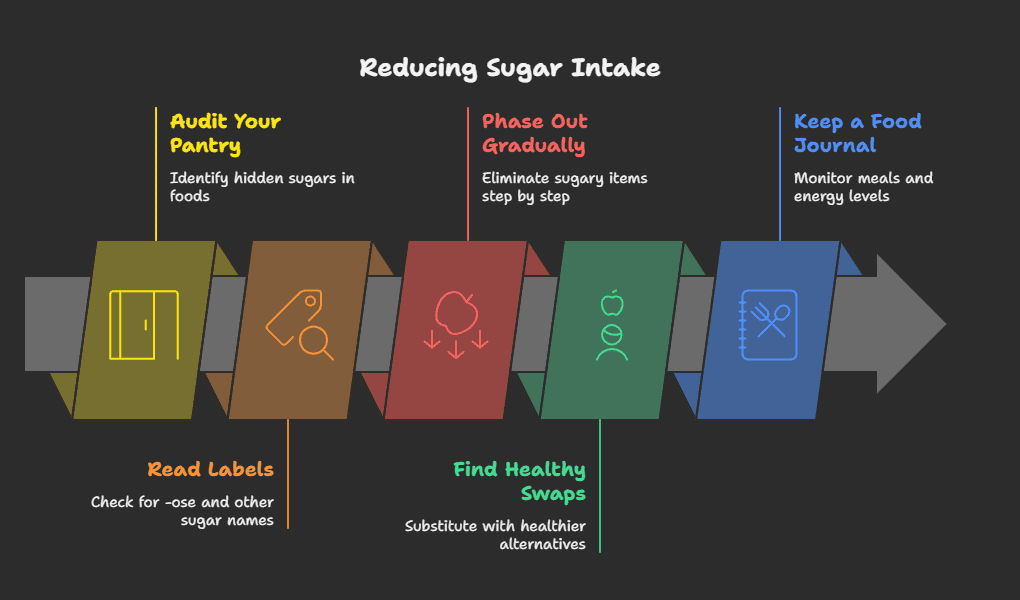
Ditch the Sugar. If prebiotics are fertilizer for the good guys, sugar is junk food for the bad guys. Pathogenic yeasts and bacteria love sugar. It helps them multiply, crowd out the good microbes, and contribute to that chronic, simmering inflammation. I know, I know. It’s tough. But cutting back on refined sugar and processed foods might be one of the most powerful things you do for your gut, and by extension, your hair.
The Building Blocks: Are You Getting Enough of the Good Stuff?
Beyond the big picture of inflammation and gut health, there are specific micronutrients that are non-negotiable for healthy hair follicles. A deficiency in any one of these can, at best, prevent healthy growth and, at worst, actively cause shedding.
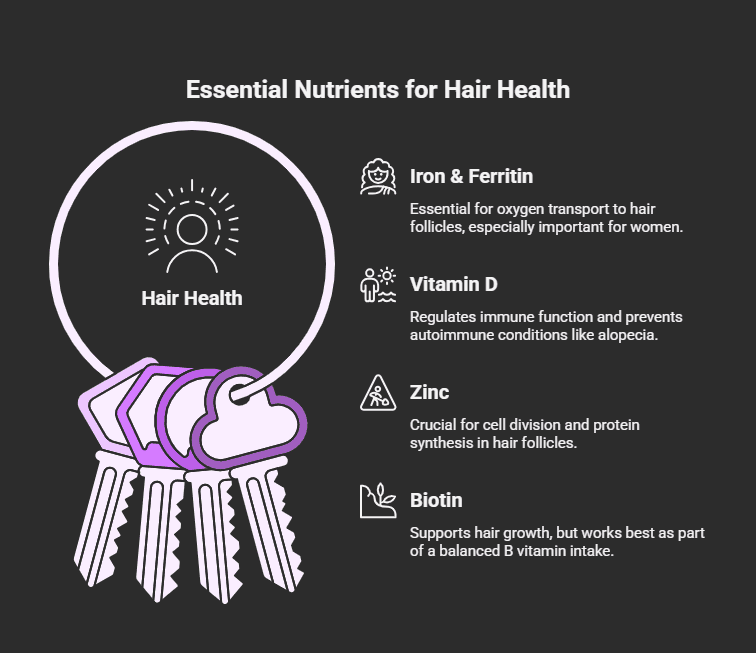
Iron (and its friend, Ferritin): This is a big one, especially for women. Iron is essential for producing hemoglobin, which carries oxygen in your blood. And your hair follicles? They need a lot of oxygen to thrive. But it’s not just about your iron level; it’s about your ferritin level. Ferritin is the protein that stores your iron. Think of it as your iron savings account. Many doctors see ferritin levels within the “normal” lab range and say you’re fine, but many trichologists (hair specialists) will tell you that for optimal hair growth, you want that ferritin level to be well above 50, even closer to 70 ng/mL. Get it checked! If it’s low, focus on iron-rich foods like red meat (if you eat it), lentils, spinach, and tofu. And always pair them with Vitamin C (like a squeeze of lemon juice on your lentils) to boost absorption.
Vitamin D (The Sunshine Vitamin): This isn’t just a vitamin; it’s a hormone that plays a massive role in immune function. Low levels of Vitamin D are strongly linked to a whole host of autoimmune conditions, including, you guessed it, alopecia areata. It helps to regulate the immune system, hopefully telling those confused T-cells to stand down. We get it from the sun, but many of us are still deficient. Fatty fish and fortified foods have some, but supplementation is often necessary. Again, get your levels checked. Don’t just supplement blindly.
Zinc (The Master Mineral): Zinc is like the hardworking foreman on a construction site. It’s involved in hundreds of enzymatic reactions in the body, including cell division and protein synthesis. Hair follicles have a very high rate of cell turnover, so a zinc deficiency can bring that process to a screeching halt. It’s also crucial for a healthy immune system. Find it in oysters (the richest source by far!), beef, pumpkin seeds, and lentils.
Biotin (The Famous One): Ah, biotin. It’s marketed as a hair vitamin. And while a true biotin deficiency (which is very rare) can cause hair loss, just taking massive doses of it probably won’t do much if your levels are already normal. It’s one piece of a much larger puzzle. Your body needs all the B vitamins working in concert. So instead of just a biotin pill, think about foods rich in B vitamins, like eggs, salmon, and leafy greens.
It’s Not Just What You Eat… It’s How You Live
You could be eating the most perfect, anti-inflammatory, nutrient-dense diet on the planet, but if you’re a walking ball of stress who sleeps four hours a night, you’re still fighting an uphill battle. A massive one.
Lifestyle isn’t the icing on the cake. It is the cake.
The Stress Spiral: Breaking Up with Cortisol
Let’s talk about stress. Not just “I have a deadline” stress, but the deep, chronic stress that comes from worry, anxiety, and, well, losing your hair. It’s a vicious cycle, isn’t it? You stress about your hair, and that stress makes your hair situation worse.
When you’re chronically stressed, your body is marinating in a hormone called cortisol. In the short term, cortisol is life-saving. But long-term? It wreaks havoc. It disrupts your immune system, messes with your gut, and can prematurely push your hair follicles from the growing phase (anagen) into the shedding phase (telogen).
You can’t eliminate stress. But you can change your relationship with it. You can build resilience.
Breathe. Just Breathe. This sounds so simple, it’s almost insulting. But it’s profound. When you’re anxious, your breathing becomes shallow and rapid. Taking slow, deep belly breaths activates the vagus nerve, which is the superhighway of your parasympathetic nervous system, the “rest and digest” system. It’s a physiological off-switch for the stress response. Try it right now. A four-second inhale, a seven-second hold, and an eight-second exhale. Do it three times. Feel that? That’s you taking back control.
Mindfulness & Meditation: This isn’t about emptying your mind. It’s about noticing your thoughts without getting swept away by them. It’s about creating a space between you and your anxieties. Apps like Calm or Headspace are fantastic starting points. Even five minutes a day can begin to rewire your brain’s response to stress. It’s exercise for your mind.
Move Your Body (Gently): Intense, grueling workouts can be another stressor on the body. But gentle movement? It’s magic. Think yoga, with its combination of movement, breathing, and mindfulness. Or Tai Chi. Or simply a long walk in nature, which studies have shown can measurably reduce cortisol levels. It’s about circulation, yes, but it’s more about tranquility.
Sleep: The Unsung Hero of Hair Health
Sleep is when your body does its repair work. It’s when you produce growth hormone, when your cells regenerate, when your brain detoxifies. If you’re skimping on sleep, you are robbing your body of its most critical healing time. Period.
Aim for 7-9 hours of quality sleep. This means practicing good sleep hygiene:
Make your room dark, cool, and quiet.
No screens (phone, TV, laptop) for at least an hour before bed. The blue light messes with your melatonin production.
Try to go to bed and wake up around the same time every day, even on weekends. Your body loves a routine.
Exploring the Path Less Traveled: Alternative Approaches
Okay, so we’ve tended the soil with diet and managed the weather with lifestyle. What else is in the toolkit? This is where we venture into complementary therapies. The key word here is complementary; they work alongside, not necessarily instead of, other approaches.
Scalp Love: Massage and Essential Oils
This feels good, and it might do good, too. Gently massaging your scalp for a few minutes every day can help to increase blood flow to the follicles, bringing all those lovely nutrients you’re eating right to their doorstep.
You can supercharge your massage with a few drops of certain essential oils diluted in a carrier oil (like jojoba or coconut oil).
Rosemary Oil: This is the star player. Some fascinating studies have shown it to be as effective as 2% minoxidil (the active ingredient in Rogaine) for androgenetic alopecia, without the side effects of an itchy scalp. It’s thought to work by improving circulation and inhibiting a hair-unfriendly hormone called DHT.
Peppermint Oil: Ever used it? That cool, tingling sensation is from the menthol increasing circulation in a big way. More blood flow = happier follicles.
Lavender Oil: Known for its calming properties, it can help with the stress component, and some studies suggest it may have properties that promote cell growth.
Crucial caveat: Never, ever apply essential oils directly to your scalp. They are incredibly potent and can irritate. Always dilute a few drops into a tablespoon of a carrier oil and do a patch test on your skin first. Think of this less as a “treatment” and more as a ritual of self-care. A moment to connect with your body in a positive, nurturing way.
Ancient Wisdom: A Nod to Acupuncture
Acupuncture, a cornerstone of Traditional Chinese Medicine, is all about restoring the flow of energy, or “qi,” in the body. From a Western perspective, it’s thought to work by stimulating nerves, reducing inflammation, and increasing blood flow. For alopecia areata, an acupuncturist might focus on points related to immune function and stress reduction. Some people find it incredibly relaxing and see it as a way to re-establish balance in a body that feels out of control.
Tying It All Together: This Is a Marathon, Not a Sprint
Whew. That’s a lot. If you’re feeling a little overwhelmed, take a deep breath. (Do you remember? Four, seven, eight.
You don’t have to do all of this tomorrow. You shouldn’t.
This isn’t about making a frantic, perfect change. That’s just another kind of stress. It’s about making a choice. Only one.
You might decide to add a big handful of spinach to your smoothie every morning this week. Great. That’s a win.
You could promise to do a five-minute breathing exercise before you check your phone in the morning next week. Wow.
This is a long journey with many small steps. It’s important to be patient, consistent, and, most importantly, kind to yourself. There will be good and bad days. Some days you eat the cake and some days you eat the kale salad. It’s fine. The goal is to make progress, not to be perfect.
And the most important thing is to talk to a professional. It’s very important to get an accurate diagnosis from a good dermatologist. A registered dietitian or a naturopathic doctor can help you make a plan that works for you and make sure you are getting enough nutrients. Make a team. You don’t have to do this by yourself.
Losing your hair can be very personal and painful. But the journey to get your health back can give you strength. It’s a chance to pay attention and hear what your body has been trying to tell you. It’s about taking back control, not by fighting your body, but by giving it what it needs to heal, supporting it, and feeding it.
And who knows? As you work on growing this beautiful, healthy inner garden… You might see some new growth that you really like start to show up.
It’s not just your skin that is losing hair. Your self-esteem goes down, and mornings feel different. But here’s the thing: you’re not the only one. There are proven treatments for both patchy alopecia areata and the classic thinning of androgenetic alopecia. Let’s look at the medical options, from the ones that have been around for a while to the newest ones, so you can find the one that works for you.
Understanding Alopecia Types
Alopecia Areata
An autoimmune trigger attacks hair follicles, leaving sudden bald spots. Sometimes hair grows back on its own within a year. Other times, medical intervention is the game‑changer.
Androgenetic Alopecia (Pattern Baldness)
Genetic and hormonal factors lead to gradual thinning, such as receding hairlines or thinning crowns. It affects a wide audience, irrespective of gender.
Knowing which type you’re dealing with is step one in crafting your tailored regrowth plan.
1. Minoxidil (Topical & Oral)
What Is It?
A vasodilator repurposed from blood pressure medicine, now a topical staple that widens vessels, nourishes follicles, and prolongs the growth phase.
Forms & Use
OTC topical foam or liquid (2% or 5%), applied twice daily
Low‑dose oral versions (off‑label) available by prescription
Results Timeline
Expect to wait 4–12 months. Stick with it, or you’ll lose any progress.
Side Effects
Scalp irritation is common. Rare side effect: excessive facial hair, especially with tight caps increasing uptake. Oral use ups the risk of unwanted hair elsewhere.
2. Finasteride (Oral/Desktop Combo)
How It Works
Blocks DHT, the hormone that shrinks follicles and triggers male pattern hair loss.
Usage
1 mg daily, men saw 80% improvement after a year versus 52% with topical minoxidil alone.
Side Effects
Some men report mild libido dips or other sexual side effects, but these reversed once treatment stopped.
For Women?
Not FDA-approved for women in pill form. Topical trials are ongoing but still experimental.
3. Low‑Level Laser Therapy (LLLT)
The Device
Comb-based, helmet-style, or cap devices shine red/infrared light onto the scalp to stimulate follicles.
Does It Work?
Studies report improved density and thickness over 3–12 months. It’s safe and side‑effect‑free, but consistency and patience are key.
Injected directly into bald spots, helping to quiet the immune reaction and trigger regrowth.
Immunotherapy
Topical irritants like diphencyprone distract the immune system. Results vary, but it’s a solid option for stubborn spots.
5. JAK Inhibitors (Breakthrough for Alopecia Areata)
What They Do
Target specific immune pathways, shutting down the autoimmune attack at its source.
Approved Options
Baricitinib (Olumiant): FDA-approved June 2022, effective in moderate to severe cases
Ritlecitinib (Litfulo): Approved June 2023 for ages 12+, delivering significant regrowth in many
Deuruxolitinib (Leqselvi): Approved July 2024 for adults with severe cases
Risks & Timeline
Hair regrowth often appears within 4–6 months. Side effects can include infections, blood clots, and high cholesterol, so medical monitoring is essential.
6. Platelet‑Rich Plasma (PRP)
The Process
Your blood is drawn, spun down, and the liquid with growth factors injected into your scalp.
Regrowth & Routine
Three sessions, one month apart, then periodic follow‑ups. Many see density improvement, though long‑term proof is still in progress.
7. Other Systemic Immunosuppressants
Drugs like Methotrexate or Cyclosporine
Reserved for stubborn alopecia areata cases. They can work, but carry significant risks (e.g. liver, kidney, infection), usually paired with steroids.
8. Combination Therapies
Why Combine?
Multiple approaches often deliver better results. For example:
Minoxidil + Finasteride = stronger together
Add LLLT or microneedling to enhance results
PRP + topicals = powerful synergy
Choosing What’s Right for You
Identify your alopecia type and severity
Autoimmune? Focus on JAK inhibitors, steroids, immunotherapy, PRP
Pattern baldness? Start with minoxidil ± finasteride ± LLLT
Set expectations
These are long‑term plans, think months, not weeks
Weigh the side effects
Topicals: irritation or stray facial hair
Orals: systemic risks
JAKs: serious monitoring required
Consider cost & accessibility
OTC options are generally affordable
Prescription meds, injections, and specialized devices are pricier
Emotional & Practical Support
Hair loss isn’t just cosmetic, it’s emotional. Combine your medical journey with psychological support, peer groups, or supportive counseling. Many find healing in shared stories and hands‑on guidance.
Treatment details
Treatment Type
Best For
Timeline
Notes & Side Effects
Topical Minoxidil
Both types
4–12 months
Scalp irritation, possible facial hair growth
Oral Minoxidil
Off‑label for both
4–12 months
Potential body hair growth, dose-dependent effects
Finasteride
Male pattern baldness
3–12 months
DHT blocker; mild sexual side effects possible
LLLT devices
Both types
3–12 months
Safe, requires consistency
Corticosteroids
Alopecia areata
Weeks–months
Local effects, injection discomfort possible
JAK Inhibitors
Severe alopecia areata
4–6 months
Effective but requires monitoring; costly
PRP injections
Both types
Months
Mild, periodic sessions; long‑term data building
Systemic Immunosuppressants
Severe alopecia areata
Variable
Significant risks; usually in combination therapy
Final Takeaway
It’s not about miracles when it comes to treating alopecia; it’s about having a plan. Begin with easy-to-get options like minoxidil and LLLT. If it makes sense, move up to finasteride (especially for men). JAK inhibitors are changing the way autoimmune cases turn out. People who want more options can also try PRP and immunosuppressants.
Every time, consistency wins. You might notice that your hair gets thicker over time and that you feel more confident.
Your Next Steps
Book an appointment with a board‑certified dermatologist
Confirm your diagnosis and create a treatment roadmap
Start with one or two options, then adjust based on results
Track progress with photos and revisit your plan every 3–6 months
So. You see more hair in the brush. You want to know what’s going on down there. Normal. Losing hair can feel like a punch in the gut, like an emotional wake-up call. But don’t worry, you’re not alone. There are more than a hundred kinds of hair loss. It sounds scary, doesn’t it? But the good news is that most of them can be diagnosed and treated. Let’s go over how doctors figure out what’s wrong with your hair.
First Things First: Medical History & A Friendly Chat
Doctors will start by asking about you. Not in a creepy way. (Well… maybe a little.) They want to know your story:
When did this all start?
Was it sudden or gradual?
Any big triggers, stress, illness, new meds?
Family history (think: male or female pattern baldness)?
Other symptoms, like nail changes, itching, and flare‑ups?
This history is gold. It feeds right into diagnosing the different types of alopecia; each has its own little backstory.
Patterns & Symptoms: Eyes On the Scalp
Ok, now comes the physical exam. This is where things get interesting, and maybe a bit graphic. But don’t worry, I’ll explain it in plain English.
a. Types of Hair Loss Patterns
Patchy loss = alopecia areata? Think round or oval bald spots, anywhere from the scalp to the eyebrows to the beard. Sometimes hair regrows in one spot even while another falls out. There might even be itching or a burning sensation before it appears.
Diffuse thinning hair = telogen effluvium? All-over thinning, especially if you’ve had a shock to the system: major surgery, new meds, stress, or postpartum changes. Your hair follicles are going into the resting phase all at once.
Receding hairline or crown thinning = androgenetic alopecia Also known as male/female pattern hair loss. In men, it’s that temple and crown combo; women usually see broad thinning across the top.
Traction alopecia If you wear tight hairstyles, braids, buns, or scarves, you might notice thinning or baldness along your hairline.
Scarring alopecias (like lichen planopilaris, discoid lupus, folliculitis decalvans)… These are less common but more serious, leading to permanent hair loss, often accompanied by itching, redness, pain, flaking, or pustules.
b. Other Clues: Nails & Hairs
“Exclamation‑point hairs,” or those short broken hairs at the edges of bald patches? That usually points to alopecia areata.
Nail pitting or ridges, don’t laugh, it’s a key dermatology clue often found in alopecia areata.
Hair shaft damage or breakage, a sign of trichotillomania (hair‑pulling disorder) or styling damage.
The Pull Test & Magnifying Tech: Doctors Get Hands‑On
Hair Pull Test
The doctor gently grasps 40–60 hairs and pulls firmly. Normally, only a few hairs will come out. If many (four or more) are loose, something’s off, like telogen effluvium or active shedding.
Dermatoscope / Trichoscopy
This handheld magnifier lets doctors get up close to your scalp and hair follicles.
With alopecia areata, you might see yellow dots, black dots, and broken hairs.
Female pattern hair loss shows many miniaturized (thin) hairs clustered in one area.
Scarring alopecias show inflammation, pustules, and clear destruction of follicles.
“Trichoscopy” is just the high‑falutin term for dermatoscopy; dermatologists do love their long words.
Extra Help: Blood Tests, Microscopy, Biopsy
Sometimes looking or pulling isn’t enough. Docs dig deeper:
Blood tests: They might check your thyroid (TSH), iron levels, B12, vitamin D, hormones, or autoimmune markers, especially if they suspect telogen effluvium or lupus.
Scalp biopsy: A small tissue sample used to diagnose scarring alopecias and nail down exactly what’s active. Usually, one biopsy is enough.
Yes, it might sound intense. But most of these are quick and low‑risk procedures.
Weave It All Together: Putting Clues Into Diagnosis
Here’s how doctors think, behind the scenes:
Observation
Likely Diagnosis
Next Steps
Patchy bald spots + exclamation hairs + nail pitting
Alopecia areata (autoimmune)
Dermatoscope exam; maybe biopsy or blood tests
Diffuse shedding 2–3 months after a stressful event
Telogen effluvium
Pull test, blood tests to find the trigger
Physical exam often involves a psych evaluation, too
Androgenetic alopecia
Clinical exam, dermatoscope, check family history
Hairline thinning from tight styling
Traction alopecia
Ask about hairstyle practices, physical exam
Physical exam often involves a psych evaluation too
Scarring alopecia
Dermoscopy; scalp biopsy is essential
Broken, uneven hairs of varying lengths
Trichotillomania
Burning, redness, and scarring on the scalp
Believe it or not, most of the time doctors can diagnose these types with just tools, tests, and a bit of pattern-spotting.
5. Why It Matters: Choosing the Right Treatment
Here’s the kicker: each type of hair loss needs its game plan.
Alopecia areata: often treated with steroids (topical or injections) or newer options like JAK inhibitors; sometimes hair just regrows on its own.
Telogen effluvium: fix the underlying trigger, improve diet, adjust medications, and reduce stress. Hair often recovers in 3–6 months.
Androgenetic alopecia: options include minoxidil, finasteride (for men), spironolactone (for women), low‑level laser therapy, or even hair transplant surgery.
Traction alopecia: stop pulling on your hair. If caught early, regrowth is possible.
Scarring alopecias: early diagnosis is critical; treatment involves anti‑inflammatories or immunosuppressants to prevent further loss.
Trichotillomania: Behavioral therapy has shown better success than topical treatments.
Funny thing is, you could drop big money on generic hair remedies, but if you don’t know why your hair is falling out, those products are mostly snake oil.
When to See a Dermatologist vs. Just Your GP
Your general practitioner (GP) can handle most non‑scarring concerns, like pattern baldness, telogen effluvium, or early alopecia areata. But you’ll want a dermatologist if:
Scarring alopecia is suspected.
You’re still unsure after the initial assessment.
You’ve tried over-the-counter stuff with no improvement.
It’s taking a real emotional toll; don’t beat around the bush; ask for help.
Dermatologists have access to advanced tools, dermatoscopy, scalp biopsy, and targeted blood panels, so they can give you a precise diagnosis.
Wrapping Up: What You Can Do Now
Track your hair loss, note when it began, how it looks, and any triggering events. Even a simple journal helps.
Book an appointment with your GP or dermatologist.
Be prepared: a hair pull test might happen.
Ask about tests like blood panels, biopsies, or dermatoscopy.
Stick with the plan. Once you have a clear diagnosis, treatments work so much better.
Final Thoughts: You’re Not Just Losing Hair. You’re Finding Answers.
Hair loss isn’t just cosmetic, it’s emotional, personal, and sometimes downright scary. But here’s the thing: information is power. You can take real steps, with the help of your doctor, that will help you grow once you know what’s going on. Not just strands, but also trust.
Believe it or not, you can figure out most hair loss with just a few simple tools: talk, scalp examination, and maybe a gentle tug. And from there? Options. Treatments. Solutions that match your hair story.
So go ahead, share your story with a doctor. Get the full scoop. And if you want more tips on alopecia areata, telogen effluvium, pattern loss, scarring types, or just someone to rant to, I’m here for it.
History & patterns = your starting clues
Physical exam & specialist tools = identifying the type
Tests reserved for complicated or scarring cases
Treatment varies wildly depending on the diagnosis
Early specialist input matters most for scarring forms
Emotional support is key, hair is identity
P.S. Did you think it would only be about minoxidil? Get it. But it turns out that it has a lot more layers. Don’t give up, and if you want me to explain scalp biopsies, JAK inhibitors, or ways to deal with your feelings next, just let me know.
That creeping fear that comes over you when you see that your part line is a little wider. Seeing a lot of hair swirling at the bottom of the shower drain makes you feel sick. A lot more than normal. When you look at old pictures and think, “Wow, things have really changed,” your heart sinks.
It’s a lonely feeling. And one that makes you mad.
You probably know someone who is living some version of that story. You may have spent hours, even in the middle of the night, staring into the mirror and looking at your scalp from angles you never knew existed. You typed in a lot of desperate questions into a search bar, hoping to find an answer, a solution, or a magic bullet. Anything.
And what do you usually find? Articles that are cold and clinical and sound like they were written by robots. Or, on the other end of the spectrum, sketchy websites that promise miracle cures but don’t seem right.
So let’s just stop. Take a deep breath.
I want to talk to you like a person. Alopecia, or hair loss, is more than just a physical problem. It’s a journey of the heart. It can change how you see yourself, how you feel about yourself, and how you show yourself to the world. Believe it or not, the first and most important thing you can do is understand what’s going on. It’s about getting back control.
Here’s the thing: “hair loss” isn’t just one thing. It’s a word that covers a lot of different conditions. And the kind of alopecia that shows up at your door will completely change your path forward and your story.
So, get a cup of tea. Make yourself at home. Let’s work together to peel back the layers and find out what’s going on. We’re not going to beat around the bush. In plain English, we’re going to talk about the most important people in the world of hair loss.
The Big One: Androgenetic Alopecia (The Slow Fade)
Alright, let’s start with the most common culprit by a long shot. The one most people think of when they hear “baldness.” This is Androgenetic Alopecia.
Sounds complicated, right? It’s not. Let’s break it down.
“Andro” refers to androgens, which are male hormones (like testosterone) that everyone has, regardless of gender. And “genetic,” well, that one’s pretty self-explanatory. It’s in your DNA. This is the hair loss that runs in the family. Thanks, Mom and Dad.
Funny thing is, it doesn’t present the same way for everyone.
For the Fellas (Male Pattern Baldness):
You know the script. It’s practically a cultural trope. It usually starts with a little bit of recession at the temples, creating that classic “M” shape. Or maybe it begins at the crown, the vertex, with a thinning spot that you can only see when you hold up a second mirror (a moment of true horror for many).
For some guys, it’s one or the other. For many, it’s both, and they eventually meet in the middle, leaving that familiar horseshoe pattern of hair around the sides and back of the head.
What’s going on here? Well, it’s all about a pesky little hormone called Dihydrotestosterone, or DHT. Your body naturally converts a certain amount of testosterone into DHT. For guys genetically predisposed to hair loss, the hair follicles on their scalp are hypersensitive to this stuff. DHT latches onto these follicles and, over time, shrinks them. It’s a process called miniaturization.
Think of it like a healthy, thriving oak tree slowly being starved of water and nutrients until it becomes a tiny, weak little bonsai sprout. The hair that grows from these shrunken follicles becomes finer, shorter, and wispier… until eventually, the follicle just gives up and stops producing hair altogether. It’s a slow, progressive fade. Not an overnight shock, but a gradual retreat.
For the Ladies (Female Pattern Hair Loss):
Now, for women, the story is a bit different. While some women might see some recession at the hairline, it’s far less common. For women, Androgenetic Alopecia usually looks like diffuse thinning, primarily over the top and crown of the scalp.
You might first notice that your ponytail feels less substantial. Or, the classic sign: your part line starts looking wider. It’s often described as the “Christmas tree” pattern, a widening part that spreads out from the center of the scalp. Unlike with men, it’s incredibly rare for women to go completely bald from this condition. But the thinning can become quite pronounced, and honestly, the emotional toll can be just as severe, if not more so.
The underlying mechanism is similar; that pesky DHT is still involved, but it’s more complex in women. Hormonal shifts during menopause, for example, can often kickstart or accelerate the process. The balance between female and male hormones changes, and those sensitive follicles suddenly find themselves under attack.
The bottom line for Androgenetic Alopecia? It’s genetic, it’s hormonal, and it’s progressive. But the good news? It’s also the type of hair loss with the most FDA-approved treatments available. So, getting a proper diagnosis here is key.
The Surprise Attack: Alopecia Areata (The Patchy Intruder)
Let’s switch gears completely.
Imagine you’re just going about your day. You’re brushing your hair, or maybe a friend or hairdresser points it out, and then you see it. A perfectly smooth, coin-sized patch of bare skin on your scalp.
No rash. No pain. No warning. Just… gone.
This is Alopecia Areata. And it is a whole different ballgame.
This isn’t about shrinking follicles or genetics in the traditional sense. This is an autoimmune condition. If you want to get technical, your immune system, the very thing that’s supposed to protect you from illness, gets its wires crossed. It mistakenly identifies your hair follicles as foreign invaders, like a virus or bacteria, and launches an all-out assault.
Think of it like friendly fire. Your body’s defense soldiers start attacking your hair-making factories. The good news? The attack is usually on the follicle, not the stem cells that create the follicle. This means the follicle isn’t destroyed; it’s just suppressed. It has the potential to wake up again.
Alopecia Areata is wildly unpredictable.
Alopecia Areata: The most common form, with one or more of those quarter-sized bald patches.
Alopecia Totalis: In some cases, the condition progresses, and the person loses all the hair on their scalp.
Alopecia Universalis: This is the rarest form, where the hair loss extends to the entire body. Eyebrows, eyelashes, arm, leg, and chest hair… everything.
Who gets it? Anyone. It can strike at any age, any gender, any ethnicity. It often first appears in childhood or young adulthood. And the triggers? Well, that’s the million-dollar question. Sometimes it’s linked to severe stress or a traumatic event, but for many people, it happens for no discernible reason at all. It just… appears.
The emotional impact of Areata can be profound. The sheer unpredictability of it, will the patch get bigger? Will I get more? Will my hair grow back? Will it fall out again?, is a heavy burden to carry. It can feel like your body has betrayed you. If you’re experiencing this, know that your feelings are completely valid. This isn’t just “hair”; it’s a condition that can turn your world upside down overnight.
The Great Shed: Telogen Effluvium (The Stress Response)
Have you ever been through something… big? A major surgery, a serious illness (especially with a high fever), giving birth, a period of intense psychological stress, or even a drastic change in diet or rapid weight loss?
And then, maybe two or three months after the event, you experience something terrifying. Your hair starts falling out. Not just a little extra shedding. We’re talking handfuls. You run your hands through your hair, and it just comes away. Your brush is full after a few strokes. The shower drain looks like a horror movie.
This, my friend, is most likely Telogen Effluvium. And if I’m being honest, while it’s incredibly distressing, it’s a sign that your body is working correctly, in a weird way.
Here’s a quick-and-dirty breakdown of your hair’s life cycle:
Anagen Phase (The Growing Phase): Most of your hair (like 85-90%) is in this phase right now. It’s actively growing. This can last for years.
Catagen Phase (The Transition Phase): A brief, 2-3 week phase where the hair follicle shrinks and detaches from its blood supply.
Telogen Phase (The Resting Phase): This is where the hair just hangs out for a few months, not growing, before it eventually sheds. Normally, only about 10-15% of your hair is in this phase at any given time, which is why we all shed about 50-100 hairs a day without even noticing.
Now, when your body goes through a major shock (physical or emotional), it hits a giant panic button. It decides, “Whoa, we have bigger fish to fry than making hair right now! We need to divert all resources to healing and survival!”
As a result, a huge number of your hairs that were happily growing in the anagen phase are prematurely shocked into the telogen (resting) phase. They all get the signal at once. Then, they hang out there for about three months, and after that… they all shed. At the same time.
It’s a massive, synchronized exodus.
The shock of seeing so much hair fall out at once often causes people to panic, which (and this is the cruel irony) can create more stress, potentially prolonging the issue. But here’s the most important thing to know about Telogen Effluvium: in most cases, it is temporary. Once the initial trigger is gone and your body finds its equilibrium again, the cycle resets. The shedding slows down, and the hair almost always grows back. It takes time, and patience is an absolute virtue here, but it’s a recovery story more often than not.
The Style Strain: Traction Alopecia (The Pulling Problem)
We all want to express ourselves. And for many, hairstyles are a huge part of that. Tight braids, sleek high ponytails, heavy extensions, intricate weaves. They can look incredible. They can be a part of your culture, your identity, your brand.
But… there can be a dark side to all that tension.
This is where Traction Alopecia comes into the picture. The name says it all: “traction” as in pulling. When your hair is constantly pulled tight in the same direction for long periods, it puts a tremendous amount of physical strain on the hair follicles.
At first, you might just notice a few bumps around the hairline, or a bit of tenderness after you take your hair down. But over time, this chronic pulling can yank the hair out of the follicle. Even worse, it can cause inflammation and damage the follicle permanently.
This isn’t an internal, hormonal, or autoimmune issue. This is a mechanical one. It’s caused by an external force. You’ll typically see it along the hairline, behind the ears, or at the nape
of the neck, wherever the pulling is most intense. Think of ballerinas with their tight buns, or people who wear tight cornrows or dreadlocks for years.
The crucial thing about Traction Alopecia is that in its early stages, it’s completely reversible. If you stop the hairstyle that’s causing the strain, the follicles can recover, and the hair will grow back. Give your hair a break! Wear looser styles. Let it breathe.
But, and this is a big but, if you ignore the signs and continue with the same high-tension styles for years and years, you can cause irreversible damage. The follicles can become so scarred and damaged that they can no longer produce hair. At that point, the hair loss is permanent.
This is a tough one, because it’s so tied to our appearance and cultural practices. No one is telling you to never rock a snatched ponytail again. But it’s about moderation. It’s about being mindful of the tension. It’s about listening to your scalp when it tells you it’s had enough.
The Tough Stuff: Scarring Alopecias (When It’s Permanent)
Okay, let’s take a deep breath. We’re wading into some heavier territory now, but it’s important.
All the types of alopecia we’ve talked about so far are non-scarring. This means that even though the hair has fallen out, the hair follicle itself, the little factory under the skin, is still there. It might be shrunken, dormant, or under attack, but it still exists and has the potential to produce hair again.
Scarring Alopecias, also known as Cicatricial (sik-uh-TRISH-ul) Alopecias, are different.
In this group of rare disorders, the hair follicle is destroyed by inflammation and replaced with scar tissue. And once that follicle is gone… It’s gone for good. The hair loss is permanent.
This isn’t one condition; it’s a whole family of them, with names you’ve likely never heard of, like Lichen Planopilaris, Frontal Fibrosing Alopecia (FFA), or Central Centrifugal Cicatricial Alopecia (CCCA).
The cause is often inflammation deep in the scalp, but what triggers that inflammation is still a big area of research. The symptoms can vary. You might experience itching, burning, or pain on your scalp along with the hair loss. The skin in the affected area might look shiny, smooth, or scarred.
Because the follicle is destroyed, the goal of treatment for scarring alopecias isn’t necessarily regrowth (though that can sometimes happen at the edges of the affected area). The primary goal is to stop the inflammation and prevent the hair loss from spreading further. It’s about halting the process in its tracks.
This is why, if you suspect any kind of hair loss, but especially if you’re experiencing symptoms like pain or itching, getting to a dermatologist ASAP is non-negotiable. With scarring alopecias, time is absolutely of the essence.
So, What Now?
It’s okay if your head is spinning a little. The goal of all this isn’t to turn you into a medical expert right away. It’s not to be sure that you can diagnose yourself in the mirror.
The point is to show you that “hair loss” is a hard problem to solve. It has a lot of different sides. And it’s not crazy to be worried or confused.
There is a name for what you’re going through. There is a reason. There is a story.
The first step to feeling less like a victim and more like an active participant in your health is to figure out which story is yours. A dermatologist’s correct diagnosis is where you should really start. They can look at your scalp, do a blood test, or even take a small biopsy to find out exactly what’s going on with your hair follicles.
Knowing gives you power. It takes away the fear of the unknown and gives you a clear way to move forward. It all starts with understanding, whether that means getting treatments, changing your lifestyle, or just finding a group of people who get it.
You are not the only one who feels this way. Not even close. Take a look around. In one way or another, a lot of us are going through this journey. So be nice to yourself. There is so much more to the person you see in the mirror than just their hair. And now is the time to start your journey to understanding. Give that to yourself..
Have you ever looked at those small clumps in the shower drain and thought, “Really?” You’re not the only one. Believe it or not, hair loss in men is one of the most common problems. But before you freak out or grab your hat collection, let’s talk about what’s going on, why it matters, and most importantly, what you can do about it.
Quick snapshot:
What? Your precious strands are making a break for it.
Who? Approximately 50% of men experience noticeable hair thinning by the age of 50.
Why? A cocktail of genetics, hormones, lifestyle… and sometimes, just plain bad luck.
How to fix? From science-backed treatments to simple home tweaks.
Ready? Let’s dive in.
The Usual Suspects: Why Your Hair Might Be Checking Out
Genetics (The Big G)
Family history isn’t just about your dad’s cheekbones or your uncle’s height. If men in your family tree have sported a receding hairline or a thinning crown, odds are you might too.
Funny thing is, this “androgenetic alopecia” sounds fancy, right?, ‘s super common: up to 70% of men will show some signs in their lifetimes. Random? Not really. If the gene’s in play, DHT (dihydrotestosterone) messes with your follicles, making them shrink and produce finer hair until, eventually, they stop altogether.
Hormones & DHT Drama
Dive deeper into that acronym: DHT is a testosterone byproduct, and while it’s crucial for male development, it also binds to hair follicles.
By the time your 30s hit, if you’re prone, you’ll likely notice more hair in your brush, or patches that feel airier than they used to.
Stress: The Sneaky Saboteur
Who doesn’t stress? Work deadlines, personal drama, that huge presentation… it adds up. And hair? It feels it.
Telogen effluvium, anyone? It’s a fancy term for stress-induced shedding: your follicles go into premature “rest” mode, and hairs tumble out.
(If you’ve ever had a shock, illness, surgery, or even a scary breakup, you might’ve seen this firsthand.)
Nutritional Gaps
You are what you eat… or not.
Protein, iron, zinc, vitamin D, and B vitamins all play starring roles in healthy hair growth.
Skipping meals, fad diets, or living on energy drinks? Your follicles throw up their hands. Literally.
Scalp Health & Hygiene
Too much scrubbing? You could irritate the scalp, inflame follicles, and trigger shedding.
Too little washing? Oils build up, pores clog, and you guessed it, follicles suffocate.
Balance is key. Kinda like Goldilocks: not too hot, not too cold.
Environmental & Lifestyle Culprits
Pollution, UV exposure, harsh styling products… they all chip away at hair integrity.
Smoking? It restricts blood flow, meaning less oxygen to your scalp.
All-nighters and poor sleep? Your body’s repair crew never shows up on time.
Solutions That Don’t Suck: From Lab to Lifestyle
Here’s the kicker: some fixes are high-tech, some are low-key, but most work best when you combine them. Mix and match like your favorite playlist.
FDA-Approved Treatments
Minoxidil (Rogaine): Applied topically, it can kick-start follicles into growth mode. Side effects? Sometimes itching or dryness, but hey, worth a shot if you’re losing ground.
Finasteride (Propecia): A daily pill that reduces DHT levels by blocking the enzyme 5-alpha reductase. Not for everyone (ask your doc), but it’s been shown to slow, even reverse, hair loss in many men.
Laser Therapy & DIY Gadgets
Low-level laser therapy (LLLT) caps or combs.
Sounds sci-fi? It’s thought to boost circulation and cellular activity in the scalp.
Studies show moderate gains, perfect if you’re on the fence about pills.
Platelet-Rich Plasma (PRP) Injections
By the time you read this, your blood could be working overtime, thanks to centrifuge magic that concentrates growth factors.
Painful? Mild. Effective? Many report thicker hair within months.
Costly? Yes. Worth it? Depends on your budget and commitment.
Hair Transplants: The Real Deal
Follicular Unit Extraction (FUE) or Transplantation (FUT).
Doctors harvest healthy follicles, usually from the back of your head, and graft them to thinning areas.
Recovery takes weeks, but the results can last a lifetime.
Talk to friends, join a support group, or see a counselor if it’s dragging you down.
Wrapping Up: Why It’s More Than Just Hair
Hair loss isn’t just a cosmetic problem. It can be a sign of health problems, lower self-esteem, and even change the way you interact with the world. Who would have thought a string could be so strong?
But the most important thing is that you have choices. A lot of them. From drugstore bottles to the newest clinics. It’s all about finding the right mix for your hair story, budget, and way of life.
Try it out. Keep going. (And yes, those little “baby hairs” will probably show up, real champions.) Every strand counts on this journey… And you do too.
Are you thinking about giving up sugar? It might be hard, especially since sugar hides in things like pasta sauce and dressings. But here’s the good news: you don’t have to miss out on anything when you stop eating sugar. It’s really a way to feel great. You will find many health benefits of a No Sugar Diet that can make you feel better, boost your mood, and even give you more confidence. We’ll talk about five surprising benefits of giving up refined sugars in this post, as well as some simple tips to help you stick with it and enjoy the ride..
1. A Glowing, Healthy Complexion
One of the earliest things you’ll notice on a no-added-sugar diet is how your skin looks. Here’s why:
Less Inflammation: Added sugars induce inflammation and fuel the bacteria that cause acne on your skin. By removing added sugars, you reduce markers of inflammation such as C-reactive protein (CRP), which dermatologists attribute to redness, swelling, and breakouts.
Balanced Collagen Production: Excessive sugar consumption promotes glycation, a reaction in which sugar molecules attach to collagen strands, rendering skin less elastic and more susceptible to wrinkles. A no-sugar diet keeps collagen integrity intact, resulting in firmer, younger-looking skin.
Hydration and pH Balance: Fruits and vegetables that take the place of sugary snacks tend to be high in water and nutritious elements like vitamin C and antioxidants. These promote skin hydration, even pH, and antioxidant protection from free radical damage.
Real-Life Story: Sarah, a 32-year-old marketing manager, struggled with adult-onset acne. After six weeks sugar-free, she reported a 60% reduction in breakouts and a clearer complexion, without changing her skincare routine.
Pro Tips for Glowing Skin on a No-Sugar Diet
Hydrate Wisely: Target 2–3 liters of water per day; infuse with cucumber or mint to taste.
Boost Antioxidants: Add berries, nuts, and green tea to combat oxidative stress.
Gentle Exfoliation: Apply a weekly enzyme-based scrub to exfoliate dead skin cells.
2. Sustained Energy from Morning to Night
Do you find yourself crashing mid-afternoon, grabbing for a sugary snack or extra cup of coffee? Here’s how the no-sugar diet revolutionizes things:
Stable Blood Sugar: Without the ups and downs of spikes and crashes, your body is able to keep a steady concentration of glucose, allowing muscles and organs to have consistent fuel.
Improved Fat Adaptation: As the years pass, your cells get better at tapping into stored fat for energy, increasing endurance and less of those energy crashes.
Regulated Hormones: Insulin sensitivity is enhanced, minimizing spikes in cortisol (the stress hormone) that cause you to feel jittery or drained.
Supporting Research: A 2023 study in the Journal of Nutritional Biochemistry found that participants on a low-sugar plan experienced 25% fewer energy crashes than those on a standard diet.
Practical Tips to Maintain Energy
Protein Breakfast: Eat eggs, Greek yogurt, or a plant protein smoothie.
Smart Snacks: Have nuts, hummus, and veggie sticks, or slices of cheese, handy.
Regular Exercise: Short walks or stretch breaks every 60–90 minutes can increase circulation and alertness.
3. Clearer Focus, Sharper Mind
Brain fog, those times when focus is like swimming in molasses, is frequently related to diet. Below’s why eliminating sugar can improve your mental clarity:
Neurotransmitter Balance: Fluctuating glucose changes levels of dopamine and serotonin, mood, and attention. Consistent sugar consumption maintains optimal neurotransmitter function.
Less Oxidative Stress: Too much sugar produces free radicals that can destroy brain cells. Antioxidant-sufficient, sugar-free diets maximize neuroprotection.
Better Sleep Quality: Diminished sugar intake tends to promote deeper, more restful sleep, critical for memory consolidation and learning.
Dietary Tips for a Brain-Friendly Diet
Include Omega-3s: Fatty fish, flaxseeds, and walnuts nourish brain cell membranes.
Complex Carbs: Quinoa, sweet potatoes, and legumes yield slow-release energy.
Herbal Brain Boosters: Rosemary and ginkgo biloba are old-fashioned nootropics to try.
4. A Robust Immune Guard
Did you know that sugar can take your immune system offline? The evidence is clear: White Blood Cell Suppression: Excessive glucose reduces the function of neutrophils, your initial defense against infection, by as much as 50% for a few hours following sugar consumption.
Chronic Inflammation: Repeated sugar spikes induce systemic inflammation, making it more difficult for the immune system to fight legitimate threats.
Gut-Immune Link: A diet rich in sugar promotes unhealthy gut bacteria, which can interfere with the gut-associated lymphoid tissue (GALT) that accounts for 70% of your immune system.
Study Highlight: In a 2022 trial, individuals who cut added sugars saw a 40% reduction in upper-respiratory infections over 12 weeks compared to those who didn’t change their diets.
Boost Your Defenses Naturally
Stock Up on Vitamin C: Citrus fruits, bell peppers, and strawberries.
Probiotic Power: Yogurt, kefir, and fermented veggies keep the gut in balance.
Get Sufficient Sleep: 7–9 hours; lack of sleep compromises immunity.
5. Balanced Gut, Happier You
Your gut microbiome feeds on fiber and varied nutrients, not on refined sugars. This is what happens when you stay sugar-free:
Microbial Diversity: Friendly bacteria such as Lactobacillus and Bifidobacteria thrive without sugar-driven overgrowth of pathogens.
Improved Nutrient Absorption: A balanced gut lining absorbs vitamins and minerals better.
Less Bloating: Sugar-free diets tend to include more whole foods, cutting down on FODMAP overload and stomach discomfort.
Feed Your Microbiome
Fiber-Rich Foundations: Oats, chia seeds, and leafy greens.
Probiotic Delights: Kimchi, sauerkraut, and kombucha (unsweetened).
Polyphenol-Specific Foods: Dark chocolate (85 %+ cocoa), green tea, and olives.
Getting Started: Tips and Tricks
Audit Your Pantry: Find hidden sugars in sauces, condiments, and packaged foods.
Read Labels: Check for -ose (fructose, dextrose, maltose) and other names such as corn syrup or agave.
Phase Out Gradually: Begin by eliminating beverages, then desserts, then condiments.
Find Healthy Swaps: Substitute mashed banana or unsweetened applesauce in baking.
Keep a Food Journal: Monitor meals, moods, and energy levels to identify patterns.
Common Challenges and How to Overcome Them {challenges}
Challenge
Strategy
Sugar Cravings
Drink water, chew sugar-free gum, or snack on nuts and seeds.
Social Situations
Offer to bring a no-sugar dish or enjoy naturally sweet fruits
Cooking Adaptation
Experiment with spices like cinnamon, vanilla, and citrus zest.
Dining Out
Ask for sauces on the side and choose whole-food dishes.
Meal Plan Sample: 7 Days of No-Sugar Inspiration {meal-plan}
Stress is a constant part of life for many people in today’s fast-paced, high-strung world. But what if that constant feeling of being overwhelmed and stressed out is doing more than just making your daily life hard? What if it’s quietly letting in an even worse problem down the road, like dementia? The connection between stress and dementia is becoming more and more important to study and worry about. Knowing about this connection is the first step toward keeping your brain healthy. This article goes into great detail about the complicated link between long-term stress and dementia, looking at the science, the risks, and most importantly, what you can do.
It’s easy to think of stress as just a part of modern life that you can’t avoid. Stressors that are common include having a rough day at work, worrying about money, and having problems in a relationship. Researchers are now seeing that chronic stress, the kind that lasts day after day, is a major but hidden cause of cognitive decline and, eventually, a higher risk of getting dementia. The process from stress to dementia is long and complicated, but the evidence is strong enough to warrant further investigation.
Getting to Know the Perpetrators: What Are Stress and Dementia, After All?
Before we untangle their relationship, let’s first appreciate these two terms independently.
What is Stress?
Stress, in its simplest terms, is the body’s automatic reaction to any stress or danger. When you feel threatened – be it a physical threat or a mental one, such as an impending deadline – your nervous system goes into overdrive, releasing a cascade of hormones, including adrenaline and cortisol. This “fight-or-flight” mechanism is meant to assist you in coping with the moment at hand.
Acute Stress: This is temporary stress. It can be helpful, heightening your senses and giving you an energy boost when you need it most (e.g., slamming on brakes to prevent an accident). After the danger has passed, your body reverts to its normal state
Chronic Stress: This is chronic, ongoing stress. It happens when the cause of stress is ongoing, or when the stress response is locked in the “on” mode. Typical causes are persistent financial struggles, unhappy work arrangements, extended caregiving, or lingering trauma. It’s this chronic type of stress and dementia that scientists are most interested in.
The body’s physiological reaction to long-term stress is having your body bathed in stress hormones all the time. This can result in:
Increased heart rate and blood pressure
Weakened immune system
Gastrointestinal problems
Sleep disturbances
Mental illnesses such as anxiety and depression
And, importantly, alterations in the brain.
What is Dementia?
Dementia is not a disease but a broad term for a variety of progressive neurological disorders that impair cognitive function. It’s a loss of memory, thinking, problem-solving, language, and judgment severe enough to interfere with daily life.
Common forms of Dementia:
Alzheimer’s Disease: The most prevalent form, occurring in 60-80% of cases. It includes the formation of abnormal proteins (amyloid plaques and tau tangles) in the brain.
Vascular Dementia: Frequently develops after a stroke or from conditions that injure brain blood vessels
Lewy Body Dementia: Marked by unusual deposits of a protein called alpha-synuclein (Lewy bodies) in brain cells.
Frontotemporal Dementia: Affects the frontal and temporal areas of the brain, causing personality, behavioral, and linguistic changes.
Symptoms of dementia are based on the type and location of the brain affected, but can be:
Memory loss (particularly short-term)
Trouble finding the right words
Troubles with decision-making or judgment
Getting lost in familiar environments
Mood and behavior changes
Trouble carrying out routine tasks
The Scientific Bridge: How Chronic Stress and Dementia Intersect
The notion that chronic mental stress might affect long-term brain health is not new, but new science is painting a more distinct picture of the mechanisms by which chronic stress and dementia are connected.
The Cortisol Connection:
When you’re under chronic stress, your body produces too much cortisol, commonly referred to as the “stress hormone.” Although cortisol is essential in limited amounts, chronically elevated levels can be harmful to the brain.
Hippocampal Damage: The hippocampus is one area of the brain responsible for learning and memory creation – functions both severely compromised in dementia, and specifically in Alzheimer’s disease. Studies demonstrate that excessive exposure to elevated cortisol levels can harm and shrink the hippocampus. It can decrease neurogenesis (the growth of new neurons) and result in dendritic atrophy (shrinkage of the branches of neurons responsible for communication).
Memory Impairment: Research has directly associated elevated cortisol levels with reduced performance on tests of cognitive function, including memory, executive function, and processing speed.
Inflammation: The Brain on Fire:
Chronic stress stimulates a low-grade inflammation within the body, including the brain (neuroinflammation).
Dysregulation of the Immune System: Stress can interfere with the proper functioning of the immune system. In the brain, immune cells known as microglia may over-activate, releasing inflammatory chemicals that cause damage to neurons and their connections.
Misfolding of Proteins: Chronic inflammation is considered to contribute to Alzheimer’s disease development by helping cause the misfolding and clumping of amyloid-beta and tau proteins – the disease hallmarks.
The HPA Axis Dysregulation:
The Hypothalamic-Pituitary-Adrenal (HPA) axis is the central stress response system of the body. Its dysregulation can be caused by chronic stress, or it does not shut off as it should.
Prolonged Stress Response: Continuously active HPA axis implies the ongoing release of stress hormones, fueling the deleterious impact on the brain. This dysfunction is now more often regarded as a pivotal element on the road to chronic stress and dementia.
Effect on Brain Structure and Plasticity:
Outside the hippocampus, other important brain areas can be influenced by chronic stress:
Prefrontal Cortex (PFC): It is responsible for higher-order cognitive processes such as decision-making, planning, and emotion regulation. Chronic stress can diminish PFC volume and disrupt its functions.
Amygdala: The fear center of the brain. Hyperactivity and even enlargement of the amygdala can occur with chronic stress, and this can make people more sensitive to anxiety and stress, which are themselves risk factors for dementia.
Decreased Brain Plasticity: Brain plasticity, or neuroplasticity, refers to the brain’s capacity to reshape itself through new neural connections. Chronic stress can undermine this adaptability and expose the brain to age-related changes and pathologies.
Indirect Pathways:
Chronic stress usually results in poor coping behaviors and lifestyle habits that are independent risk factors for dementia.
Poor Sleep: Stress is a significant etiology of insomnia and disrupted sleep. Sleep is essential for brain detoxification (including amyloid protein removal) and memory consolidation.
Unhealthy Diet: Stressed individuals are likely to consume comfort foods rich in sugar and unhealthy fats, which can lead to obesity, diabetes, and cardiovascular issues, all associated with an elevated risk for dementia.
Deficient Physical Activity: Stress may drain motivation for exercise. Exercise is neuroprotective.
Social Isolation: Withdrawal from social contacts can result from chronic stress. Social interaction is essential for cognitive well-being.
Risk of Depression and Anxiety: These are highly associated with stress, and they are also considered major risk factors for developing dementia.
Chronic Stress and Dementia Risk: What Do the Studies Say?
The link isn’t just theoretical; a growing body of research supports the connection between chronic stress and dementia:
Longitudinal Studies: Longitudinal research on tracking people over decades has identified that individuals who reported high stress levels in middle age have a very high risk of developing dementia, including Alzheimer’s disease, in their old age. Increased sequential risk is indicated by some studies with more and longer experiences of stress.
Work-Related Stress: Research focusing on midlife work-related stress has identified links with increased risk of Mild Cognitive Impairment (MCI – usually a harbinger of dementia), dementia, and Alzheimer’s disease.
Stressful Life Events & PTSD: Having been exposed to a large quantity of stressful life events or having Post-Traumatic Stress Disorder (PTSD) has been correlated with a greater chance of cognitive decline and dementia.
Meta-Analyses: Large-scale reviews combining data from multiple studies (meta-analyses) have consistently concluded that various forms of psychological stress, including perceived stress, neuroticism (a personality trait characterized by anxiety and negative emotions), and exposure to stressful life events, are associated with an elevated risk of both MCI and all-cause dementia.
Clinical Stress Diagnoses: Those who are given clinical diagnoses of stress-related disorders during midlife also seem to have an increased subsequent rate of dementia.
It should be mentioned here that studies frequently wrestle with the inherently subjective nature of stress – what is enormously stressful to one is not stressful at all to another. But the replication across types of studies and measures of stress indicates a real and alarming relationship.
Can We Break the Cycle? Stress Management to Potentially Lower Dementia Risk
The silver lining is that even though chronic stress and dementia are associated with each other, dementia is not a foregone conclusion of a stressful life. Many of the contributors are reversible. By taking proactive steps to manage stress, we might be able to counteract its negative impact on the brain and possibly lower our risk for dementia. These evidence-based strategies are:
Welcome Physical Activity:
Routine exercise is a top stress-buster and brain booster.
How it works: It slows down cortisol and adrenaline production, releases endorphins (natural mood elevators), increases blood flow to the brain, and fosters the growth of new neurons.
Aim for: A minimum of 150 minutes of moderate-intensity aerobic exercise (such as brisk walking, biking, or swimming) weekly, plus muscle-strengthening exercises two times a week.
Prioritize Quality Sleep:
Sleep is when your brain washes itself and fixes memories.
How it helps: Good sleep calms stress hormones and enables the brain to flush out metabolic waste, including Alzheimer s-related waste.
Aim for: 7-9 hours of quality sleep each night. Establish a consistent sleep schedule, develop a calming bedtime routine, and turn your bedroom into a sleep sanctuary.
Practice Mindfulness and Meditation:
These methods can assist you in becoming more present in your thoughts and emotions without judgment, which decreases reactivity to stressors.
How it helps: Ongoing practice can decrease cortisol, inflammation, increase attention, and even affect positive structural changes in the brain.
Try: Mindfulness meditation, yoga, tai chi, or deep breathing exercises. Just a few minutes each day can have an impact.
Feed Your Brain a Healthy Diet:
Your diet has a direct effect on your brain health.
How it helps: Anti-inflammatory foods high in antioxidants, omega-3 fatty acids, vitamins, and minerals may protect brain cells and oxidative damage.
Emphasize: Diets such as the Mediterranean diet or the MIND diet (Mediterranean-DASH Intervention for Neurodegenerative Delay), focusing on fruits, vegetables, whole grains, lean protein (primarily fish), nuts, seeds, and olive oil. Avoid processed foods, sweetened beverages, and excessive red meat.
Nurture Strong Social Ties:
Strong social connections and a busy social life shield against stress and mental deterioration.
How it helps: Social engagement activates the brain, offers emotional support, and lowers loneliness and isolation, which are stress factors.
Engage: Contribute to loved ones, participate in clubs, volunteer, or take courses.
Challenge Your Brain Continuously:
Stimulating your brain and keeping it occupied aids in the development of cognitive reserve – the brain’s resistance to damage.
How it works: Acquiring new knowledge and participating in mentally challenging activities may enhance neural pathways and retard the development of cognitive symptoms.
Activities: Puzzles, reading, studying a new language or instrument, playing strategic games, or acquiring a new hobby.
Reduce Unhealthy Coping Behaviors:
Reaching for alcohol, cigarettes, or too much caffeine to cope with stress can boomerang on your brain’s health.
Why it works: Minimizing or removing these drugs decreases their direct adverse effect on brain cells and overall health.
How to seek: Healthier means of stress management, like the above-mentioned techniques.
Although you can’t always avoid stress, you can modify your reaction to it.
How it assists: Knowing what triggers your stress enables you to create plans to avoid them or deal with your response to them better.
Strategies: Prioritizing, boundary setting, problem-solving, cognitive restructuring, and learning to say “no.”
Take Professional Assistance When Necessary:
When stress becomes too much to handle or if you’re having any of the following symptoms: anxiety, depression, or ongoing memory issues, do not hesitate to seek help.
How it assists: Therapists can offer coping mechanisms for stress, depression, and anxiety. Physicians can eliminate other conditions and offer proper interventions or referrals. Early evaluation of cognitive alterations is also very important.
When to be Worried: Identifying Early Warning Signs
It is normal to experience periodic memory slips or feel uptight from time to time. Nevertheless, the following signs may prompt a consultation with a healthcare provider:
Symptoms of Chronic Stress Overload:
Recurrent feelings of worry, anxiety, or irritation
Trouble concentrating or making decisions
Ongoing feelings of being overwhelmed or drained
Sleep changes (too much or too little)
Changes in appetite or weight
Increased alcohol or drug use to manage emotions
Physical complaints such as headaches, muscle tension, or stomach problems
Early Warning Signs That Might Suggest Cognitive Decline (More Than Normal Aging):
Forgetting recently acquired information, important dates, or recurrent feelings of worry, anxiety, or irritation
Trouble concentrating or making decisions
Ongoing feelings of being overwhelmed or drained
Sleep changes (too much or too little)
Changes in appetite or weight
Increased alcohol or drug use to manage emotions
Physical complaints such as headaches, muscle tension, or stomach problemsepeating the same questions over and over
Problems with planning or problem-solving
Difficulty with familiar tasks at home, work, or during leisure time
Disorientation with time or place
Difficulty with visual images and visual-spatial relationships
New difficulty with words in conversation or writing
Forgetting things and losing the ability to retrace steps
Poor or decreased judgment
Withdrawal from work or social life
Mood and personality changes (e.g., becoming more easily confused, suspicious, depressed, fearful, or anxious)
If you or a family member is having a number of these symptoms, seeing a doctor is a good first step. Early detection of diseases such as MCI or dementia can result in improved management and care.
The Takeaway: Empowering Yourself Against Stress and Dementia
The link between chronic stress and dementia is a worrying issue, yet it is also a point of prevention. By learning how long-term stress can affect our brain’s health, we become empowered to take action. Stress management isn’t merely about living better today; it is an essential investment in your mental future.
While there are no promises in avoiding dementia, embracing a brain-healthy lifestyle that incorporates effective stress management can quite literally tip the scales in your direction. It’s about making conscious decisions every day to feed your mind and body. The path to guarding your brain against the negative impacts of chronic stress and dementia starts with awareness and is maintained by regular, positive action.
In our ongoing quest for greater brain power, improved concentration, and a strong mind, we rarely notice a deeply simple but incredibly powerful ally: the breath. It’s an automatic behavior, a life-force rhythm we hardly ever focus on. Yet what if I told you that by simply modifying how you breathe, you could tremendously increase brain power with breathing? Interested? You should be. This’s not a passing wellness fad; it’s a field of increasing scientific curiosity, uncovering the amazing link between our breathing patterns and our mental abilities.
The idea that control of the breath can affect the mind is centuries old, based on practices such as yoga and meditation. Nonetheless, contemporary neuroscience is increasingly peeling back the veil of mystery on this connection and is now present we work to make our brains smarter, our minds stronger, and our concentration better, we often overlook a very simple but very powerful ally: the breath. It’s something we do without thinking about it, like a life-force rhythm. But what if I told you that changing the way you breathe could make your brain work a lot better? Are you interested? You should be. This isn’t just a passing health trend; it’s a field of science that’s getting more and more interested in how our breathing affects our mental abilities.
People have believed for hundreds of years that controlling the breath can change the mind. This is based on things like yoga and meditation. However, modern neuroscience is slowly removing the mystery from this link and is now showing very strong evidence that some breathing exercises can boost memory, focus, reduce stress, and improve brain health in general. This article will go into great detail about the practice and science of using your breath to unlock your brain’s full potential. It will give you useful tips on how to breathe to boost your brain power and make your mind sharper and more resistant.ing very compelling evidence that certain breathing practices can boost memory, improve concentration, alleviate stress, and improve brain health in general. This piece will dive deeply into the practice and science of harnessing your breath to tap into your brain’s maximum potential, providing you with practical tips to increase brain power through breathing and develop a sharper, more resistant mind.
How Breathing Shapes Your Brain Activity
Our brains need a lot of oxygen, using about Better Memory and Sharper Focus: Breathlessly, 20% of the body’s total oxygen consumption, even though they only make up about 2% of the body’s weight. Breathing properly keeps this valuable fuel flowing, but conscious breathing has many more benefits than just getting oxygen.
The Nasal Advantage: More Than Just Airflow
One of the basic changes you can implement is from mouth breathing to nasal breathing. The nasal passages have more to do than filter and warm the air; they are vital to brain function.
Entraining Brain Rhythms: Studies, including those published in the Journal of Neuroscience and noted by institutions such as Northwestern University, have demonstrated that nasal breathing assists in the synchronization of electrical activity in brain areas essential for memory and emotion, such as the olfactory cortex, amygdala, and hippocampus. This rhythmic synchronization, also commonly referred to as respiratory-related oscillations, is weaker during mouth breathing. Nose inhalation seems to be especially critical for these functions.
Better Memory and Emotions: Research has shown that people score higher on tests of memory recall and discrimination of fear when they breathe through their nose. The olfactory bulb, directly linked to the limbic system (the emotional and memory center of the brain), is specially excited during nasal breathing, which may lead to a stronger ability for these mental functions.
Nitric Oxide Boost: The nasal sinuses secrete nitric oxide (NO), a dilator of blood vessels that enhances the supply of blood and oxygen to tissues. When you breathe in through your nose, NO is delivered to the lungs and transferred into the blood system, which can improve oxygenation not only in the body but also in the brain.
The Power of Slow and Deep: Accessing the Diaphragm
In our fast-paced, often stressful lives, many of us adopt shallow, chest-breathing patterns. Shifting to deeper, diaphragmatic (or belly) breathing can have profound effects on brain power.
Activating the Parasympathetic Nervous System: Diaphragmatic breathing activates the vagus nerve, a key part of the parasympathetic nervous system – our body’s “rest and digest” system. This reverses the sympathetic nervous system’s “fight or flight” response, which, when constantly triggered, can damage cognitive function and cause brain fog. By inducing relaxation, diaphragmatic breathing produces the best possible state for clear thinking and learning. Increased Oxygen Exchange: Greater breathing ensures greater oxygen exchange in the lower lobes of the lungs, where there is a more abundant supply of blood vessels. This can result in greater oxygen saturation in the blood, which gives the brain more fuel. Decreased Cortisol Levels: Repeated stress results in high cortisol levels, a stress hormone that is toxic to brain cells and erodes memory. Breathing exercises done slowly and deeply have been found to decrease cortisol levels, safeguarding the brain and improving cognitive resistance. Studies by organizations such as Lone Star Neurology and reports published by PMC point to these advantages.
Rhythmic Pacing: How Various Patterns of Breathing Affect Cognition
The pace and rhythm of our breathing also send us specific messages to our brain.
Slow Breathing and Attention: Experiments, such as those at Trinity College Dublin published in Neuroscience News, have shown that slow, controlled breathing can have a direct influence on noradrenaline levels in the brain. Noradrenaline is a neurotransmitter that is essential for attention, focus, and arousal. By controlling the breath, we can tune noradrenaline levels for optimal attentional control and cognitive functioning.
Coherent Breathing: This is a breathing at a constant, moderate rate, usually 5-6 breaths per minute. This rhythm is thought to optimize heart rate variability (HRV), a sign of good stress response and autonomic nervous system regulation. Enhanced HRV is related to enhanced executive functions, emotional intelligence, and cognitive flexibility.
Alternate Nostril Breathing (Nadi Shodhana): This yogic exercise involves breathing in and out through one nostril at a time. Though more studies are necessary to identify its precise neural actions, practitioners note enhanced mental clarity and relaxedness. It’s theorized to balance the left and right hemispheres of the brain.
Breathing Techniques to Boost Your Brain Power
It is interesting to understand the science behind it, but the true strength comes with application. Below are some evidence-based breathing techniques you can add to your daily routine that can enhance brain power using breathing:
Conscious Nasal Breathing:
How to do it: Simply try to consciously breathe in and out from your nose as much as possible during the day, including while exercising and sleeping (if tolerated and not contraindicated by medical conditions).
Benefits: Enhanced synchronization of brain rhythms, greater memory and emotional processing, enhanced uptake of nitric oxide.
When to do it: Throughout the day, make it your default rate of breathing.
Diaphragmatic Breathing (Belly Breathing):
How to do it: Sit in a comfortable chair or lie down. Put one hand on your belly and the other on your chest, below your rib cage. Breathe in slowly and deeply through your nose, feeling your belly rise as the diaphragm contracts and pulls air into the lower lungs. Your chest should not move much. Breathe out slowly through your mouth or nose, feeling your belly drop. Strive for a longer exhalation than inspiration (e.g., inhale 4 counts, exhale 6 counts).
Benefits: Reduces stress, increases oxygenation, increases concentration, and engages the parasympathetic nervous system.
When to practice: Every day for 5-10 minutes, or whenever you are stressed or need to concentrate.
Box Breathing (Square Breathing):
How to do it:
Slowly breathe in through your nose for a count of 4.
Hold your breath for a count of 4.
Slowly breathe out through your nose or mouth for a count of 4.
At the end of the exhalation, hold your breath for a count of 4.
Repeat the cycle for a few minutes.
Benefits: Sedates the nervous system, sharpens concentration and focus, increases stress resistance. Favorite among Navy SEALs for staying composed under pressure.
When to practice: Before stressful situations, during pauses to refresh focus, or as a daily mindfulness practice exercise
4-7-8 Breathing Technique (Relaxing Breath):
How to do it:
This outline provides a step-by-step guide on how to accomplish the task effectively.
Sit with your back straight. Put the tip of your tongue against the ridge of flesh just behind your upper front teeth, and hold it there during the whole exercise.
Exhale slowly through your mouth, making the whoosh sound.
Close your mouth and breathe in quietly through your nose to a count of 4.
Hold your breath for a count of 7.
Exhale slowly through the mouth, making a whooshing sound to a count of 8
This is one breath. Inhale again and repeat this cycle three more times for four breaths
Benefits: Encourages relaxation and can improve sleep, decreases anxiety. Created by Dr. Andrew Weil. When to practice: Before sleeping, or when anxious or overwhelmed.
Alternate Nostril Breathing (Nadi Shodhana):
How to do it
Sit in a relaxed meditative position with your back straight.
Put your left hand on your left knee. Use your right hand to manage your breath. Put your ring finger on your left nostril and your thumb on your right nostril. Your middle and index fingers can be folded or placed between your eyebrows.
Close your right nostril with your thumb and exhale fully through your left nostril.
Inhale slowly and deeply through your left nostril.
Close your left nostril with your ring finger, lift your thumb off the right nostril, and exhale slowly through your right nostril.
Inhale through your right nostril.
Close your right nostril with your thumb, lift your ring finger, and exhale through your left nostril.
One round is complete. Repeat for 5-10 rounds.
Benefits: Calms the mind, lessens anxiety, enhances concentration, and is believed to balance energy channels. When to practice: Morning to begin the day with clarity, or whenever to ground yourself.
How to Incorporate Breathwork into Your Life for Long-Term Brain Benefits
The secret to experiencing the cognitive benefits of these breathing practices is consistency. Here’s how you can incorporate them into your life on a sustainable basis:
Start Small: Don’t attempt to integrate all the techniques at once. Choose one or two that appeal to you and work with them for just 5 minutes a day
Schedule It: As with any other significant appointment, schedule in your breathing practice. This may be in the morning, over lunch, or before sleeping.
Use Reminders: Remind yourself to practice by setting reminders on your phone or putting notes in places where you can see them.
Anchor to Existing Habits: Tie your breathing in with an existing daily habit you already have, like before sipping your morning coffee or after you brush your teeth. This is called habit stacking.
Be Patient and Observant: Developing new habits requires time and fully utilizing the benefits. Observe your state of mind before and after practice. Pay attention to any improvements in your concentration, stress, or mental clarity over the weeks and months.
Mindful Moments: In addition to regular practice, cultivate mindful awareness of your breath throughout the day. Paying attention to your breath for a moment or two can be enough to keep you anchored and enhance concentration.
The Science-Backed Connection: More Evidence to Increase Brain Power Through Breathing
The idea of increasing brain power using breathing is not an unsubstantiated claim. Some studies point to definite physiological alterations:
Brainwave Modulation: Varying breathing patterns are able to affect brainwave activity. For instance, slow, deep breaths can tend to increase alpha waves, which are related to a state of relaxed awareness that is supportive of learning and creativity. Certain practices are also known to increase theta waves, which relate to deep relaxation, meditation, and memory consolidation.
Neuroplasticity: Mindful breathing techniques, in lowering stress and improving concentration, can provide a more favorable setting for neuroplasticity – the brain’s capacity to reshape itself through the creation of new neural pathways. Consistent practice could solidify neural pathways linked to attention and emotional control. Studies emphasized by organizations such as Shape Your Vibe and research in PMC on mindfulness substantiate this.
Increased Cerebral Blood Flow: Similar to what was mentioned with nitric oxide, certain breathing methods can promote blood flow to the brain, thus providing a greater amount of oxygen and nutrients that are necessary for peak cognitive performance.
Vagus Nerve Stimulation and Neurotransmitter Release: The vagus nerve, activated by slow and controlled breathing, is implicated in releasing neurotransmitters such as acetylcholine, vital for learning and memory, as well as the release of soothing neurotransmitters such as GABA. Direct vagus nerve stimulation is a medical intervention, yet breathwork provides a non-invasive means of modulating its action.
Decreased Inflammation: Stress is a chronic state that can cause inflammation, which negatively affects brain health. Conscious breathing activates the parasympathetic nervous system and thus decreases systemic inflammation.
Caveats and Considerations
While the advantages of breathwork are significant, it is wise to do so mindfully:
Medical Conditions: If you have any pre-existing respiratory conditions (such as asthma or COPD), cardiovascular disease, or a history of panic attacks, you should speak with your physician before initiating any new breathing exercises, particularly those that involve breath-holding or forceful breathing.
Listen to Your Body: Do not force your breath. Stop the exercise and resume normal breathing if you experience dizziness, lightheadedness, or discomfort. Begin slowly and build up over time, and practice duration and intensity.
Not a Panacea: Breathwork is a potent instrument, but it’s not a single solution for cognitive decline or mental illness. It should be viewed as an adjunct practice in addition to a healthy lifestyle, which includes good food, regular exercise, sound sleep, and necessary medical interventions when appropriate.
The Future of Breath and Brain
The scientific inquiry into the augmentation of cognitive function through respiration is perpetually advancing, yet the current evidence is compellingly persuasive. As scientists keep looking into the neurophysiological processes, we can expect to learn more about how to use this life-giving process to improve our health and intelligence.
It is empowering that anyone, anywhere, can use this resource at any time. You don’t need expensive tools or special training to get started. You just need to breathe and want to learn how to use it to its fullest. When you breathe with conscious awareness and deliberate control, you are not just keeping life going; you are actively building your brain, making it stronger, more focused, and more powerful.
So take a deep breath, through your nose if you don’t mind. Watch your belly rise. Slowly let go. You are just starting a great journey to improve your brain power through breathing. You can literally sharpen your mind right in front of you.
Eating one egg a day is not bad for a healthy person’s blood cholesterol levels. Meta-analyses of randomized trials and extensive cohort studies indicate that moderate egg consumption does not elevate cardiovascular risk; however, a small subset of “hyper-responders” may experience an increase in LDL (“bad”) cholesterol levels..
Cholesterol: Types and Functions
Cholesterol is a waxy, fat-like material vital for cell membrane function, hormone production, and the production of vitamin D. In the blood, it is carried in lipoproteins:
LDL (Low-Density Lipoprotein): Delivers cholesterol to tissues; elevated levels are associated with the development of plaque in arteries.
HDL (High-Density Lipoprotein): Carries excess cholesterol from tissues to the liver to be eliminated; considered preventive against heart disease.
Notably, food cholesterol is different from blood cholesterol (in the bloodstream), and the two do not relate as closely as previously thought.
The Relationship Between Dietary Cholesterol and Blood Cholesterol
In the past, people were told to limit their dietary cholesterol to 300 mg/day, which made many people avoid egg yolks. More recently, scientists have come to agree that dietary cholesterol doesn’t raise blood LDL as much as saturated and trans fats do. The 2020 U.S. Dietary Guidelines did away with the cholesterol limit and instead focused on how people eat in general..
Will Eggs Impact Cholesterol Levels?
When we inquire about whether eggs impact cholesterol, research demonstrates:
Nutritional Profile of Eggs. Egg intake raises total cholesterol and both LDL‑C and HDL‑C by comparable amounts, with little change in the LDL‑C: HDL‑C ratio.
A randomized controlled trial concluded that the consumption of 12 fortified eggs per week did not increase LDL‑C relative to consuming fewer than two eggs per week; some measures improved.
Observational cohort trials mostly show no meaningful correlation between moderate egg consumption (≤1 egg/day) and cardiovascular events in the general population.
Nutritional Profile of Egg
A big (50 g) whole egg contains:
Cholesterol: ~186 mg (all in the yolk)
Protein: ~6 g of excellent, complete protein.
Healthy fat: ~5 g of both monounsaturated and polyunsaturated fat.
Vitamins & minerals: A, D, E, B12, riboflavin, folate, selenium, choline, and lutein/zeaxanthin for eye health.
Egg whites have no cholesterol from the yolk, so they are a cholesterol‑free protein choice.
What Science Says: Research Evidence
Observational Cohort Studies
Large prospective cohorts demonstrate no excess cardiovascular disease (CVD) risk from moderate egg consumption (up to 1 egg/day) in apparently healthy individuals. However, certain studies in individuals with diabetes result in an additional slight CVD risk, potentially as a result of confounding diet.
Randomized Controlled Trials
A systematic review reinforced that eggs elevate both LDL‑C and HDL‑C, but neither changes their ratio, an important predictor of CVD risk.
A trial detected no harmful lipid changes after 4 months’ consumption of 12 enriched eggs per week; some subjects experienced decreased insulin resistance.
Meta‑Analyses & Umbrella Reviews
An umbrella review concluded there was no relation between up to one egg a day and risk of CVD in the general population.
However, a prospective meta‑analysis noted a small relationship between increased egg consumption and CVD in specific high‑risk populations, highlighting the requirement for tailored advice.
Factors Influencing Individual Response
Why do others observe larger cholesterol changes?
Genetics: Approximately 25% of individuals are “hyper‑responders” whose LDL increases more dramatically with dietary cholesterol.
Baseline lipid profile: Those with pre-existing elevated LDL can have larger relative increases.
Total diet: Saturated fat intake exaggerates LDL response more than dietary cholesterol by itself.
Lifestyle factors: Physical activity, weight status, cigarette smoking, and other lifestyles regulate cholesterol metabolism.
Practical Recommendations for Egg Consumption
General healthy adults: One egg per day as part of a balanced diet is healthy and safe.– Target reducing saturated fats (fatty meats, butter) instead of eggs.
High cholesterol or diabetics:– Limit to 4–5 eggs per week; use egg whites and vegetable proteins.– Keep an eye on lipid profile with periodic check‑ups and decrease intake accordingly.
Persons with familial hypercholesterolemia:– See a healthcare provider for individualized dietary advice; egg limitation may be recommended.
Tips for cooking:– Use boiling, poaching, or low‑oil frying to reduce added saturated fats.– Accompany eggs with vegetables, whole grains, and healthy fat sources (olive oil, avocado) for a healthy heart meal.
Conclusion
So, will eggs affect cholesterol? For most people, eating a moderate amount of eggs doesn’t raise blood cholesterol or the risk of heart disease. Eggs are a great source of essential nutrients, high-quality protein, important vitamins, and healthy fats. When eaten with fruits, vegetables, whole grains, and lean proteins, they can be part of a heart-healthy diet. People who already have lipid disorders or are genetically prone to them should change how many eggs they eat with the help of a doctor. You can eat eggs and still be healthy if you focus on broad patterns of eating instead of individual nutrients.
For decades, there has been debate about eggs and their effect on cholesterol. There has been a long-running debate about whether eggs affect cholesterol levels, and it has changed with the latest research. This article tries to make things clear by going through the current evidence. We will look at the link between eating eggs, cholesterol in the diet, and cholesterol in the blood, separating fact from fiction. Eggs are an easy-to-get food that is full of nutrients like protein, vitamins, and minerals. Previous dietary guidelines often linked dietary cholesterol to blood cholesterol levels. Because they are high in dietary cholesterol, eggs were limited. More recent studies, on the other hand, have shown that this is too simple. Also, the foods eaten with eggs and the way they are cooked may make heart disease more likely than just eating eggs.
What is Cholesterol and Why Is It Important?
Cholesterol is a fat that is essential for the formation of cell membranes, hormone production such as estrogen and testosterone, and fat digestion in the form of bile. Cholesterol circulates in the bloodstream on lipoproteins. Low-density lipoprotein (LDL) is sometimes called “bad” cholesterol since it can cause fatty deposits to build up within arteries. High-density lipoprotein (HDL) or “good” cholesterol transports cholesterol away from the arteries into the liver for breakdown. Excess LDL cholesterol can build up in artery walls and cause the formation of plaque. This plaque can constrict the arteries, limiting the flow of blood and the potential for blood clots, heart attack, and stroke. HDL is a scavenger that removes excess cholesterol, including LDL, from the arteries and carries it back to the liver, where it’s excreted from the body. Dietary cholesterol is the cholesterol that we eat in food, mostly from animal sources such as eggs, meat, and milk. Blood cholesterol is the cholesterol present in our body, which is controlled by dietary intake and the body’s own manufacturing. Our liver is the chief organ that produces cholesterol, and it produces enough to satisfy the body’s basic requirements. Without this basic information, people may misunderstand the connection between the role of dietary cholesterol and overall heart health. Describing LDL and HDL explains why cholesterol levels are measured. Furthermore, when we eat more cholesterol, the body can have less of it produced, and vice versa, to have a balance. This system of control makes the straightforward correlation between what we eat and blood concentrations difficult.
The Cholesterol Content in Eggs
Eggs, particularly the yolk, are indeed a good source of food cholesterol. One large egg will have about 186 to 200 milligrams of cholesterol, all of which is found in the yolk. The egg white contains virtually no cholesterol. Despite their cholesterol content, eggs are a nutritional powerhouse, providing high-quality protein, essential vitamins like A, D, and B12, and minerals such as selenium and choline. It’s important to provide a balanced perspective. Focusing solely on the cholesterol content might lead readers to avoid a nutrient-rich food. Highlighting the other benefits encourages a more informed view.
Does Egg Consumption Affect Cholesterol Levels?
An Examination of the Historical Concerns
For decades, health organizations recommended reducing the consumption of foods with cholesterol, such as eggs, on the theory that dietary cholesterol itself contributes to elevated blood cholesterol levels and coronary heart disease risk. The American Heart Association (AHA) previously suggested limiting dietary cholesterol to less than 300 mg daily and egg intake to no more than three whole eggs weekly. These earlier suggestions instilled an unfavorable image of eggs that persists for a few individuals
Evolving Scientific Environment.
However, more recent evidence has shown that in most individuals, the eggs’ cholesterol does not appreciably increase blood levels of cholesterol. Research has indicated that the body’s own production of cholesterol adapts in response to diet. For instance, a major study revealed that eating as many as one egg a day was not linked to an elevated risk of heart disease in healthy people. Likewise, a study of almost 40,000 men and more than 80,000 women discovered that up to one egg per day was not linked to a higher risk of heart disease. A few meta-analyses, which together tally the findings of many studies, have suggested that moderate egg eating is not linked with an elevated risk of cardiovascular disease among the population in general. The scientific view changed, with most studies now indicating that dietary cholesterol has a lesser impact on blood cholesterol compared to what was formerly believed.
The Importance of Saturated and Trans Fats
Experts now focus on the fact that saturated and trans fats, which occur in fatty meats, processed foods, as well as in some baked foods, play a much more significant role in increasing LDL cholesterol levels than the cholesterol in eggs. In most cases, eggs are eaten together with foods containing high levels of saturated fat, i.e., bacon and sausage. Such accompanying foods tend to have a more damaging effect on cholesterol levels. The emphasis has changed from restricting individual nutrients such as cholesterol to advising total healthy eating habits high in fruits, vegetables, whole grains, and lean protein. The quality rather than the quantity of fat eaten is more important for controlling cholesterol levels.
Individual Responses to Dietary Cholesterol
While the majority of people will experience little change, a group of the population, “hyper-responders,” will have a varying, more dramatic rise in blood cholesterol when they ingest higher amounts of dietary cholesterol. Genetic variations affect the way our bodies absorb and metabolize cholesterol, which causes differences in people’s responses to food intake. In most, the body does an incredible job of maintaining cholesterol levels. As dietary intake goes up, the liver can decrease its cholesterol production to keep the body in balance. Individual metabolic variability can produce mixed reactions to dietary cholesterol, and thus, dietary counseling may require tailoring.
Eggs and Heart Health: What Does the Research Say?
Numerous studies have found that moderate egg intake (about one per day) is not linked with an elevated risk for heart disease in healthy adults. Some studies even indicate the possibility of a protective effect against stroke. Some studies, however, report that persons with type 2 diabetes may experience an increased risk of cardiovascular disease as egg intake increases. Likewise, those with a high genetic predisposition toward high cholesterol will also have to be careful. On the other hand, other research has established an association between increased egg and dietary cholesterol consumption and greater cardiovascular disease and death risk. In these studies, the cholesterol content is usually noted as a causative factor. It’s important to put such findings in the context of the overall diet, lifestyle, and other health status of the participants. What people consume with the egg profoundly determines the net effect on cardiovascular health. The relationship between egg consumption and heart health is complex and may vary depending on individual health status and overall diet. Some studies suggest that the cooking method and what eggs are eaten with can influence their impact on heart health.
Beyond Cholesterol: The Nutritional Powerhouse of Eggs
Eggs are packed with essential nutrients, including vitamin A for vision, vitamin D for bone health, B vitamins for energy metabolism, and minerals like selenium for thyroid function and iron for oxygen transport. They are also an excellent source of complete protein, containing all nine essential amino acids. Egg yolks are a rich source of lutein and zeaxanthin, two potent antioxidants that are associated with decreased risk of age-related macular degeneration and cataracts. Choline is a vital nutrient essential for brain development, nerve function, and metabolism. Eggs are a major source of choline in the diet. The protein content in eggs is high and can contribute to feelings of satiety and fullness, leading to a potential reduction in overall calorie consumption for weight management. Being an extremist about cholesterol, however, misses the strong nutritional role that eggs play.
Current Dietary Recommendations regarding Egg Consumption
Healthy individuals are now recommended by the American Heart Association to consume up to one egg per day as part of an overall heart-healthy eating plan. Up to two eggs per day may be suitable for older adults with normal cholesterol levels. The Dietary Guidelines for Americans have eliminated the prior advice to restrict dietary cholesterol intake, acknowledging that the data do not significantly favor a direct association between dietary cholesterol and blood cholesterol levels. The Heart Foundation of New Zealand says people who are at higher risk of heart disease can consume up to six eggs a week as part of a healthy heart diet. The Australian Heart Foundation recommends no egg intake restriction for healthy people. The World Health Organization recommends that healthy people consume a maximum of seven eggs a week. Major health agencies have generally shifted towards less stringent restrictions on egg intake for the general healthy population. Table 1: Nutritional Content of One Large Egg
Nutrient
Amount (approx.)
Calories
72-78
Protein
6-6.3 g
Total Fat
4.8-5.3 g
Saturated Fat
1.6 g
Monounsaturated Fat
1.8-2.0 g
Polyunsaturated Fat
0.7-1.0 g
Cholesterol
186-200 mg
Vitamin D
41-44 IU
Vitamin B12
0.45-0.555 µg
Selenium
15.4 µg
Choline
126-147 mg
Table 2: Summary of Major Health Organization Recommendations on Egg Consumption
Organization
Recommendation for Healthy Adults
Recommendation for Individuals with High Cholesterol/Heart Disease Risk
American Heart Association
Up to one whole egg daily, up to two for older adults.
Caution is advised for those with abnormal blood cholesterol, especially with diabetes or risk of heart failure.
Dietary Guidelines for Americans
No specific limit on dietary cholesterol. Emphasizes overall healthy eating patterns.
Advised to eat as little dietary cholesterol as possible while maintaining a healthy eating pattern.
Heart Foundation of New Zealand
Up to six eggs per week as part of a heart-healthy diet.
Up to six eggs per week as part of a heart-healthy diet.
Australian Heart Foundation
Australian Heart Foundation
Suggests a limit to fewer than 7 eggs per week for those with type 2 diabetes or CVD requiring LDL cholesterol-lowering interventions.
World Health Organization
Up to seven eggs per week.
Suggests a limit of fewer than 7 eggs per week for those with type 2 diabetes or CVD requiring LDL cholesterol-lowering interventions.
Dispelling Popular Egg and Cholesterol Myths
Myth: Eggs are harmful to your cholesterol
Fact: Moderate egg eating has little effect on raising blood cholesterol levels for most people. Saturated and trans fats are more important.
Myth: Consuming food that contains a high amount of cholesterol will directly increase your blood cholesterol.
Fact: Cholesterol from food is less potent in raising blood cholesterol than saturated and trans fats. The liver controls the production of cholesterol as well.
Myth: Cholesterol from eggs is the primary dietary offender for elevated blood cholesterol.
Fact: Saturated and trans fats in other foods are greater contributors to high LDL cholesterol.
Myth: You can just consume egg whites to exclude cholesterol.
Fact: Egg whites have no cholesterol but are rich in protein, while the yolk has numerous key vitamins, minerals, and antioxidants.
Myth: Brown eggs are healthier to eat than white eggs.
Fact: The eggshell color is determined by the hen’s breed and has little impact on egg nutritional value
Adding Eggs to a Healthy Heart Diet
Although moderate egg intake is safe for most people, patients with high cholesterol or heart disease should speak with their physician regarding proper consumption. Add eggs to lunches and dinners that include generous helpings of vegetables and whole grains to make a healthy and heart-healthy meal. When preparing eggs, use heart-healthy oils such as olive oil or avocado oil rather than saturated fats such as butter. Pay attention to what you’re eating with your eggs. Select lean meats and avoid processed types such as bacon and sausage. If you worry about cholesterol consumption, replacing eggs with egg whites will decrease the level of dietary cholesterol but still offer protein. Keep in mind that the overall quality of your diet contributes more to heart health than any one food.
Conclusion
In summary, existing research indicates that for most healthy individuals, moderate egg consumption is unlikely to significantly impact their cholesterol levels adversely. The answer to the question of whether eggs affect cholesterol is complicated and depends on a number of personal factors and the overall diet. For many people, the effect is small compared to other foods that are high in saturated and trans fats. Most people can eat eggs as part of a healthy diet that is good for their hearts.
Without giving our gait much thought, we all fasten our shoelaces and go for a stroll. Beyond the well-established advantages of exercise, however, recent studies suggest that your gait may have some unexpectedly significant health impacts. Your walk may hold the secret to a host of unanticipated health advantages, ranging from boosting cognitive function to developing specific muscles.
The Foundation: Advantages of Walking Daily
We all tie our shoelaces and take a walk without really thinking about how we walk. However, new research indicates that your gait may have some surprisingly important health effects in addition to the well-known benefits of exercise. From improving cognitive function to building particular muscles, your walk could be the key to some unexpected health benefits.
Step It Up the Intensity: The Benefits of Brisk and Power Walking
For those who want to step up the health benefits, taking your step can pay off. Brisk walking, usually described as walking at over 100 steps per minute or approximately 3 to 4 miles per hour, has been associated with greater heart health and longevity. Studies have shown that converting a leisurely 14-minute walk to a brisk 7-minute walk may cut your risk of heart disease by 14%. In the long run, walking briskly may even result in your biological age being up to 16 years younger than that of those who walk slowly. Simply incorporating a brief, 10-minute brisk walk into daily life has been estimated to enhance life expectancy. Interestingly enough, the pace of your gait may be a better predictor of your likelihood of dying of heart disease than the usual suspects, such as blood pressure and cholesterol.
One step further is power walking, which is usually at an average of 4 to 5.5 miles per hour. This more intense type of walking provides similar benefits to jogging, including a heightened heart rate and calories burned, but with decreased joint impact. Power walking has been found to decrease the risk of developing high blood pressure, high cholesterol, and diabetes. It can also lead to bone strength and greatly reduce the risk of hip fractures. In addition, it will tone muscles in your glutes, calves, core, arms, shoulders, and back. In addition to the physical benefits, power walking will also benefit your mental state in terms of decreased anxiety and depression, and cognitive function improvement, as well as sleep quality.
Hiring More Muscles: The Nordic Walking Method
For a total workout that utilizes both upper and lower body muscles, try Nordic walking. This technique consists of using specially adapted poles to push yourself along actively, working your arms, shoulders, and core as well as your legs. Research has established that Nordic walking is more efficient than fast walking without poles in heart rate, oxygen uptake, and exercise capacity. It has also proved to be advantageous for individuals with other conditions, such as reducing resting heart rate, blood pressure, and exercise tolerance. In addition, Nordic walking may reduce pain and tiredness in individuals with chronic illnesses such as back pain and fibromyalgia. It can also enhance upper-body strength, cardiovascular fitness, and flexibility, which makes it most suitable for older adults.
The Unexpected Twist: Health Gains from Backward Walking
In an unexpected finding, studies have uncovered distinct advantages to walking backward, or retro walking. This opposite direction of walking activates muscles differently than forward movement, including your hip flexors, glutes, quadriceps, hamstrings, and calves. Backward walking studies estimate that it strengthens back muscles and increases hamstring flexibility. It can also aid in the strengthening of ankles and enhancing balance, posture, and coordination. For lower back pain sufferers, walking backwards may provide relief and can be easier on the knee and hip joints. Surprisingly, it is connected to heightened activity in the prefrontal cortex, the part of the brain related to problem-solving and decision-making. Physiologically, it is more strenuous than forward walking, burning more calories. Backward walking has also been found to enhance gait, walking pace, and balance, particularly in recovery from an injury.
Finding Your Inner Peace: The Benefits of Mindful Walking
Turn your ordinary walk into a mind-body practice by practicing mindfulness. Mindful walking brings together physical movement, attentive focus, awareness of the sensations in your body, and regulated breathing. The emphasis lies in being entirely present with each step, instead of focusing on the goal of reaching somewhere. The practice has been found to help decrease stress by reducing cortisol levels. Mindful walking also activates the release of endorphins, which are natural mood elevators, and can also help lead to better sleep. By heightening your awareness of your body, you can increase self-awareness, possibly resulting in healthier lifestyle habits. Research has also shown that mindful walking can enhance metabolic health, such as maintaining blood pressure and blood sugar levels.
Walk This Way: The Significance of Proper Technique
No matter what kind of walking style you adopt, you must have an appropriate technique to achieve maximum benefits and avoid injuries. Professionals suggest keeping your head in a raised position, gazing forward, releasing your shoulders, swinging your arms naturally, using your core, and involving a heel-to-toe roll in every step. Steer clear of slouching, taking unusually long strides, and wearing proper shoes as well.
Listen to Your Body: When to Exercise Caution
Walking is generally safe, but in certain situations, precautions or adjustments may be necessary. It is important for people with neurological conditions, musculoskeletal conditions, joint disorders, arthritis, or balance issues to understand their limitations. A medical professional should always be consulted, especially when starting a new or more demanding walking technique.
You can tailor your daily walk to target specific fitness goals and overall health by learning about the surprising health benefits of various walks. A healthier and happier you can achieve by varying your walking routine, whether you choose to increase your pace with brisk or power walking, work more muscles with Nordic walking, challenge your body and mind with walking backwards, or develop inner peace with mindful walking.
Table: Summary of Key Health Benefits by Walking Style
Walking Style
Key Benefits
Regular Walking
Improved cardiovascular health, blood sugar control, weight management, sleep quality, mental well-being, and reduced risk of chronic diseases
Brisk Walking
Enhanced cardiovascular benefits, increased calorie expenditure, reduced risk of heart disease and early death, and potential for increased life expectancy
Power Walking
Similar benefits to jogging, with lower joint impact, increased calorie burn, muscle toning, improved VO2 max, enhanced mental health, and cognitive function
Nordic Walking
Upper body engagement, increased energy expenditure, improved cardiovascular fitness, benefits for chronic pain, back pain, diabetes, and cardiovascular disease, enhanced balance and posture
Backward Walking
Strengthens specific muscle groups (quadriceps, glutes, hamstrings), improves balance and coordination, has potential cognitive benefits, increases calorie burn, and may ease knee and back pain
Mindful Walking
Stress reduction, improved mood, enhanced body awareness, potential positive impacts on metabolic health (blood pressure, blood sugar), increased sense of presence and gratitude
Have you ever wondered what’s in the water when you drink from the tap? That’s what it is: tiny pieces of plastic. Microplastics have gotten into our water supplies all over the world, which has scientists and regular people worried. But here’s some good news: you don’t need any fancy tools to fight back. Recent research shows that there are simple ways to get rid of these annoying particles right in your own home.
In this article, we’ll talk about the details of microplastics in drinking water, how they get there, why they matter, and, most importantly, how to get rid of them. We’ll talk about everything from a surprisingly easy way to boil water to more advanced ways to filter it. Stay with us; it could change the way you drink water.
What Are Microplastics, Anyway? A Quick Primer
Microplastics. Those are the minuscule plastic fragments, often smaller than a grain of rice, breaking down from larger items like bottles, bags, and even synthetic clothes. They measure under 5 millimeters, sometimes dipping into the nano range, and are invisible to the naked eye.
They crop up everywhere. From ocean depths to mountain streams, these bits hitch rides through wastewater, runoff, and even the air. Believe it or not, they’re in our rivers, lakes, and yes, the tap water flowing into your kitchen. Studies show they’re pervasive in both bottled and municipal supplies, with concentrations varying by location.
Why care? Well, they’re not just floating harmlessly. Research links them to potential health issues, though experts stress more studies are needed. For now, it’s about minimizing exposure, kind of like cutting back on junk food, you know?
The Growing Concern: Microplastics in Our Daily Drink
Picture this: you’re filling a glass from the faucet. Unseen, microplastics might be tagging along. Global surveys reveal they’re in 80% or more of tap water samples tested across continents. In some spots, counts reach hundreds per cubic meter.
How do they invade? Mostly through human activity. Plastic waste degrades, fibers shed from laundry, and microbeads from old cosmetics all contribute. Wastewater treatment plants catch some, but not all, especially the tiniest ones slip through.
Here’s the kicker: even treated water isn’t immune. A study in Switzerland found microplastics lingering post-filtration in conventional plants. Raw water there showed 19 to 143 particles per cubic meter, dropping significantly after processing, but not to zero. It’s a wake-up call for better defenses at home.
Health Risks: What Science Says So Far
No one’s panicking yet, but caution is key. Microplastics can carry chemicals or toxins, potentially messing with our bodies over time. Animal studies hint at inflammation, gut issues, or even reproductive woes, though human impacts remain unclear.
One worry? They might accumulate. Researchers have detected them in blood, lungs, and placentas. A recent review tied higher exposure to risks like infertility or certain cancers, but correlations aren’t causations. Still, reducing intake makes sense, especially for vulnerable groups like kids or pregnant folks.
Funny thing is, we’re already ingesting them through food, too, seafood, salt, even beer. Water’s just one piece of the puzzle. The goal? Cut down where we can, starting with that daily glass.
A Simple Hack: Boiling Your Way to Cleaner Water
Now, onto the star of the show. Worried about microplastics in drinking water? Try boiling it first. Sounds too easy, right? But science backs it up. Researchers in China tested this on tap water, adding nano and microplastics to mimic real contamination.
They boiled samples, then filtered out the gunk. Results? Up to 90% removal in hard water, that’s the mineral-rich kind common in many areas. Why? Heating causes calcium carbonate, or limescale, to form. It traps plastics like a net, encasing them in a crust you can skim off.
Soft water saw less success, around 25-30% removal, but still worthwhile. The team used a basic stainless steel mesh, like a tea strainer, to catch the residue. No high-tech needed, just your stove and a simple filter.
Believe it or not, this could be a game-changer globally. In places with hard water, it’s especially potent, potentially slashing human intake through everyday consumption. And get this: it works on nanoplastics too, those ultra-tiny invaders.
Step-by-Step: How to Boil and Filter at Home
Ready to try? It’s straightforward. Here’s a quick guide, broken down:
Gather your tools. A pot, tap water, and a filter, like a coffee filter or fine mesh strainer. Nothing fancy.
Boil it up. Pour water into the pot and bring to a rolling boil for a few minutes. Let it cool slightly; that helps limescale form.
Filter away. Pour through your strainer. The chalky bits? That’s limescale trapping plastics. Discard and enjoy.
Pro tip: For best results, use hard water. If yours is soft, consider adding a pinch of baking soda to mimic minerals, though test small batches first.
Simple as that. One study showed 84-90% efficiency at higher hardness levels. Repeat for batches, and you’re set. Oh, and if I’m honest, it might even improve taste by reducing other impurities.
Beyond Boiling: Advanced Filtration Methods
Boiling’s great, but not always practical, say, for large quantities or on the go. Enter filters. These come in various flavors, each tackling microplastics differently.
Activated carbon filters, for instance, adsorb contaminants. Their porous surfaces snag plastics alongside chlorine and lead. Ceramic options work similarly, trapping particles via tiny pores.
Reverse osmosis? That’s the heavy hitter. It pushes water through a semi-permeable membrane, blocking even nano-sized bits. Efficiency? Often 99% for micros, per lab tests.
Don’t forget portable solutions. Filtering water bottles with built-in tech let you sip safely anywhere. Just refill from taps, and they handle the rest, removing plastics, bacteria, and more.
Coagulation and Flocculation: The Science Behind Better Removal
Ever heard of coagulation? It’s a process used in treatment plants, but you can mimic it at home with additives. Chemicals neutralize particle charges, clumping them for easier filtering.
In one pilot study, adding coagulants boosted removal to 97% for microplastics over 63 microns. Without? Around 89%. Synthetic fibers saw similar jumps, from 81% to 96%.
At home, it’s trickier; stick to commercial filters that incorporate this. Or, in a pinch, alum-based kits for water purification. But always follow instructions; safety first.
This nesting of methods, boiling plus filtration, say, amps up effectiveness. Layer them, and you’re covering more bases.
Real-World Studies: Efficiency in Action
Let’s look at the data. A Geneva plant study tracked microplastics from raw to treated water. Raw counts: 19.5 to 143.5 per cubic meter. After sand and activated carbon filters? Down to 0-8, with coagulants helping.
Another from China: Boiling hard water at 300 mg/L calcium carbonate nabbed 90% of nano/microplastics. Softer stuff? Less, but still notable.
Globally, tap water contamination varies. EU samples average lower, 3.6 particles per liter, versus higher in the US or India. Treatment plants retain most, but home steps bridge the gap.
Here’s a stat to chew on: One review found 89% retention without extras, jumping with advanced tech. It’s progress, yet room for improvement remains.
On-the-Go Solutions: Filtering Bottles and More
Traveling? Don’t fret. Portable filters are lifesavers. Bottles with integrated carbon or ceramic elements remove microplastics as you drink. Check specs: some last hundreds of uses before needing replacement.
Replace filters regularly, every few months, depending on usage. That ensures peak performance, keeping plastics and other nasties at bay.
For offices or homes, dispensers with patent-pending tech filter and even add minerals. Flavors, too, if that’s your thing. It’s convenient, cutting single-use plastics while purifying.
This isn’t just about your glass. Microplastics harm ecosystems. Fish ingest them, mistaking them for food; birds, too. They disrupt food chains, ending up on our plates.
Sources? Laundry’s a biggie; synthetic fibers wash into sewers. Tires wear down, releasing particles via roads. Cutting personal use helps: opt for natural fabrics, air-dry clothes, use laundry bags that catch fibers.
Policy plays a role. Bans on microbeads in cosmetics have curbed some influx. Wastewater upgrades trap more at the source. Your actions? They ripple out.
Home Tips: Preventing Microplastic Entry
Prevention beats cure. Install mesh screens on drains to catch fibers. Choose glass or metal over plastic containers, less.
Filter washing machine outflow if possible. And boil that water; it’s dual-purpose, killing bacteria too.
For bottled water fans: it’s not always cleaner. Studies show similar or higher microplastic levels in some brands. Tap, treated right, often wins.
Challenges in Removal: What to Watch For
Not everything is perfect. Boiling works best in hard water; soft water needs some changes. Over time, filters get clogged and need to be cleaned.
Size is important; nano bits are the hardest to catch. Advanced membranes are helpful, but they cost more.
How much? Boiling: free. Good filters cost between $20 and $200 up front, plus the cost of replacements. Think about the health benefits.
To be honest, no method is perfect. For the best odds, mix them together.
Future Outlook: Innovations on the Horizon
Science isn’t going to stop. New technologies, such as magnetic nanoparticles, can pull plastics with magnets. It looks like biodegradable filters made from natural materials will work.
More research is needed to improve detection and removal rates. The goal of global efforts is to stop plastic pollution at its source.
Keep up with the news. Strategies change as studies change. That boiling pot is a good start for now.
Wrapping It Up: Take Control of Your Water
So there you have it. Microplastics in drinking water are a modern headache, but solutions abound, from a humble boil to high-tech filters. Start simple, build from there.
Remember, every drop counts. Cleaner water means a healthier you… and planet. Give it a shot next time you fill up. You might be surprised.
You might not believe it, but carrots aren’t just for cartoon rabbits or salads on the side. These crunchy orange veggies are at the center of modern nutrition research. What are their health benefits? Well, they are truly amazing. Carrots can really help your body by improving your eyesight and heart health.
Why Carrots Deserve a Closer Look
Carrots, rich in vitamin A, a powerhouse of beta-carotene, and loaded with dietary fiber, have been a staple in kitchens the world over. But the science behind their health impact is just as vivid as their color. Whether you munch, juice, roast, or puree these humble root vegetables, you might be surprised how much good they’re doing for your body. Let’s dig in.
Carrot Nutrition at a Glance
Before getting to the juicy details, here are some key carrot nutrition facts per 100g raw portion:
Calories: 41
Water: 89%
Carbohydrates: 9g (mainly sugars and starch)
Fiber: 2.7g
Protein: 0.8g
Fat: 0.1g
Beta-carotene: 5,050mcg
Vitamin A (from beta-carotene): 509mcg RAE
Vitamin C: 3.6mg
Vitamin K1: 8.1mcg
Potassium: 195mg
Lutein & Zeaxanthin: 156mcg
Funny thing is, one medium carrot can provide more than half your daily vitamin A. Science-Backed Health Benefits of Carrots
Carrots Promote Eye Health
Let’s start with the superpower everyone knows.
Carrots are packed with beta-carotene, a pigment your body transforms into vitamin A, which is critical for maintaining healthy vision. Deficiency in vitamin A can lead to night blindness and dry eyes, so eating carrots can directly support everything from seeing in dim light to preventing age-related vision loss. Even yellow and orange carrots offer lutein and zeaxanthin, nutrients proven to help slow the progression of macular degeneration, a leading cause of blindness among older adults. Beta-carotene, vitamin A, lutein, zeaxanthin
How to boost absorption: Combine carrots with a bit of healthy fat (like olive oil or avocado) and cook them lightly; this increases the bioavailability of carotenoids.
Carrots Support a Healthy Immune System
You want your body’s defense system in top shape; carrots help.
Vitamin A and beta-carotene work hand in hand to stimulate the production of white blood cells and antibodies. Plus, carrots supply vitamin C, which aids wound healing and infection resistance. A steady diet of carotenoid-rich foods like carrots has been linked to a lower risk of infectious diseases and faster recovery from illnessKey nutrients: Beta-carotene, vitamin C, vitamin A
Carrots Improve Skin Health
Here’s the kicker: Beta-carotene is not just good for your eyes; it’s a powerful skin protector.
Regular carrot consumption nourishes skin, enhances cell turnover, and helps maintain elasticity and moisture. Research shows vitamin A (mostly from beta-carotene in carrots) can even slow the effects of aging, improve hydration, and shield against sunburn. Vitamin C in carrots supports collagen production, vital for skin strength and structure. Beta-carotene, vitamin C, and vitamin A
Carrots Reduce the Risk of Heart Disease
If you’re working to keep your ticker healthy, carrots offer a helping hand.
Carrots are rich in potassium, which helps regulate blood pressure. An impressive mix of antioxidants (carotenoids, including beta-carotene, and anthocyanins) works to reduce oxidized LDL (“bad” cholesterol) and, in turn, protects your arteries. Even red carrots offer lycopene, linked to reduced heart disease risk. Several long-term studies connect eating carrots with lower cardiovascular risk overall. Key nutrients: Potassium, beta-carotene, lycopene, fiber
Carrots Aid Digestion and Support Gut Health
You heard right, crunchy carrots are your digestive tract’s best friend.
High in both soluble and insoluble fiber, carrots support regularity, ease constipation, and feed beneficial gut bacteria. Pectin, the main soluble fiber in carrots, helps slow sugar digestion, stabilize blood sugar, and reduce cholesterol absorption. Insoluble fibers, cellulose, hemicellulose, and lignin keep things moving smoothly. Key nutrients: Fiber (soluble and insoluble), pectin
Carrots Lower Cholesterol
Let’s not gloss over this: Eating carrots has been linked to reduced cholesterol levels.
Fibers in carrots bind bile acids, helping to flush excess cholesterol from your body. Lower cholesterol means less risk of clogged arteries and heart attacks, making carrots perfect for heart-smart dietsKey nutrients: Soluble fiber, beta-carotene
Carrots Help Balance Blood Sugar
You might think “sweet = sugar spike,” but not with carrots.
Non-starchy vegetables like carrots rank low on the glycemic index. Eating carrots slows the absorption of sugars, leading to steady blood sugar. They’re a safe choice for most people managing diabetes or pre-diabetes, and some studies even suggest regular intake can lower diabetes risk. Key nutrients: Fiber, vitamin A
Carrots Support Bone Health
Believe it or not, carrots supply more than just vitamins; they contain bone-friendly minerals.
Calcium and vitamin K1, both found in carrots, play a role in maintaining bone density and supporting the healing of bone tissue. These nutrients are crucial as you age and may help reduce the risk of osteoporosis. Key nutrients: Calcium, vitamin K1
Carrots May Reduce the Risk of Certain Cancers
Stunning evidence here: Carrots, because they’re packed with carotenoids and other antioxidants, show promise in cancer prevention.
Scientists have found strong links between carotenoid-rich diets (think lots of carrots) and lower risks for breast, lung, colon, and even pancreatic cancers. Compounds like alpha-carotene, polyacetylenes, and anthocyanins in different carrot varieties add to their protective arsenal. Want the best results? Eat a mix of carrot colors: orange, purple, and red. Key nutrients: Beta-carotene, alpha-carotene, polyacetylenes, anthocyanins, lycopene
Carrots Help with Weight Management
Short on calories, big on satisfaction, carrots can help you feel full without overeating.
A medium carrot contains about 25 calories, with a generous dose of fiber to curb hunger. This combination supports healthy weight loss over time. Studies consistently show fibrous veggies like carrots lead to smaller waistlines when paired with a balanced diet and exercise, of course. Key nutrients: Fiber, low-calorie content
More Surprising Benefits and Uses
Oral Health: Chewing raw carrots cleanses teeth and gums, removing surface stains and plaque. Some call it “nature’s toothbrush
Wound Healing: Carrots’ vitamin C and antioxidants aid recovery and support healthy skin formation.
Blood Pressure Regulation: High potassium helps keep blood pressure in check, reducing stroke risk
Cognitive Support: There’s preliminary evidence connecting beta-carotene to slower cognitive decline in aging adults.
Liver Health: Carrot juice and carrots themselves may help liver detoxification, according to emerging research
Beta-Carotene, The Star Player
Beta-carotene is responsible for that unmistakable orange hue, and it’s not just about looks.
The body converts beta-carotene into vitamin A at a variable rate.
Cooking carrots improves beta-carotene absorption and conversion.
Adding fat (like oil or cheese) to carrots further increases uptake, scientifically proven!
Beta-carotene from plants isn’t converted as efficiently as retinol from animal sources, but it remains vital, especially for vegetarians. Vitamin A, as produced in your body from beta-carotene, impacts far more than eyesight. It supports immune function, reproductive health, cellular communication, and organ function (heart, lungs, kidneys).
Insoluble fiber (cellulose, hemicellulose, lignin): Prevents constipation and maintains gut health.
Carrots in All Colors, More Than Just Orange
Don’t stop at orange, carrots come in red, purple, yellow, and even black.
Red carrots: Loaded with lycopene, a heart-protective compound.
Purple carrots: Abundant in anthocyanins, antioxidants linked to lower inflammation and cancer risk.
Yellow carrots: Offer more lutein and zeaxanthin, targeting eye health.
Black carrots: Rare, but they have bioactives helpful in controlling blood glucose and cholesterol.
Mixing carrot colors in your diet can diversify the phytochemical profile, amplifying health benefits.
Getting the Most Nutrition From Carrots
Maximizing Beta-Carotene and Vitamin A Absorption
Here’s how to get the best bang for your carrot buck:
Cook Carrots: Lightly steaming, roasting, or boiling carrots helps release beta-carotene from tough cell walls.
Add Fat: Toss carrots in olive oil, eat them with hummus or dip, or add avocado to carrot salads. Fats make nutrients accessible to your body.
Eat a Rainbow: Choose carrots of different colors for a wider antioxidant range.
Raw vs. Cooked: Both have benefits. Raw carrots offer fullness and crunch, but cooked carrots deliver more absorbable carotenoids.
Juicing: Great for concentration of nutrients, but watch the sugar content and consider pairing with healthy fats for absorption enhancement.
Safe Handling, Storage, and Preparation Tips
Store carrots in sealed plastic bags in the fridge; trim off greens to preserve moisture and nutrients
Washing and peeling carrots before eating reduces the risk of consuming pesticide residues.
Carrots are available year-round: fresh, frozen, canned, juiced, and pickled. All forms deliver nutrition, though fresh or lightly cooked offer the most bang for your buck.
Are Carrots Safe For Everyone?
Almost everyone can enjoy carrots. However:
Excessive carrot intake (several servings/day for a prolonged period) may turn skin slightly orange, a harmless effect called carotenemia.
People with conditions affecting fat absorption (e.g., certain GI diseases) may not convert beta-carotene to vitamin A efficiently.
But, unless your doctor says otherwise, carrots are a healthful, low-risk addition to virtually any diet.
How To Add Carrots To Your Diet
Raw Snacks: Dip in hummus or yogurt dressing
Roasted: Toss in olive oil, sprinkle with herbs, until tender
Soups & Stews: Add chopped carrots for sweetness and texture
Smoothies: Blend with fruit and leafy greens (add nut butter for healthy fat)
Juices: Mix with celery, ginger, and a splash of citrus
Salads: Grate or slice, combine with seeds, nuts, and dried fruit
Baked Goods: Use in carrot cakes, muffins, or pancakes
Pickled: Make tangy carrot pickles for probiotic support
Conclusion: Crunch On This, Carrots Are a Science-Backed Superfood
If you want a simple and effective way to boost your health, carrots are the way to go. They are cheap, useful, and good for your health in many ways, including your eyes, skin, immunity, heart, bones, and digestion. You can get the most nutrition out of carrots by choosing them in different shapes and colors and adding a little fat to them.
So go ahead. Put a few in tonight’s dinner. Or make juice out of them for breakfast. No matter how you look at it, carrots give you more reasons than ever to crunch with confidence.
Rajma is not only a hearty North Indian dish, but it’s also very good for you. But there’s a twist: kidney beans (or “rajma” in Hindi) can be even better for your health, especially when it comes to fiber, if you know how to use them. Want to know how to make your favorite rajma dish better for your gut, heart, and more? Let’s go over everything.
What Is Rajma?
Let’s start at the beginning. Rajma, or red kidney beans, are a staple legume in Indian cuisine and worldwide. While native to Mexico and Central America, these beans made their mark, particularly in the northern regions of India, earning superstar status with dishes like “rajma chawal” (kidney beans with rice).
Those little red beans? They’re loaded with plant-based protein, complex carbs, and, yes, tons of fiber.
The Fiber Factor: Why It Matters
Here’s the deal: One of rajma’s biggest nutritional selling points is dietary fiber. This isn’t just about “feeling full” (though, side note, it totally helps you manage weight).
Fiber in kidney beans plays a deep role in…
Regulating digestion and preventing constipation
Supporting healthy blood sugar levels (big news for folks dealing with diabetes or prediabetes)
Lowering LDL (“bad”) cholesterol, protecting your heart
Helping maintain healthy gut bacteria
Fiber Content, By the Numbers
Let’s get specific:
Rajma Type / Preparation
Fiber per 100g (approx)
Raw/dry
25g
Cooked (boiled)
6.4–8.5g
1 cup cooked
13g
Pretty impressive. But here’s the kicker: You can boost that fiber further just by adjusting how you cook and what you pair with your beans.
How Cooking Methods Affect Fiber Content
Funny thing is, not all rajma is created, or cooked, equal.
Soaking: Your Very First Step
Don’t skip it. Soaking dry kidney beans for 8–12 hours:
Softens beans for easier (faster) cooking
Reduces anti-nutrients like phytic acid and lectins (they can block mineral absorption and cause tummy troubles)
Makes beans easier to digest and less likely to cause that unwanted bloating or gas
Here’s a little pro tip: Always discard the soaking water and rinse beans well before cooking. That gets rid of even more of the pesky stuff.
Boiling/Pressure Cooking: Getting It Just Right
Pressure cook soaked beans for tender, creamy rajma that’s easy on the gut.
Overcooked or mushy beans aren’t a problem; they’re often even easier to digest.
Simmer with the lid slightly askew to help break down fiber without too much nutrient loss.
Add Digestive Spices
If I’m honest, Indian cooks have known it all along: Spices like cumin, ginger, ajwain, turmeric, and hing (asafoetida) don’t just taste great, they help break down beans and cut digestive discomfort. Plus, these “warming” spices may help your body absorb more fiber and nutrients.
Should You Use Canned Rajma?
Sure, it’s fast. But. Canned beans often contain more sodium and preservatives. Cooking beans fresh from dry yields better texture, more flavor, and, oddly enough, a chance for higher fiber intake, depending on soaking and draining habits.
Pairings That Pack a Punch: Simple Veggies to Maximize Rajma’s Fiber
How’s this for a hack? Adding fiber-rich vegetables to your rajma takes your meal from “great” to “superfood” territory.
According to nutrition experts and the USDA, try:
Carrots: 23.6g fiber/100g (dehydrated); 3.4g (frozen/cooked). Their soluble fiber boosts gut health and slows the absorption of sugars, keeping blood sugar more stable.
Spinach: Rich in both soluble and insoluble fiber. Bonus: more iron and antioxidants.
Cauliflower: Surprisingly high in fiber, packs vitamins too.
Broccoli: Fiber, vitamin C, and a lovely crunch.
Peas: Plant protein and dietary fiber with a sweet, starchy note.
How to use them? Dice or shred, and toss into the simmering beans. For best results, add at the last stage of cooking, just enough to soften, but not so much that they become mushy.
Pro Tips for Maximizing Fiber in Every Serving
Always Soak and Rinse: 8–12 hours, ideally overnight. Reduces anti-nutrients, bumps up digestibility, and can improve fiber effectiveness in your system.
Cook Thoroughly: No shortcuts. Kidney beans need to be tender, all the way through. Undercooked beans can be tough to digest, leading to, well, you know…
Go Easy on the Oil, Heavy on the Veggies: Minimal oil keeps calories in check; fiber-rich veggies boost volume, nutrition, and, yes, taste.
Add Spices for Digestion: Cumin, ginger, turmeric, ajwain, and hing help your body handle all that fiber.
Pair with Brown Rice: Whole-grain rice adds another fiber boost and helps round out the amino acid profile, giving you “complete” protein from a vegetarian meal.
Don’t Overdo Salt or Processed Ingredients: Canned or packaged beans lose nutrition (and add sodium). Fresh is best for flavor and health.
Skip Cream and Butter for Vegan/Low-Fat Options: Coconut cream or vegan butter can be tasty if you’re in the mood, but skip them to keep the focus on high-fiber, low-fat nutrition.
Nutritional Breakdown: Rajma at a Glance
Nutrient (per 100g cooked)
Amount
Why It Matters
Calories
127
Moderate; fills you up, not out
Water
67%
Hydrating
Protein
8.7g
Muscle repair, energy for vegetarians
Carbohydrates
22.8g
Complex carbs: slow-release energy
Fiber
6.4–8.5g
Key for digestion, satiety, heart & gut
Fat
0.3–0.5g
Virtually none
Iron
2–3mg
Crucial for blood & energy
Potassium
350–1,400mg
Regulates blood pressure
Magnesium
37–63mg
Muscle & nerve health
Calcium
31–54mg
Bone strength
Folate (B9)
160µg
Essential for cell repair and pregnancy
Zinc
~1mg
Immunity, metabolism
Vitamins A, C, K, E
Present
Antioxidant-supporting
That’s a lot of nutrition… for a bean.
Health Benefits, Backed by Science
Digestion & Gut Health
Rajma’s high fiber, both soluble and insoluble, acts like a broom for your gut. It “sweeps out” waste, feeds good bacteria (prebiotic fiber), and cuts the risk of constipation. Some studies even link regular bean intake to a lower risk of colon cancer.
Heart Health
Dietary fiber, magnesium, and potassium together:
Lower LDL cholesterol
Improve blood flow
Support normal blood pressure
Blood Sugar Regulation
With a low glycemic index (ranging 32.47 to 52.99), rajma won’t spike blood sugar dramatically. That steady energy is especially helpful for anyone managing diabetes or prediabetes.
Weight Management & Satiety
High levels of both protein and fiber mean rajma helps you feel full longer, naturally curbing overeating. Great news if you’re working on shedding pounds or just want stable energy all day.
Bone & Muscle Strength
Contributing calcium, magnesium, phosphorus, and plant protein, these beans help maintain strong bones and support everyday muscle functions.
Antioxidant Power
Red kidney beans are rich in polyphenols, anthocyanins, and other antioxidants. Put simply? They fight free radicals, supporting your long-term health and potentially reducing the risk of some chronic conditions.
“Don’t Beans Cause Gas?” Real Talk on Side Effects
Yep, fiber is amazing, but if your body’s not used to it, you may experience bloating or gas (especially at first). Here’s how to skip the discomfort:
Soak overnight and rinse thoroughly, flush out those gas-causing compounds
Cook beans completely, no “al dente” allowed
Start with smaller portions, gradually building up so your gut adjusts
If you have any underlying digestive conditions, always check with a health professional before changing your diet. Raw or undercooked kidney beans should never be eaten, they contain phytohaemagglutinin, which is toxic in high amounts. Cooking beans properly eliminates this risk.
Cook: In a pressure cooker, cook with water until tender (4–5 whistles or ~15 minutes in an Instant Pot). Test softness, beans should mash easily between your fingers.
Sauté Base: In another pan, heat a teaspoon of oil. Add cumin seeds, optional hing, then sauté onions until golden. Add ginger, then tomatoes and any remaining spices.
Mix In Veggies: Stir in your chosen vegetables. Sauté until just soft.
Combine: Add cooked beans and their water (add more if needed for the desired consistency). Simmer 10–15 minutes, mashing some beans to thicken the curry.
Season and Serve: Add salt, garnish with coriander, and maybe a squeeze of lemon. Serve with brown rice or whole-grain roti for a complete meal.
More Ways to Sneak In Fiber
Salads: Slice boiled rajma and toss with cucumbers, tomatoes, onions, and lemon.
Soups: Stir in carrots, spinach, or kale for even more fiber.
Wraps: Use spicy rajma and grilled veggies for a grab-and-go meal.
Key Takeaways: Why Rajma Is a Smart, High-Fiber Choice
Packed with protein, complex carbs, and, most importantly, fiber
Helps digestion, heart health, blood sugar balance, weight management, and more
Cooking right + veggie additions = maximum nutrition
Bottom line
With a few changes to your kitchen, you can turn your everyday rajma into a real nutritional powerhouse, one bowl at a time. If you want to eat better without spending a lot of money or time, a steaming hot bowl of classic rajma with lots of vegetables is a great option.
Sodium. We all want it, and most of the time, we don’t even know it. It makes up a lot of what we eat out, like soups, seasonings, breads, curries, and sauces. Most people who eat out don’t stop to think, “How much sodium did I just eat?” But as more and more medical evidence comes in, health officials around the world are starting to worry about that. Here’s the kicker: new research shows that putting clear salt warning labels on restaurant menus can sometimes push people toward lower-sodium options. Let’s go over these new findings and what they mean for your health, your favorite restaurants, and the country’s food policy before you order your next plate of fries.
Why We Care: Salt Intake and Health Disasters
Too much salt doesn’t feel like a crisis when you’re eating. But according to the World Health Organization (WHO), adults should consume less than 5g a day (that’s under a teaspoon). Now here’s the scary part: 1.89 million deaths per year are linked to too much sodium.
Salt overload causes blood sodium which causes water retention which causes higher blood volume. The fallout? High blood pressure or hypertension. Untreated it’s a ticket to strokes, cardiovascular disease, kidney damage, osteoporosis and even obesity. And with restaurant food often packed with ‘hidden salt’, eating out can blow your diet out of the water.
So can a little label on a menu save lives? Turns out it just might.
What Happened: Salt Warning Labels Unveiled
The Research Setup
Researchers in the UK, led by teams at the University of Liverpool, decided to put the theory to the test with a pair of rigorous randomized controlled trials (RCTs).
Participants received menus either with or without salt warning labels, bright triangles or octagons signaling dishes with high sodium. Some featured a red triangle for visibility; others, black or red octagons. The control group got standard menus.
Impact on Choices and Salt Consumption
The results? Far from subtle.
Restaurant Setting: Diners given labelled menus ordered meals with 12.5% less salt, about 0.54g less per meal, compared to those with ‘unlabelled’ menus.
Online Setting: Participants selected food with 0.26g less salt per meal after seeing labels. That’s a 7–8% drop per restaurant meal, and around 8.5% less per packaged item at supermarkets.
Funny thing is, every label worked, black, red, triangle, octagon, but the red octagon prompted the most dramatic reduction in high-salt selections.
And here’s something reassuring: labels moved behavior across the board. Age, gender, and educational background didn’t matter. All groups responded. Salt warning labels offered equal nudge power, so the policy won’t sharpen health inequalities.
Peeling Back Why It Works
So, why do these little symbols push people to rethink dinner? Turns out, it’s all about visibility and simplicity.
A clear label, right next to the menu item, instantly brings salt content into focus, without you tracking down microprint nutrition panels.
Most people don’t know recommended salt limits or which dishes are the big offenders. When the label calls out hidden salt, the choice feels straightforward: avoid the one with a warning.
Researchers found that labelled menus made customers 19 times more likely to think about salt content as they ordered.
Quote from Dr. Rebecca Evans, lead researcher:
“Our study has found that salt warning labels on menus help people make healthier choices. Given that excess salt intake is a leading cause of diet-related disease, this kind of labeling policy could play a vital role in improving population health”.
How Diners Reacted: Not Just Numbers
Of course, not everyone changed their order; some still went for the salty option. But, most found the warnings helpful. Labels were rated as not just clear, but meaningful. They brought a real, immediate awareness that was missing before. A few saw the label and shrugged it off, but for the majority, it triggered a pause. “Do I want, or need, this much salt right now?”
Some consumers shared that they felt labels were especially valuable for people with health concerns, hypertension, kidney disease, or diets needing tight sodium control. Parents said warning labels made it easier to pick meals for kids; others that it felt reassuring simply to know what they were eating.
Global Context: Menu Warnings and Policy Change
India, as it happens, is considering similar steps. The country’s food regulator is actively exploring front-of-pack warnings for foods high in salt, sugar, and fat, a move aimed at dialing down ultra-processed food intake. The global mood is shifting. Countries like the US and UK have started testing salt warnings in restaurants and supermarkets. In places like Chile and Uruguay, front-of-package (FOP) warning labels for high-salt, high-fat, or sugar foods have shown marked success. “Clear and visible warnings help people avoid the unhealthiest purchases,” says a Pan-American Health Organization report.
And, for restaurants themselves? An unexpected benefit: menu labelling might push chefs and food companies to reformulate recipes, lowering salt at the source over time.
What Do These Labels Look Like?
A red triangle or octagon beside the menu item, a universal sign of warning, not quite “danger!”, but a signal: “Hey, this dish is high in salt.”
Simple, explicit text. No tricks. No ambiguous icons.
Researchers tested design variations, but the message was clear: as long as the label stood out and was easy to understand, results followed. The red octagon edged out the others in effectiveness, but all forms worked, as long as they were visible, unambiguous, and included a plain-language warning.
The Science Behind the Salt: Physiological Damage Explained
Let’s step back and peek at what all this sodium does inside the human body.
Blood Pressure: Salt raises sodium levels in your bloodstream. More sodium equals more water held in the body. That bumps up blood volume…and blood pressure.
Cardiovascular Chaos: Over time, high pressure wears down arteries, boosting risks for heart attacks and strokes.
Kidneys & Water Balance: Kidneys struggle to balance sodium excretion; too much salt leads to kidney strain, and eventually damage.
Bone Health: Salt leeches calcium from bones, paving the way for osteoporosis.
Obesity Linkages: Some studies suggest excess salt can make you gain weight, partly by influencing appetite and eating patterns.
Salt: The Sneaky Ingredient in Everyday Foods
Think it’s only junk food? Think again. Restaurant staples, bread, soups, curries, fried foods, salads, often pack more sodium than a day’s worth in a single serving. Sometimes, even meals that taste “healthy” hide heavy doses. Supermarkets? Packaged items frequently exceed half the recommended daily salt limit in a single portion.
This makes warnings doubly important in commercial kitchens and chains, where corporate recipes rarely change unless flagged by policy or public scrutiny.
How Do These Warnings Compare to Other Nutrition Labels?
Salt warnings aren’t the only game in town. Many countries have tried nutrient warnings for sugar, fat, and calories.
But here’s the twist: salt warnings, especially big and bold, may be the most universally effective. Studies show that consumers find FOP (front-of-package) warnings simpler, more “see it, get it”, than nutrition panels or traffic-light systems. You don’t need to tally grams or study nutritional science. If the dish flashes a “high salt” warning, most people look for another option.
Policy Challenges: Will Restaurants Play Ball?
Rolling out menu warnings won’t be simple. Restaurants must identify which dishes pass the threshold and relabel promptly. Regulations vary: New York City, for example, uses a limit of 2,300mg sodium per item; the UK study flagged dishes at 3g or more. Unless policies define “high salt” clearly and consistently worldwide, there’s a risk of confusion for both eateries and diners.
Also, let’s not forget, change takes time. Initial data from New York showed little immediate reformulation of dishes, though purchases of high-sodium items did decline. Restaurant owners may need prompts, incentives, or simply more time to adjust recipes.
Beyond the Restaurant: The Ripple Effect
Funny thing is, once warning labels hit menus, ripple effects sweep across the food environment.
Packaged Foods: Warning labels reduce salt purchases not just in restaurants, but at the supermarket. Consumers start to check, consciously or unconsciously.
Industry Reformulation: Food companies notice shifting customer preferences; some quietly lower sodium in recipes, hoping their products escape the warning label altogether.
Health Awareness: As labels become routine, salt consumption peaks fade. The population, you, your family, people everywhere, tips toward the WHO-recommended daily limits.
Not Just Numbers: What People Say
Interesting as the numbers are, it’s worth pausing on the voices behind the statistics. From Liverpool to Beijing, public health researchers and consumers alike echo similar themes.
“Clear labels make me feel safer ordering food for my kids,” one parent shared.
“Now I know I can avoid the salty stuff; before, it all looked the same.”
“Honestly, if there’s a warning, I think twice. Not every time, but more than before.”
Some downplay the power of labels: “If I want to eat it, I’ll eat it,” one diner shrugged. But, in aggregate, labels move the needle for the population, and that’s where lives, health budgets, and policies change.
Implementation in India: What’s Next?
India’s food regulator (FSSAI) has publicly acknowledged the need for stronger labeling policies. Discussions include front-of-pack warnings for salt, sugar, and saturated fat on packaged goods and restaurant menus. Given India’s rising rates of hypertension and cardiovascular disease, and with eating out part of urban and rural life, a national rollout could redefine public health, sparking shifts in recipes, supermarket offerings, and consumer habits.
The Small Nudge with a Big Impact
What this clutch of studies makes clear is surprising, not just the effect size (sometimes double-digit percentage drops), but the fact that a “little nudge” at the point of purchase can make a real, immediate difference in public health.
As a policymaker, Dr. Evans put it:
“Even small nudges at the point of purchase can encourage healthier choices”.
Salt warning labels won’t banish sodium from every plate overnight. But they help diners make informed choices, nudging us back toward healthier living, one meal at a time.
Bottom Line: Eat With Your Eyes Open
In the end, the proof tells a simple story. When you look at a restaurant menu next time, don’t be surprised if you see a bright red triangle or octagon next to some of the dishes. That short warning might help you and millions of other people make better, healthier choices about what you eat.
In a world full of sodium, even a small triangle might be the best tool we have.
Key Takeaways
Salt warning labels on menus help people reduce their sodium intake by as much as 12.5% per meal in real-world trials.
All versions of the label (triangle, octagon, red, black) work, but red octagons deliver the biggest impact.
The effect holds for every demographic group, with no added health inequalities.
With 1.89 million annual deaths linked to excessive salt, these tiny warnings may save lives, prevent strokes, heart attacks, and kidney disease.
India and other nations are considering rolling out similar policies for both restaurants and packaged foods.
Menu labels prompt diners and the food industry alike to rethink how much salt we need.
Remember: knowledge is power, and sometimes, it comes in a tiny, salty triangle.
Experienced chefs do this. They choose oil not only for its health benefits but also for the dish. High smoke point oils ensure a clean taste in final recipes, blazing heat for deep-frying, and no drama during sautéing.
However, they also mix it up. Dressing for salads? Extra virgin olive oil. Spicy stir-fry? Peanut oil or avocado, please.
Ready to Take Your Cooking to the Next Level?
You’re sautéing some onions one minute, and then you’re avoiding clouds of smoke from burnt oil. The irony is that even the best of us experience it. What is the solution, then? Knowing your cooking oil is the first step. In particular, the smoke point—that enchanted cutoff point that no kitchen should overlook.
What’s a Smoke Point Anyway?
Alright, before we dive into all the oils and their secrets, let’s get straight to the basics:
Smoke Point: The temperature at which oil starts to smoke, break down, and release substances that might not be so great for your health (or your dinner’s flavor).
Why does it matter? Well, heated past this point, oils break down into free radicals and acrolein, a chemical that gives burnt food its distinctive, not-so-pleasant aroma. Yep, not ideal.
But there’s more… Choosing an oil with the right smoke point doesn’t just keep your kitchen air clear; it means better flavor, texture, and nutrition. Let’s crack this open.
Cleaner taste: No burnt, bitter notes sneaking in.
Versatility in recipes: From Mediterranean to Asian cuisine, these oils fit right in.
Less breakdown of healthy fats: Quality is maintained for heart health.
Longer shelf-life: Many high-smoke-point oils stick around longer in your pantry.
Breaking Down the Science (If You’re Interested)
Different oils contain different fatty acids. The more refined an oil, funny enough, the higher its smoke point tends to be. Why? Refining strips away impurities that cause smoke, those tiny bits left over from the seeds, nuts, or fruits.
Here’s the kicker: Not all “refined” oils are created equal. You need to peek at the label, maybe ask a store clerk, and double-check what’s inside.
The Heavy Hitters: Types of High Smoke Point Oils
Alright, here comes the real nuts and bolts. Let’s roll through the line-up of kitchen MVPs.
Avocado Oil
Smoke Point: 520°F (271°C)
Good for: searing, grilling, deep-frying, and salad dressings.
Profile: Mild, buttery flavor. Packed with monounsaturated fats.
Health notes: High in vitamin E and good fats. Naturally anti-inflammatory.
Downside: Not always budget-friendly.
Refined Peanut Oil
Smoke Point: 450°F (232°C)
Good for: frying, roasting, Asian stir-fries, tempura.
Profile: Neutral to slightly nutty flavor. All-purpose champ.
Health notes: Lowers cholesterol, good vitamins.
Allergy warning: Might not be safe for folks with peanut sensitivities. Always check.
Safflower Oil
Smoke Point: 510°F (266°C)
Good for: high-heat stir-frying, deep-frying, and baking.
Profile: Super mild, light texture.
Health notes: Rich in unsaturated fats.
Shelf life: Stays fresh longer if stored cool.
Rice Bran Oil
Smoke Point: 450°F (232°C)
Good for: deep frying, grilling, and dressings.
Profile: Slightly nutty, neutral aroma.
Health notes: Loaded with antioxidants like vitamin E.
Refined Sunflower Oil
Smoke Point: 450°F (232°C)
Good for: everyday frying, roasting, and sautéing.
Profile: Clean, unobtrusive flavor.
Health: High in vitamin E. Good for skin, too.
Note: Look for “refined”, unrefined has a lower smoke point.
Refined Sesame Oil
Smoke Point: 450°F (232°C)
Good for: pan-frying, deep-frying, Korean BBQ, and noodle dishes.
Profile: Neutral flavor (unless toasted).
Health: Antioxidants, heart-friendly fats.
Refined Canola Oil
Smoke Point: 400°F (204°C)
Good for: baking, sautéing, everyday use.
Profile: Neutral, light, doesn’t overpower.
Health: Low in saturated fat, omega-3, and omega-6 fatty acids.
Grapeseed Oil
Smoke Point: 420°F (216°C)
Good for: frying, salad dressings, grilling vegetables.
Profile: Light taste, smooth texture.
Health: Vitamin E, polyunsaturated fats.
Vegetable Oil (Blend)
Smoke Point: 400–450°F (204–232°C)
Good for: everything from baking to deep-frying.
Profile: Varies, a blend of different seeds, so check the label.
Affordable and easy to find.
High Smoke Point Oils vs. Low Smoke Point Oils
Let’s get this squared away. What’s the real difference?
High Smoke Point Oils
Low Smoke Point Oils
Avocado, Peanut, Refined Sunflower
Extra Virgin Olive, Flaxseed, Walnut
Deep-frying, grilling, wok cooking
Salad dressings, drizzles, dips
Stable at high heat
Breakdown quickly at 300–350°F
Neutral flavor profile
Delicate, robust, sometimes bitter when overheated
Now, a little secret. Sometimes, low smoke point oils bring wild flavor notes to dishes. Think: walnut oil in salad, sesame oil in a marinade. But for anything over medium heat? Stick with the pros.
Choosing Your Oil: What Should You Look For?
Here’s what matters, besides the smoke point.
Flavor preferences: Some oils are just practically invisible. Others, like toasted sesame, are bold.
Allergens: Peanut, nut-based oils? Check twice if you’re serving a crowd.
Nutritional value: Omega-3s, Vitamin E, monounsaturated fats.
Refined vs. unrefined: Refined means higher smoke point, less flavor.
Cost and availability: You know this one, what fits your budget and what you can actually find on shelves.
Pro Cooking Tips: Making the Most of High Smoke Point Oils
So, you’ve made your pick. Now what? Take these tips on board for home-cooking, restaurant-worthy results.
Start with a dry pan. Less moisture means faster heating, no splatter.
Pour oil before preheating; most high smoke point oils can take it.
Watch out for the shimmer. When oil starts to shimmer, it’s hot enough. Any hotter, and smoke may follow.
Don’t reuse oil too many times. Each use lowers its smoke point and increases the risk of breakdown.
Store oils in cool, dark places. Light and heat spoil even the toughest oils.
Where High Smoke Point Oils Shine (Real-Life Uses)
Let’s move from theory to reality. Picture these scenarios:
Deep Frying: Fried chicken, samosas, tempura, and French fries all need oil above 400°F. Go with peanut, avocado, or safflower.
Stir-Frying: Restaurant-quality stir fries need a blazing wok; reach for rice bran or canola.
Searing Steak or Fish: Avocado oil doesn’t burn at the edges, crisp outside, juicy inside.
Roasting Veggies: Sunflower oil makes potatoes golden and tender, with no burnt undertones.
Making Popcorn: Grapeseed or canola gives crisp pops with no lingering smell.
Health Angle: Are All High Smoke Point Oils Created Equal?
Not really. Here’s the scoop.
Oils high in monounsaturated and polyunsaturated fats tend to be better for heart health. Some (like avocado, sesame, and grapeseed) pack bonus antioxidants.
But refining, even when it raises the smoke point, can strip away some nutrients. Sometimes, less flavor means less nutrition.
Watch out for:
Trans fats (rare, but possible if oil is overheated or reused)
Over-processing (check labels)
Unnecessary additives (preservatives, coloring)
If you’re cooking at lower temps, consider using unrefined oils for that full nutritional wallop.
Environmental and Ethical Considerations
Surprising? Maybe. But more people are thinking about how their cooking oil is grown, harvested, and processed.
Palm oil is common in blends, but its farming can harm ecosystems.
Peanut, avocado, and grapeseed are generally sustainable if grown carefully.
Organic oils cost more, but skip synthetic pesticides.
Local options? Sometimes fresher, sometimes pricier.
Read up where you can. Every little bit helps.
Busting Myths About Cooking Oils
People say a lot about oil… Some of it is true, some of it is not so much.
Myth: Oil boils like water.
No. Oil doesn’t boil; it smokes, then eventually, it burns.
Myth: All oils lose their health benefits when heated.
Kind of. Most high smoke point oils retain good fats at high temps. Overheating does cause breakdown, though.
Myth: Olive oil is always best.
Depends. Extra virgin olive oil has a low smoke point. Great raw, not ideal for frying.
Frequently Asked Questions
Does the smoke point only matter for frying?
Nope. It matters any time you heat oil close to its limit, think baking, stir-frying, roasting.
Can you tell when oil hits the smoke point?
You sure can. The oil shimmers; then thin wisps of smoke pop up. Smells get sharper. Time to remove from heat.
Is coconut oil high in smoke point?
Refined coconut oil hits around 400°F, good, but not the highest. Unrefined (virgin) sits lower, so check the label.
Should you throw away oil after it smokes?
Best idea? Yes. Once oil smokes, it’s started breaking down. Toss it and start over.
How to Store Your High Smoke Point Oils
Quick steps:
Cool, dark place, pantry or cabinet.
Seal tightly; oxygen breaks down oil fast.
Don’t refrigerate unless the label says so (most oils don’t need it).
Buy smaller bottles if you cook less often; fresh is best.
Cooking Oil Safety: What Not to Do
Never heat oil unattended.
Don’t add water to hot oil, you know what happens next: pops, splatters, mess.
Avoid plastic containers near hot oil.
Dispose of old oil responsibly, not down the drain.
Final Word: Choosing the Best Oil for the Job
Experienced chefs do this. They choose oil not only for its health benefits but also for the dish. High smoke point oils ensure a clean taste in final recipes, blazing heat for deep-frying, and no drama during sautéing.
However, they also mix it up. Dressing for salads? Extra virgin olive oil. Spicy stir-fry? Peanut oil or avocado, please.
Handy Quick Reference Table
Cooking Task
Best High Smoke Point Oils
Approximate Smoke Point
Deep-frying
Peanut, Avocado, Safflower
450–520°F
Searing
Avocado, Sunflower
450–520°F
Stir-frying
Rice Bran, Grapeseed
420–450°F
Roasting
Sunflower, Canola
400–450°F
Everyday use
Vegetable Blend, Canola
400–450°F
Asian recipes
Peanut, Sesame
450°F
Fast Facts You’ll Want to Remember
Always check oil labels for smoke point and whether it’s refined.
Not all oils are equally healthy; look for unsaturated fats and antioxidants.
High smoke point oils are your friend for high-temp tasks.
So, you have Alzheimer’s disease? Isn’t it just this never-ending, heartbreaking thing? The most common type of dementia slowly and surely takes away memories, personalities, and everything else. And for all of our brilliant minds and years of hard work, where are the truly effective treatments? To say the least, they have been hard to find. That’s why we’re always looking for new ideas, new ways of looking at things, or anything else that might help us break this very hard nut.
Here’s the kicker: what if it all starts in your stomach? For real. This isn’t just a crazy idea; it’s a brand new hypothesis that is really changing the game. It points to a specific pathway that involves a very strong neurotoxin called BF-LPS, which is made by a very common gut bacterium called Bacteroides fragilis. This report is going to go into a lot of detail about the science and the nitty-gritty mechanisms. It will show how these gut-derived factors, yes, from your own digestive system, might be a big part of Alzheimer’s, maybe even the first step. We mean how they affect brain cells, inflammation, and those well-known protein clumps that are linked to AD.
We’ll also talk about what this means for learning more about the disease, finding new ways to spot it early (biomarkers, as they are called), and, most importantly, coming up with treatments that work on the gut itself. Think about how gut health could help with diagnosing, preventing, and even treating Alzheimer’s. To be honest, it’s a pretty convincing vision. This new understanding of the gut-brain axis, the amazing two-way street between your belly and your brain, is a very promising area of research. It could completely change how we deal with Alzheimer’s, making lifelong gut health not just a good idea, but a key part of the puzzle for keeping our brains sharp and healthy.
The Gut, the Brain, and a Lifelong Mystery
Alzheimer’s disease, or AD as it’s often called, is, without a doubt, the leading cause of dementia. It’s a cruel thief, relentlessly taking away cognitive function, memory, and even the ability to regulate one’s own behavior. When we look at the brains of people with AD, what do we see? Well, there are these tell-tale signs: sticky clumps of amyloid-beta, or Aβ, outside the cells, and twisted tangles of hyperphosphorylated tau protein, called NFTs, inside the neurons. These aren’t just innocent bystanders; they’re known to kick off inflammation in the brain, cause synapses, those vital communication points between neurons, to wither, and ultimately, lead to widespread brain cell death.
For decades, scientists have been poring over this, trying to unravel the incredibly complex, multifaceted reasons why AD happens. And despite all that effort, finding truly effective treatments to stop or even slow its march? It’s been incredibly tough, a real uphill battle. That’s why we desperately need fresh perspectives, new ways of looking at what’s really going on.
Enter the gut-brain axis, or GBA. This concept has really exploded in recent years, describing this amazing, continuous, two-way conversation that happens between your central nervous system, your brain and spinal cord, and your gastrointestinal tract. And believe it or not, there’s this rapidly growing appreciation for just how much influence your gut microbiota, those trillions of tiny organisms living inside you, have on your neurological health, for better or worse. This intricate communication system, sometimes called the “brain-gut-microbiota axis” (a mouthful, I know), works through all sorts of channels: nerves, immune cells, hormones, and even metabolic signals. It’s quite the network.
Now, here’s where it gets really interesting, and frankly, a bit mind-blowing. A recent, truly groundbreaking hypothesis, the kind that makes headlines, suggests that Alzheimer’s disease might actually start in the gut. This isn’t just a minor tweak to our understanding; it’s a radical shift. It’s based on cutting-edge research that points to a new, direct pathway for AD to begin, with a potent toxin, produced by a common gut bacterium, acting as the initial spark.
This idea, that AD might not be solely a brain problem but one with origins in our digestive system, well, it forces us to take a much broader, more holistic view of the disease. It’s not just about finding another risk factor; it’s about identifying a potential starting point for the whole devastating cascade.
And the implications? Oh, they’re huge. If this AD-linked pathway truly begins inside the body and stays active throughout our lives, it completely changes when and how we can intervene. If the disease process is a chronic, lifelong affair, deeply influenced by gut health, then prevention isn’t just about treating symptoms late in the game. It means we could potentially target gut health much, much earlier, maybe even decades before anyone shows a single sign of cognitive decline. This opens the door to true primary prevention, moving beyond just managing symptoms to actually stopping the disease from taking hold. It also broadens our idea of “healthy aging” to explicitly include proactive gut health management. It’s a whole new ballgame for understanding AD and developing innovative ways to diagnose and treat it.
The Gut-Brain Axis: The Foundation of a Healthy Mind
Your human gastrointestinal tract is just incredible, isn’t it? It’s home to this unbelievably dense and diverse ecosystem of microorganisms, which we call the gut microbiome. We’re talking trillions of bacteria, fungi, parasites, and even viruses. And this vast microbial community? It’s not just hanging out; it’s actively involved in all sorts of essential bodily functions. Think about it: developing your immune system, digesting your food, and, perhaps most surprisingly, profoundly influencing the overall health of your brain. The gut-brain axis, or GBA, is the grand framework for this complex, two-way conversation between these gut microbes and your central nervous system.
This communication along the GBA it’s a marvel of complexity, involving a sophisticated dance of various signaling pathways. Neural signaling, for instance, is a big one. Your enteric nervous system, often affectionately dubbed your “second brain,” has this remarkable autonomy in controlling how your gut works. And it’s intimately connected to, and influenced by, your main brain through sympathetic and parasympathetic nerves, with the vagus nerve acting as this crucial, direct highway for communication.
But it’s not just direct nerve lines. Immune signaling plays a huge part, too. The gut microbiota, those tiny residents, significantly shapes how your immune cells behave and what kind of inflammatory signals, or cytokines, they produce. These systemic immune responses, in turn, can directly affect inflammation, both throughout your body and right there in your brain, forming a critical link within the GBA.
Then there’s endocrine signaling. Your gut microbes, believe it or not, can churn out a whole host of neuroactive compounds and hormones. These substances can then hop into your bloodstream, travel around, and ultimately influence how your brain functions and even your behavior.
And finally, metabolic pathways are absolutely key to GBA communication. We’re talking about microbial metabolites here. Short-chain fatty acids, or SCFAs, for example, are produced by gut bacteria when they ferment dietary fibers. These are vital, not just for a happy gut, but for brain function too. They can actually cross the blood-brain barrier, that protective shield around your brain, and tweak the activity of microglial cells, which are basically the brain’s resident immune cells, thereby regulating inflammatory responses right there in the central nervous system. Similarly, tryptophan derivatives, which are products of microbial metabolism, also play roles in brain function; some are protective, others, well, not so much.
Now, when this delicate balance in the gut microbiome gets thrown off, we call it gut dysbiosis. And it’s increasingly recognized as a major player in GBA impairment and, sadly, in the development of neurodegenerative diseases. This dysbiotic state can lead to something often called “leaky gut,” where the gut barrier, that protective lining, becomes more permeable. What happens then? Bacteria-derived products and pro-inflammatory cytokines can sneak into the bloodstream. This systemic inflammation, a real troublemaker, can then compromise the integrity and function of the blood-brain barrier, promote inflammation within the brain, cause neural injury, and, ultimately, contribute to neurodegeneration.
And here’s the thing: in people with Alzheimer’s disease, we often see these changes in the gut microbiome. It’s usually a decrease in microbial diversity and stability, and a shift towards a more pro-inflammatory bacterial profile. This detailed understanding of GBA communication reveals something rather unsettling: gut dysbiosis doesn’t just contribute to AD; it sets up a self-reinforcing, bidirectional amplification loop. The initial gut barrier dysfunction leads to systemic inflammation, which then weakens the blood-brain barrier, allowing even more gut-derived toxins to flood into the brain and further fan the flames of neuroinflammation. And a compromised blood-brain barrier, in turn, allows even more harmful substances to cross into the brain, exacerbating the neuroinflammatory response and accelerating the whole pathological cascade. It’s a vicious cycle, you see.
These intricate connections within the GBA suggest that keeping your gut microbiome healthy isn’t just a specific intervention for AD; it’s a fundamental strategy for building overall brain resilience against all sorts of neurodegenerative insults. The GBA’s influence, after all, extends to broad “human neurological health and disease.” The way gut dysbiosis leads to blood-brain barrier impairment implies that a compromised gut barrier weakens the brain’s defenses against any harmful substances, not just those specific to AD. So, a healthy, diverse, and stable gut microbiome, by maintaining the integrity of both your gut and your blood-brain barrier, provides a foundational layer of protection. This elevates gut health beyond just a targeted AD therapy to a general principle for promoting neurological well-being and reducing susceptibility to various forms of neurodegeneration. It’s almost like saying gut health is a prerequisite for optimal brain function, for a lifetime.
Specific Mechanisms: How Gut Factors Might Be Driving Alzheimer’s Pathology
The gut microbiome it’s a busy place, and it seems it contributes to Alzheimer’s disease pathology through a really complex dance of multiple, interconnected pathways. These mechanisms they involve everything from direct neurotoxin delivery to generalized inflammatory responses, even inducing protein misfolding, and messing with your metabolism. All of these, mind you, converge to exacerbate the core pathologies we see in AD.
The BF-LPS Pathway: A Direct Line from Your Gut to Your Brain
Now, let’s talk about some cutting-edge research, the kind that makes you sit up and take notice. Drs. Yuhai Zhao and Walter J. Lukiw, over at the LSU Health New Orleans Neuroscience Center, they’ve really been at the forefront, identifying Bacteroides fragilis as a crucial bacterium in the whole AD story. This common Gram-negative bacterium, a natural resident of your gastrointestinal tract, produces a potent neurotoxin. It’s called BF-LPS, a lipopolysaccharide. And Dr. Lukiw, he doesn’t mince words; he says lipopolysaccharides, including this BF-LPS, are considered “among the most potent microbial-derived pro-inflammatory neurotoxic glycolipids known.” Pretty serious stuff, right?
The research meticulously traces the journey of this BF-LPS. Under certain conditions, and this is key, this toxin can actually breach the gut lining, slip into your bloodstream, and then, believe it or not, cross that protective blood-brain barrier to infiltrate various parts of your brain. The permeability of both the gut and blood-brain barriers, it turns out, can notably increase as we age and as diseases progress, making it easier for these harmful microbial products to sneak through.
Once it gets into the brain, BF-LPS directly triggers inflammation right there in the neurons. And it’s not just a theory; it’s well-established that various forms of LPS have been found within neurons affected by Alzheimer’s disease in multiple labs. BF-LPS, specifically, has been pinpointed as an exceptionally potent inducer of a pro-inflammatory transcription factor called NF-κB (the p50/p65 complex, if you want to get technical). This NF-κB, by the way, is a known trigger in the expression of pathogenic pathways involved in inflammatory neurodegeneration.
But here’s a critical finding, a real “aha!” moment: BF-LPS directly inhibits the production of neurofilament light chain, or NF-L. What’s NF-L, you ask? Well, it’s a vital protein, a core component of the neuronal cytoskeleton, acting like a crucial scaffolding element for the axoskeleton. It’s absolutely essential for keeping nerve cells structurally stable and intact, supporting their shape, their internal architecture, how they form connections (synaptogenesis), and how they transmit signals (neurotransmission). Without it, things start to fall apart.
The study went even further, showing that BF-LPS activates the NF-κB signaling pathway within brain cells. And this activation of NF-κB, in turn, significantly boosts the production of a tiny RNA molecule, microRNA-30b (miRNA-30b). This microRNA-30b then directly latches onto NF-L messenger RNA, leading to an even further reduction in NF-L protein production. It’s like a “double blow” mechanism, where the BF-LPS toxin not only directly messes with NF-L but also activates a genetic suppressor, making the deficiency even worse.
And get this: overexpression of microRNA-30b in the hippocampus, that part of your brain crucial for memory, has been shown to impair basic synaptic transmission, reduce those little tree-like branches on neurons called dendritic spines, and negatively affect learning and memory. Sound familiar? It closely mimics the cognitive deficits we see in AD. This discovery it’s a first: the first identified instance of a microbiome-derived neurotoxin altering neuron structure through microRNA-mediated gene suppression. The result of all this? That drop in intracellular NF-L levels due to BF-LPS exposure leads to the collapse of the axoskeleton, causing neurons to shrink, axons to thin, synapses to get disrupted, and ultimately, cell death. These are widespread, characteristic pathological changes, mind you, observed in the brains of Alzheimer’s patients. And this structural degradation? It directly compromises neurotransmission, memory formation, and overall brain function. It’s a big deal.
The continuous production of neurotoxins like BF-LPS, as natural byproducts of gut microbial metabolism, combined with the age-related increases in gut and blood-brain barrier permeability, well it paints a picture. It suggests a model where AD could be seen as the cumulative result of chronic, low-grade systemic insults, originating right there in the gut, throughout a person’s entire life. The research it explicitly states that BF-LPS is a “natural byproduct of GI-tract-based microbial metabolism” and that this AD-linked pathway “begins inside the body… and is active throughout life.” At the same time, scientific literature points out that gut and blood-brain barrier permeability “alter or increase with aging and disease.”
So, when you put all that together, it leads to this understanding: your brain is potentially under a continuous, albeit low-level, assault from gut-derived toxins over many, many decades. This shifts how we think about AD, from a disease with a sudden, late-life onset to a slow, cumulative process of “wear and tear” on the brain, made worse by the natural physiological changes that come with aging. This model has profound implications, really emphasizing that lifelong gut health management is a critical piece of preventative care for AD. It’s something to chew on, for sure.
Broader Gut Microbiota Contributions to AD Pathogenesis
Beyond the specific effects of BF-LPS, there’s a whole host of ways the general gut microbiota contributes to AD. In older folks, age-related shifts in the gut microbiome, less diversity, less stability, can lead to this persistent, low-grade inflammation in the gut lining, a phenomenon we call “inflammaging.” This dysregulation causes a breakdown of the intestinal barrier, the “leaky gut” we talked about. And what happens then? More pro-inflammatory cytokines and bacteria-derived products can sneak into the bloodstream. This systemic inflammation, in turn, compromises the integrity of the blood-brain barrier and fuels neuroinflammation right there in the brain. What’s more, specific pathogenic bacterial products, like exotoxins from E. coli, Salmonella, and yes, Bacteroides fragilis, can directly mess with the integrity of those epithelial cells and their tight junctions in the gut lining.
The gut microbiota it’s a significant source of amyloids, too. Curli, produced by Escherichia coli, is one of the most studied bacterial amyloids. And here’s the fascinating part: even though their primary amino acid sequences are different, these bacterial amyloids share striking similarities in their three-dimensional β-sheet structures with the amyloids we find in the brain, like Aβ and tau. Exposure to bacterial amyloid proteins in the gut can actually “prime” your immune system, leading to an exaggerated immune response when your brain starts producing its own neuronal amyloid. This process, dubbed “mapranosis” (microbiota-associated proteopathy and neuroinflammation), suggests that bacterial amyloids can act like prion-like proteins through something called molecular mimicry. In this scenario, a bacterial amyloidogenic protein (like curli) can trick a host protein (like Aβ or tau) into adopting a pathogenic β-sheet shape, thereby speeding up its aggregation and misfolding. It’s a bit like a bad influence, if you will.
And it’s not just bacterial amyloids. General bacterial lipopolysaccharides, or LPS, have been shown to reproduce key inflammatory and pathological features of AD when injected into the brains of animal models. LPS can promote amyloid fibril formation and induce a more pathogenic β-pleated sheet conformation of prion amyloids in lab studies. LPS activates Toll-like receptors, or TLRs, especially TLR4 and TLR2, which are found on microglial cells. Remember, those are the brain’s resident immune cells, thereby triggering strong inflammatory responses. Interestingly, these very same TLRs are also triggered by Aβ and bacterial amyloids, further supporting the idea of molecular mimicry as a link between gut and brain pathology.
Your gut microbes also produce a whole diverse range of metabolites that significantly influence brain function. Short-chain fatty acids, or SCFAs, generated by gut bacteria from the fermentation of dietary fibers, are crucial for both digestive health and brain function. SCFAs, particularly butyrate, can impact brain health by modulating the integrity of the blood-brain barrier, reducing neuroinflammation, and even improving the growth of new brain cells, neurogenesis. But, and this is important, too much of a good thing can be, well, not so good; excessive levels of SCFAs might potentially interfere with microglial activity or even induce amyloid β formation. Tryptophan derivatives, part of the kynurenine pathway of tryptophan metabolism, are also involved in brain function and mood regulation. While some derivatives, like kynurenic acid, offer neuroprotection, others, like quinolinic acid, are neurotoxic and can cause inflammation and cell death. Plus, the metabolism of bile acids by gut microbes is a key physiological process, and impaired gut bacteria-metabolized bile acids have been observed in AD, hinting at their role in gut-to-brain communication.
An altered threshold for microglial activation, which we see in neurodegeneration and aging, might stem from repeated or chronic systemic infections or inflammatory exposures. Microglial cells that have been “primed” by exposure to bacterial amyloids or LPS may become hyper-responsive to subsequent stimuli, like Aβ in the brain, leading to an exaggerated and harmful inflammatory response that speeds up neurodegeneration. It’s a snowball effect.
So, what does all this tell us? The research reveals that the gut microbiome doesn’t just contribute to AD through one isolated mechanism. Oh no, it’s a complex interplay of multiple, interconnected pathways. These pathways, direct neurotoxin delivery, generalized inflammatory responses, inducing protein misfolding, and metabolic dysregulation, all converge and exacerbate the core pathologies of AD, things as inflammation, amyloid and tau aggregation, and neuronal damage. This isn’t just a collection of independent events; it’s a complex, self-reinforcing system. Gut dysbiosis acts as a central hub, initiating and worsening AD pathology through multiple, synergistic mechanisms. This implies that effective therapeutic strategies might need to take a multi-target approach, focusing on overall gut health, rather than just narrowly targeting a single pathway. It’s a big picture kind of problem, you see.
Key Gut-Derived Factors and Their Mechanisms in Alzheimer’s Disease Pathogenesis
Factor
Source/Origin
Pathway to Brain
Key Mechanism(s) in AD
Impact on AD Pathology
BF-LPS
Bacteroides fragilis (Gram-negative bacterium)
Leaks from the GI tract cross the BBB via circulation
Modulates brain health; potential for both beneficial and detrimental effects
Tryptophan Derivatives
Gut microbiota metabolism
Systemic circulation crosses the BBB
Neurotoxicity (e.g., quinolinic acid) or neuroprotection (e.g., kynurenic acid)
Contributes to inflammation and cell death or brain protection
Export to Sheets
Implications for Alzheimer’s Disease: Etiology, Biomarkers, and Prevention
Integrating the Gut-Centric Hypothesis with Existing AD Models
So, for a long time, the main ideas about Alzheimer’s disease pathogenesis have been the amyloid cascade hypothesis, which basically says Aβ aggregation is the first domino to fall, leading to tau pathology and then neuronal death, and the tau hypothesis, suggesting tau phosphorylation and aggregation might be the primary cause, maybe even before Aβ shows up. These ideas they’ve really dominated research, no doubt about it. But, and this is a big “but,” the consistent failures of clinical trials that specifically targeted Aβ have really made us all step back and take a hard look.
Now, the emerging gut-centric hypothesis, this new kid on the block, it doesn’t necessarily throw out those established models. Not at all. Instead, it offers a crucial upstream or parallel initiating factor. Think of it this way: gut-derived factors, like lipopolysaccharides (LPS) and bacterial amyloids, they’ve been shown to directly promote amyloid fibril formation and even induce those pathogenic β-sheet shapes in both Aβ and tau proteins. How? Through mechanisms like molecular mimicry and immune priming. This integration it suggests that gut dysbiosis and its associated products could be significant triggers or accelerators for both amyloid and tau pathologies, thereby weaving the gut right into the broader, multifactorial tapestry of AD etiology. It’s a more complete picture, you see.
The new research it explicitly highlights that this AD-linked pathological pathway can actually originate in the gut and, get this, remains active throughout an individual’s entire life. That’s a profound implication, isn’t it? It suggests that neurotoxins and inflammatory mediators coming from the gut aren’t just secondary consequences of AD; they have the potential to be primary initiators or, at the very least, significant exacerbators of AD pathology. And when you combine chronic, gut-derived inflammatory responses with the natural processes of aging and less-than-ideal dietary patterns in older adults, well, that’s recognized as a substantial contributor to AD pathogenesis. It’s a perfect storm, in a way.
Emerging Biomarkers from the Gut-Brain Axis
Neurofilament light chain, or NF-L, is a protein specific to neurons. When there’s axonal damage or degeneration, it gets released in pretty significant quantities into the cerebrospinal fluid, and then, you guessed it, into the blood. Now, while intracellular NF-L levels actually decrease within neurons during degeneration, notably because of the BF-LPS-induced overexpression of microRNA-30b, its elevated levels in blood and CSF make it a really promising biomarker. NF-L can be used for diagnosing and tracking the progression of various neurodegenerative diseases, including Alzheimer’s, Parkinson’s, Huntington’s, and ALS. But, and this is important to remember, NF-L isn’t specific to AD. Its levels go up no matter what kind of neuropathological damage is causing axonal loss. Plus, blood NF-L levels actually correlate positively with age, so you need to use age-dependent reference values for accurate interpretation. It’s a good tool, but you have to know how to use it.
MicroRNA-30b, or miRNA-30b, is another interesting one. It’s found to be strongly upregulated in Alzheimer’s brains, especially when neurons are exposed to LPS or amyloid-beta. And its overexpression in the hippocampus, as we discussed, has been shown to impair synaptic transmission, reduce dendritic spines, and negatively affect learning and memory. Given that it directly targets the NF-L gene, which, remember, messes with the neuron’s structural backbone, blocking the effects of microRNA-30b could potentially help preserve NF-L and keep synapses stable. This makes microRNA-30b a compelling candidate, not just for a specific biomarker, but also for a novel therapeutic target in AD. It’s a small molecule, but with potentially big impact.
Changes in the composition of the gut microbiota and the profiles of their metabolites, like short-chain fatty acids (SCFAs), are actively being investigated as potential biomarkers for the early detection and monitoring of AD progression. Specific microbial populations and their metabolic byproducts are increasingly being linked to AD pathology. And advanced multi-omics approaches, integrating data from the gut microbiome, metabolomics, and neuroimaging, are being used to build more robust diagnostic models, especially for those preclinical AD stages, before symptoms even show.
The convergence of these gut-derived pathogenic mechanisms, gut-influenced biomarkers (NF-L, microRNA-30b, microbial signatures), and gut-targeted interventions (like dietary fiber, specific diets) really positions the gut-brain axis as a cohesive and accessible platform for both AD diagnosis and therapy. The discovery of the BF-LPS pathway it provides a direct mechanistic link between the gut and AD pathology. At the same time, NF-L and microRNA-30b are identified as potential biomarkers whose levels are influenced by this gut-derived pathology. And then, dietary fiber is proposed as a simple, accessible intervention to modulate the very source of the neurotoxin. This creates a powerful, integrated framework: a pathology originating in the gut, measurable biomarkers influenced by it, and modifiable gut-based interventions. It implies that future AD management could involve a unified approach where diagnosis (through accessible gut-related biomarkers) and prevention or treatment (through gut modulation) are intrinsically linked, offering a less invasive and potentially more practical strategy compared to current brain-centric methods. It’s a pretty exciting prospect, if you ask me.
Dietary and Lifestyle Prevention Strategies
Dietary fiber it plays a crucial role, doesn’t it? It helps regulate the composition of your gut microbiome. By simply eating more fiber, you can promote a balanced microbial community, which, in turn, can limit the abundance of Bacteroides fragilis. And what does that mean? Less of its neurotoxin, BF-LPS, is produced, thereby lowering the risk of this toxin ever reaching your brain. Dr. Lukiw really emphasizes this: balancing the microorganisms in your microbiome through dietary approaches can effectively regulate those AD-related microbes and their potential to release neurotoxins like BF-LPS. It’s a simple, yet powerful, idea.
The type of diet you eat it’s a paramount factor, truly, in shaping your gut microbiota. Healthy dietary patterns, especially those plant-based diets rich in fiber, polyphenols, and unsaturated fats, they’re known to foster beneficial bacteria in the gut. Such diets are consistently linked to a healthier gut microbiome and, quite demonstrably, a lower risk of cognitive decline. On the flip side, diets packed with high sugar, high cholesterol, and high-fat content, well, they’ve been shown to negatively impact gut microbiota composition and, sadly, adversely affect cognitive abilities, including your spatial memory. Food for thought, literally.
Beyond what you eat, other environment-based lifestyle factors, like getting regular physical exercise and managing stress effectively, are increasingly recognized for their ability to influence and modulate the gut microbiome. This hints at their potential as novel and accessible preventive strategies for AD. The inherent variability in each person’s gut microbiome composition and how they respond to dietary interventions, though, it really underscores the critical need for personalized approaches in AD prevention and management. We’re talking about moving beyond generic dietary advice here. Scientific literature it keeps emphasizing that diet modifies the gut microbiota and that “individual variations in microbiome composition necessitate individualized therapeutic approaches.” The fact that the abundance of specific bacteria like Bacteroides fragilis can be regulated by dietary fiber implies that the effectiveness of such interventions will likely vary significantly between individuals, depending on their unique baseline microbiome and dietary habits. This leads to a broader understanding: a universal “one-size-fits-all” dietary or probiotic recommendation for AD prevention might just not be enough. Instead, a future of precision nutrition and personalized microbiome modulation, tailored to your specific gut profile, is suggested as a more effective strategy for reducing AD risk and managing the disease. It’s a fascinating thought, isn’t it?
Therapeutic Approaches: Targeting the Gut Microbiome for AD
The gut microbiome is not just one therapeutic target for AD, you see. Oh no, it’s more like a diverse and ever-expanding arsenal of multi-modal interventions. We’re talking everything from broad dietary tweaks to highly specific microbial or molecular modulations. It’s a whole spectrum of possibilities.
Probiotics and Prebiotics: Your Gut’s Best Friends
Probiotics are live microorganisms that, when you take enough of them, actually give you a health benefit. They work their magic on the microbiota-gut-brain axis mainly by tweaking your gut microbiota, producing healthy fermentation products, and just directly interacting with your body. Some of their specific tricks include making your intestinal barrier stronger by boosting certain proteins that hold cells together, reducing oxidative stress, and lowering those pesky pro-inflammatory cytokines.
Prebiotics, on the other hand, are non-digestible food ingredients. They’re like special food for your gut bacteria, selectively metabolized by them, leading to specific, beneficial changes in the composition and activity of your gut microbiome. When your gut bacteria ferment them, they churn out beneficial short-chain fatty acids (SCFAs) and lactic acid. It’s a win-win, really.
And the evidence? Well, it’s pretty compelling, from both preclinical studies and clinical trials. We’ve seen that taking probiotics can actually have a positive impact on anxiety, cognitive status, and even how well older adults with mild to moderate Alzheimer’s can handle their daily tasks. Plus, studies in middle-aged rats showed that symbiotic supplements, that’s a combo of probiotics and prebiotics, significantly improved spatial memory. And this improvement came with some really good stuff: lower inflammation, more brain-derived neurotrophic factor (BDNF, which is great for memory), and higher levels of butyrate, all known to boost memory formation and improve brain cell activity.
Specific probiotic strains, like Lactobacillus plantarum MTCC1325, have even been shown to help with cognition problems and significantly increase acetylcholine levels in animal models of AD. And get this: in a Parkinson’s disease mouse model, daily probiotic consumption for 16 weeks actually showed a neuroprotective impact and lessened the progressive impairment of motor activity. Immunohistochemical staining even revealed more intact dopamine neurons in the probiotic-treated group. Pretty amazing, right? Probiotic treatment in mice has also been shown to reverse the negative effects of antibiotics on gut bacteria (dysbiosis) and improve memory function. And in a randomized, double-blind, placebo-controlled clinical trial with Parkinson’s patients, taking probiotics and vitamin D together actually reduced inflammatory cytokines and increased anti-inflammatory ones. Prebiotics, too, have been shown to reduce pro-inflammatory bacteria like Proteobacteria and Escherichia coli while boosting those good SCFA-producing species. One exploratory study with AD patients even found that probiotic consumption led to a drop in zonulin concentrations, a known marker of intestinal barrier integrity. It’s all pretty encouraging, if you ask me.
5.2. Novel and Emerging Interventions: Beyond the Basics
Researchers at the Indiana University School of Medicine are really digging into the intricate connection between niacin homeostasis and the gut microbiome in the context of AD. Their big idea? It centers on the thought that specific bacteria living in your gut actually produce niacin, a B vitamin that’s super important for brain health, and for regulating blood sugar, metabolism, and cholesterol levels. In AD, they hypothesize, the pathway responsible for this niacin production in the gut might get all messed up, leading to a niacin deficiency. A key part of their hypothesis is that a lower supply of niacin to the brain could reduce the activation of the niacin receptor (HCAR2) in those brain-resident immune cells, the microglia, potentially driving AD progression. So, modulating niacin-producing bacteria or even pharmacologically activating this pathway is being explored as an easily accessible therapeutic target. A clinical trial for niacin in AD actually kicked off in 2024. Talk about moving fast!
Fecal Microbiota Transplantation, or FMT, is exactly what it sounds like. It involves taking fecal material from a healthy donor and putting it into the gastrointestinal tract of a recipient. The main goal? To restore an imbalanced gut microbiota to a healthier, more beneficial composition. Preclinical studies have shown some really promising results. FMT from wild-type mice into AD animal models, like those with certain transgenes, actually helped reduce the formation of Aβ plaques and neurofibrillary tangles, lessened glial reactivity, and even improved cognitive impairment. What’s more, clinical case reports have hinted at rapid improvement in AD symptoms after just a single FMT infusion. While it’s promising, we definitely need more robust clinical evidence. And FMT, it’s currently being explored for its potential in other neurodegenerative disorders too.
Now, when it comes to microbiome research, antibiotics are mostly used as a tool to broadly and non-specifically manipulate microbial communities for experimental purposes. But here’s the thing: their non-specific eradication of both pathogenic and beneficial bacteria can lead to significant dysbiosis and other unwanted side effects, making them potentially less than ideal for direct clinical use in AD patients. Research is still ongoing, though, to see if antibiotic use after AD symptoms appear can effectively alleviate pathology and symptoms. It’s a tricky balance.
And postbiotics? These are defined as beneficial substances produced by bacteria during their growth, like those short-chain fatty acids we talked about. While they hold promise, the research on their specific effects on AD pathologies is still in its very early stages. It’s just too soon to recommend or consider postbiotics as established therapeutic agents for AD. We need a lot more extensive research, that’s for sure. Future advancements in this field might involve some really high-tech biotechnological approaches, including microbial encapsulation, using bacteriophages therapeutically, employing microbial enzyme modulators, and even engineering microbes to produce specific beneficial metabolites. All of this, of course, to allow for more controlled and efficient interventions. It’s a brave new world, really.
Many of these gut-targeted interventions, especially the dietary and probiotic ones, inherently serve a dual role. They effectively blur that traditional line between disease prevention and active treatment, suggesting a continuum of care across the entire AD spectrum. Dietary fiber, for instance, is presented as a preventative measure by regulating Bacteroides fragilis abundance. At the same time, probiotics and prebiotics are discussed for both improving cognition in existing AD patients and potentially delaying pathology. This really shows that the same principles of maintaining a healthy gut that might prevent AD onset can also be used to manage or slow its progression once symptoms have appeared. It suggests a shift towards a continuous, lifelong management strategy where lifestyle and microbiome modulation are central components, moving beyond that rigid divide of “prevention” before diagnosis and “treatment” after. This has significant implications for how healthcare providers might advise patients at various stages of AD risk or progression. It’s a holistic view, and frankly, it makes a lot of sense.
Microbiome-Targeted Interventions for Alzheimer’s Disease: Mechanisms and Evidence
Intervention Type
Proposed Mechanism(s) of Action
Key Evidence/Findings
Current Status/Limitations
Dietary Fiber
Regulates B. fragilis abundance; reduces BF-LPS production; balances gut microbiome
Reduces BF-LPS production, lowers the risk of toxin reaching the brain
Promising dietary approach; foundational for gut health
Used as an experimental tool; some epidemiological data suggest decreased dementia likelihood
Not ideal for direct clinical AD application due to dysbiosis risk; non-specific; more research on post-symptomatic use needed
Postbiotics
Beneficial substances produced by bacteria (e.g., SCFAs)
Specific effects on AD pathologies are under investigation
Too early for recommendation; requires extensive further research
Export to Sheets
Current Research Landscape, Challenges, and Future Directions
The scientific community it’s really buzzing, actively engaged in investigating those intricate bacterial connections between the gut microbiome and the progression of Alzheimer’s disease. Right now, several clinical trials are actually underway, exploring what happens when AD patients take probiotic supplements. And the preliminary observations? They’re hinting at possible benefits in cognitive function and reduced inflammatory markers. That’s encouraging, isn’t it?
A significant research initiative, over at Indiana University, is really digging into the link between niacin homeostasis and the gut microbiome in AD. This has even led to a clinical trial for niacin in AD, which started in 2024. Furthermore, longitudinal studies, the kind that follow people over a long time, are using advanced multi-omics techniques. That’s a fancy way of saying they’re integrating data from the gut microbiome, metabolomics (studying metabolites), and neuroimaging, all to get a comprehensive look at changes in short-chain fatty acids (SCFAs) and the overall gut microbiome composition across various stages of AD. The ultimate goal, of course, is to build robust diagnostic models for preclinical AD, before symptoms even show up.
But, and there’s always a “but,” several key challenges persist in this field. A big hurdle is definitively proving a causal relationship between gut dysbiosis and neural dysfunction in AD. While we’ve seen strong associations, it’s still complex to figure out whether changes in the gut microbiota are a direct cause or just a consequence of AD pathology. That whole “chicken or egg” dilemma, you know? But the scientific community is tackling this head-on, with more and more longitudinal, multi-omics studies. They’re moving beyond just static observations to dynamic, temporal analyses, which are crucial for inferring causal links. It shows the field is really maturing, actively taking on its core challenges.
Another challenge? The sheer complexity and huge individual variability of the gut microbiome. It’s a massive hurdle for developing standardized, universally effective interventions. And inconsistent findings across studies? They often come down to differences in how the research is done: variations in sample size, experimental methods, participant age, and even a lack of detailed data, like a comprehensive history of antibiotic use or specific types of fiber consumed. Standardizing protocols for microbiome analysis and validating these methods, well, those are major hurdles that absolutely need to be cleared.
What’s more, many current studies looking at microbiome modulation are relatively short-term. To truly understand the sustained effects of these interventions and their long-term impact on AD progression, we desperately need rigorous and extended longitudinal studies. And finally, data from certain studies, like Genome-Wide Association Studies (GWAS), often include participants primarily from specific ancestries, which can limit how broadly we can apply those findings to the general population. It’s something to keep in mind.
Looking ahead, though, the field is absolutely poised for significant advancements. The future of microbiome-based therapies for AD? It’s expected to involve highly personalized approaches. This means developing anti-inflammatory diets designed using systems biology, and multi-functional drug designs that target multiple areas of the central nervous system, aiming for both symptom relief and neuroprotective properties. Integrating diverse biological markers, including microbiome signatures, genetic profiles, proteomic data, and advanced neuroimaging, will be crucial for improving diagnostic accuracy and making AD monitoring more efficient.
Research is also moving towards developing new techniques for more selective gut microbiota modulation. This includes innovative strategies like microbial encapsulation, the therapeutic use of bacteriophages, employing microbial enzyme modulators, and even engineering microbes to produce specific beneficial metabolites. All of this, of course, to allow for more controlled and efficient interventions. And there’s a critical need for more robust, well-designed human clinical trials to truly translate those promising preclinical findings into validated clinical applications. Further in-depth research into how environment-based factors like physical exercise and stress impact the gut microbiome is also warranted, as these represent novel and accessible therapeutic strategies for AD.
Despite the inherent complexity and individual variability of the gut microbiome, its relative accessibility compared to the brain really positions it as a highly promising and practical “clinical window” for both early detection and therapeutic intervention in AD. Direct brain interventions and early AD diagnosis through brain imaging or biopsies? They’re often invasive and costly, limiting widespread use. CSF biomarkers, while valuable, are also invasive. But the gut? It’s highly accessible for non-invasive sampling, think fecal samples, and modification, like diet or oral probiotics. While the gut microbiome is indeed complex and variable, the potential to leverage “specific microbial signatures” and “detectable early microbiome changes to predict the onset or progression” for diagnostic purposes, coupled with the ease of administering gut-targeted therapies, makes it a uniquely pragmatic target. This implies that despite the scientific complexities, the practical accessibility of the gut makes it an exceptionally attractive and viable avenue for future AD management, potentially revolutionizing early intervention and treatment strategies by focusing on a more approachable system. It’s a truly exciting time for this research.
Conclusion: A New Dawn for Alzheimer’s Research?
The scientific evidence is mounting, strongly corroborating the intricate and significant relationship between our gut microbiome and the pathogenesis of Alzheimer’s disease. The gut-brain axis is clearly working as a two-way communication network that is very important. When the gut microbiota’s delicate balance is disturbed, a condition known as dysbiosis, it can initiate and exacerbate Alzheimer’s disease pathology through various mechanisms. We’re talking about the making and movement of neurotoxins like BF-LPS, the start of systemic and neuroinflammation, the weakening of important neural barriers like the blood-brain barrier and the gut lining, and even the changing of how amyloid-beta and tau proteins come together. The fact that this AD-linked pathway can start in the gut and stay active for the rest of our lives changes the way we think about the causes of AD. It puts the focus on lifelong prevention and early intervention. It really changes the game.
This quickly changing understanding of these complex gut-brain mechanisms is leading to some very exciting new ways to create diagnostic tools and, most importantly, new ways to treat AD. Interventions, encompassing basic dietary adjustments such as increased fiber intake, the strategic application of probiotics and prebiotics, and advanced methodologies like Fecal Microbiota Transplantation (FMT) and niacin pathway modulation, collectively signify a novel and exhilarating frontier in the prevention and treatment of Alzheimer’s Disease (AD). These different types of interventions actually mix up the usual lines between prevention and treatment, suggesting that care is a continuous spectrum. It’s not just one thing; it’s both.
Yes, there are still big problems to solve, like figuring out how to prove causality, dealing with the wide range of microbiome composition in different people, and making research methods more consistent. However, the field is definitely moving forward quickly. Ongoing longitudinal studies, along with advanced multi-omics research, are set to fill those important gaps in our knowledge, bringing us closer to a clearer understanding of the gut’s role. It’s becoming more likely that personalized, gut-targeted approaches will be used to manage Alzheimer’s disease in the future. These will take advantage of the microbiome’s accessibility and ability to change to find the disease earlier, prevent it more effectively, and keep the therapeutic benefits going. In the end, they will change how this terrible neurodegenerative disease is understood and, hopefully, finally fought. It’s a good thought, isn’t it?
Let’s be honest. The majority of us don’t really stop to think deeply when we reach for an oil bottle. Olive oil? Yes. Canola? Why not? The worst part is that there are a ton of high-smoke-point oils out there that are just waiting to be found. oils that add a little extra flair to your food while literally withstanding the heat. (And, to be honest, to your life.)
What exactly is the “smoke point” anyway? Why is it important? Furthermore, why should you give a damn about oils that you’ve probably never heard of? Hold on tight. We will soon reveal the information.
What’s a Smoke Point, and Why Should You Care?
Okay, quick science detour (promise, it’s painless). The “smoke point” is just the temperature where oil starts to smoke, like, actually smoke. Not in a cool, mysterious way. More like, “Oh no, the fire alarm’s going off again” kind of way. When oil hits this point, it breaks down, and not in a good way. We’re talking bitter flavors, weird smells, and, here’s the not-so-fun part, potentially harmful compounds.
So, if you’re searing, frying, roasting, or just cranking up the heat, you want an oil that can handle it. Otherwise, you’re basically sabotaging your own dinner. (And who wants that?)
Meet the Underdogs: Avocado, Grapeseed, and Peanut Oil
Avocado Oil: The Green Gold
First up, avocado oil. If you’ve never tried it, you’re in for a treat. This stuff is like the Swiss Army knife of oils. It’s got a smoke point that’s, frankly, kind of ridiculous (up to 520°F for the refined stuff). That means you can crank your stove, oven, or grill and not worry about burning your oil or your food.
Why You’ll Love It
Flavor: Buttery, a little nutty, and somehow both rich and light. (Unrefined is greener and more flavorful; refined is almost neutral.)
Health Perks: Packed with monounsaturated fats (the “good” kind), vitamin E, and even lutein for your eyes. It’s basically a salad in a bottle.
How to Use: Sear steaks, roast veggies, deep-fry chicken, or just drizzle it on a salad. It’s that versatile.
Funny thing is, avocado oil doesn’t taste like guacamole. Not even close. It’s subtle, so it plays nice with whatever you’re cooking. And if you’re into baking? Swap it for butter or canola. Your banana bread will thank you.
Grapeseed Oil: The Quiet Achiever
Grapeseed oil is like that friend who never makes a fuss but always shows up when you need them. Light, clean, and almost flavorless, it’s the oil you reach for when you want your food to shine, not the oil.
Why It’s a Game-Changer
Smoke Point: Around 420–450°F. Not the highest, but plenty for most high-heat jobs.
Flavor: Practically invisible. Seriously, it lets your ingredients do the talking.
Health Angle: Loaded with polyunsaturated fats and vitamin E. Some folks say it’s good for your heart, but, you know, moderation is key.
Use it for stir-fries, baking, homemade mayo, or salad dressings. Ever tried making a herby vinaigrette and found the oil just overpowers everything? Grapeseed won’t do that. It’s the ultimate team player.
Peanut Oil: The Deep-Fry Darling
If you’ve ever had real-deal fried chicken or a proper Asian stir-fry, odds are you’ve tasted peanut oil. It’s a staple in Chinese, Thai, and Southern kitchens for a reason.
What Makes It Special
Smoke Point: 450–475°F (refined). That’s hot. Like, “bring on the wok” hot.
Flavor: Mildly nutty, but not in-your-face. Just enough to add a little something.
Health Stuff: Good mix of mono- and polyunsaturated fats. Plus, vitamin E. (But, obviously, skip it if you have a peanut allergy.)
Deep-frying? This is your oil. Stir-frying? Ditto. Even for sautéing, it’s a solid choice. And here’s a little secret: it makes the crispiest fries you’ll ever eat. No joke.
But Wait, There’s More! (Because of Course There Is)
You thought we were done? Not even close. There’s a whole cast of high smoke point oils out there, each with its own quirks and charms.
Other Oils Worth a Second Look
Safflower Oil (High Oleic): Super neutral, sky-high smoke point (up to 510°F). Great for frying, roasting, or when you just want the oil to stay out of the way.
Sunflower Oil (High Oleic): Similar deal. Light, clean, and can take the heat.
Rice Bran Oil: Slightly nutty, popular in Asian kitchens, and doesn’t soak into food as much, so your tempura stays crisp, not greasy.
Refined Almond Oil: Mild, a little sweet, and perfect for baking or sautéing.
Light Sesame Oil: Not the toasted kind (that’s for drizzling). This one’s pale, mild, and great for high-heat cooking.
Honestly, it’s like discovering a secret menu at your favorite restaurant. Once you know, you can’t go back.
How to Pick the Right Oil (Without Overthinking It)
Let’s keep it simple. Here’s a cheat sheet:
Deep-Frying: Avocado, peanut, safflower, or sunflower oil.
Stir-Frying: Peanut, rice bran, or light sesame oil.
Baking: Grapeseed, almond, or avocado oil.
Dressings/Finishing: Unrefined avocado, almond, or extra virgin olive oil (for flavor, not heat).
If you’re ever on the fence, just ask yourself, “Will this oil burn before my food is done?” If the answer is yes, swap it out for something with a higher smoke point. Easy.
Storage Hacks (Because Rancid Oil Is the Worst)
Quick tip: Oils hate light, heat, and air. Store them in a cool, dark place, keep the cap tight, and don’t let them hang out by the stove. If it smells weird, like crayons or old nuts, toss it. Life’s too short for bad oil.
Real Talk: Why This Actually Matters
Here’s the thing. Using the right oil isn’t just about avoiding smoke or weird flavors (though, let’s be honest, that’s a big part of it). It’s about making your food taste better, keeping it healthier, and, maybe most importantly, having more fun in the kitchen.
Who doesn’t love a good surprise? Next time you’re roasting potatoes or firing up the wok, reach for something new. Try avocado oil for that steak. Use grapeseed in your next batch of brownies. Go wild with peanut oil for homemade tempura. You might just find a new favorite.
Quick Recap (Because We All Love a Good List)
High smoke point oils = less smoke, better flavor, and healthier food.
Avocado, grapeseed, and peanut oil are MVPs.
There’s a whole world beyond olive and canola; explore it!
Store your oils right. Trust your nose.
Experiment. Have fun. Eat well.
Final Thoughts: Go Forth and Sizzle
Therefore, don’t just grab the typical item the next time you’re in the oil aisle. Take a chance. Try something different. Both your taste buds and your smoke detector will appreciate it.
Don’t keep it to yourself if you find a new favorite or a killer combo. Spread the love. Good food is meant to be shared, after all. Try it out. You might be surprised.