Tag: Alopecia

  • Hair Loss Alopecia Explained: Symptoms and Treatments

    Hair Loss Alopecia Explained: Symptoms and Treatments

    Let’s talk about something very personal and, for many, very upsetting: hair loss and alopecia. For a lot of people, their hair is a big part of who they are, how they feel about themselves, and how confident they are. It can be scary to find more hair than usual on your brush, in the drain, or in areas that are getting thinner. But you aren’t the only one. Alopecia, or hair loss, happens to millions of men and women around the world for a lot of different reasons.

    The goal of this article is to make alopecia hair loss less mysterious. We’ll talk about the normal cycle of hair growth, the different types of alopecia, the usual causes of hair loss, how it’s diagnosed, and, most importantly, the different ways to treat it and deal with it that are available right now. The first step to finding effective solutions and getting some control over your hair loss is to understand the “why” and “what” of it.

    The Life Cycle of Your Hair: A Quick Primer

    Before we discuss why hair loss occurs, it’s helpful to know how hair grows normally. Every hair follicle on your head works separately, going through three phases of existence:

    • Anagen (Growth Phase): This is the proliferative growth phase. Hair follicles develop hair fibre, and the hair shaft elongates. This phase lasts anywhere from 2 to 7 years and determines the length of your hair. At any time, around 85-90% of your scalp hairs are in the anagen phase.
    • Catagen (Transition Phase): A Brief transitional phase that lasts around 2-3 weeks. Hair growth ceases, and the hair follicle becomes slightly smaller, breaking away from its blood supply. Only approximately 1-2% of your hair is in this phase.
    • Telogen (Resting Phase): The follicle rests for approximately 3-4 months. The previous hair stays in position, but it’s no longer growing. This resting hair is eventually lost (usually when you brush or shampoo your hair) as a new anagen hair starts to grow underneath it, displacing it. Approximately 10-15% of your scalp hairs are usually in the telogen phase.

    You would typically lose around 50 to 100 telogen hairs daily. This is completely normal and typically unnoticed since new hairs continuously begin their anagen stage. Hair loss alopecia results if this process is interrupted – either by additional hairs entering the telogen stage too early, the anagen stage decreasing, or the follicle damaged or destroyed.

    What Exactly is Alopecia?
    Alopecia is just the technical name for loss of hair, without regard to cause or distribution. It is not one disease but a symptom that may be due to several underlying diseases or causes. It can occur in many forms:

    • Thinning of hair on top of the head (most common form).
    • Circular or patchy baldness.
    • Sudden shedding and loosening of hair.
    • Hair loss on the entire body.
    • Hair loss with scaling or redness on the scalp.

    It may be temporary or permanent, be limited to the scalp or the whole body, and happen at any age, but it gets more prevalent as we age.

    Unpacking the Various Types of Hair Loss: Alopecia

    Alopecia is not a condition that fits all. Knowing which particular type you may be suffering from is the first step to identifying the best solution. Here are some of the most prevalent types:

    What it is: This is the most common form of hair loss, commonly called male-pattern baldness or female-pattern baldness. It’s highly associated with genetics and the effect of androgens (male hormones), especially dihydrotestosterone (DHT).
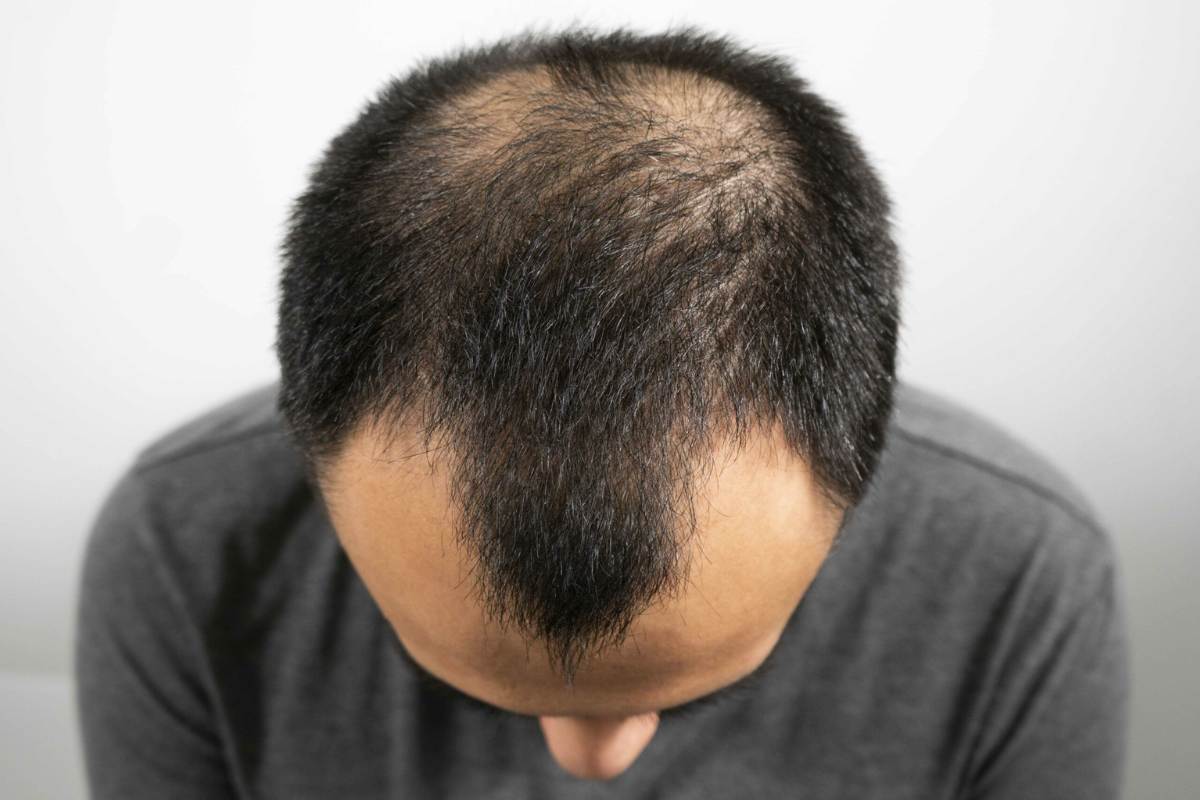
    How it looks: In men, it typically starts with a receding hairline and thinning at the crown, potentially progressing to partial or complete baldness. In women, it usually presents as diffuse thinning over the entire scalp, particularly at the part line, while the frontal hairline is often preserved. Complete baldness is rare in women.
    Mechanism: Hair follicles that are responsive to DHT slowly shrink (miniaturize). This decreases the anagen (growth) phase and prolongs the telogen (resting) phase, leading to thinner, shorter hairs until finally, growth is completely halted.
    Alopecia Areata:

    Androgenetic Alopecia (Pattern Hair Loss):

    • What it is: An autoimmune disorder in which the body’s immune system mistakenly attacks healthy hair follicles, creating inflammation and hair loss. The cause is unknown, but genetics and environmental factors are suspected to be involved.
    • How it appears: Involves abrupt onset of smooth, circular, coin-shaped bald patches on the scalp or body hair-bearing areas (beard, eyebrows). It may be one or more patches (Alopecia Areata monolocularis/multilocularis) or complete loss of scalp hair (Alopecia Totalis) or all body hair (Alopecia Universalis).
    • Prognosis: The pattern is unpredictable. The hair will regrow on its own, sometimes a different colour or texture at first, or the loss can continue or recur.

    Telogen Effluvium (TE):

    What it is: A form of diffuse hair loss that results when a major stressor forces a large number of hair follicles too early into the telogen (resting/shedding) phase.

    • Triggers: General triggers are major physical stress (surgery, high fever, childbirth, serious illness such as COVID-19), extreme emotional stress, extreme weight loss, nutritional deficiencies (particularly iron), thyroid issues, and some medications.
    • How it looks: Presented by increased shedding throughout the entire scalp, commonly observed 2-4 months following the trigger event. It usually causes appreciable thinning but not actual bald patches.
    • Prognosis: Typically temporary. Once the causative underlying factor is reversed or eliminated, the hair growth cycle usually returns to normal within 6-9 months, although healing may seem to be slow. Chronic Telogen Effluvium is possible, but it is not as prevalent

    Anagen Effluvium:

    • .What it is: Sudden and diffuse loss of hair due to damage to hair follicles during the anagen (growing) phase.
    • Causes: Most frequently linked to chemotherapy or head radiation therapy, which affects quickly dividing cells, including hair follicles. Certain poisons may also cause it.
    • How it appears: Sudden loss of most scalp hair shortly after the causative agent has been encountered.
    • Prognosis: Hair generally returns after the treatment (such as chemotherapy) has been discontinued, as the follicles are injured but not usually killed

    Traction Alopecia:

    • .What it is: Hair loss due to repeated or constant tension on the hair follicles.
    • Causes: Specific hairstyles that draw on the hair tightly, including tight ponytails, braids, cornrows, dreadlocks, and hair extensions, particularly when worn for extended periods. Heat and chemical treatment can cause the weakening of the hair, which makes it vulnerable.
    • How it appears: Usually involves the hairline (frontal and temporal regions) or regions subject to chronic tension. At first, it may appear as minute bumps near follicles (folliculitis), then breakage and thinning of the hair.
    • Prognosis: Curable if discovered early and the tension is relieved. Chronic, prolonged traction can, however, cause permanent follicle damage and scarring and result in irreparable loss of hair.

    Cicatricial Alopecia (Scarring Alopecia):

    • What it is: A collection of uncommon inflammatory conditions that destroy the hair follicle and replace it with scar tissue. This results in permanent hair loss.
    • Causes: May be caused by many conditions, such as Lichen Planopilaris, Frontal Fibrosing Alopecia, Central Centrifugal Cicatricial Alopecia (CCCA), Discoid Lupus Erythematosus, and Folliculitis Decalvans. The cause usually has an underlying inflammation targeted at the top of the hair follicle.
    • How it appears: Dependent on the particular type, but can include patchy hair loss with associated signs such as itching, burning, pain, redness, scaling, or pustules of the scalp. The scarred scalp skin can appear smooth and shiny.
    • Prognosis: Permanent loss of hair in scarring. Treatment is directed towards halting the inflammation and preventing further hair loss

    What Causes and Raise the Risk of Hair Loss Alopecia?

    .Knowledge of the possible triggers is essential for prevention and treatment. Important causes of hair loss, alopecia, are:

    Genetics (Heredity): The most prevalent cause of pattern hair loss (Androgenetic Alopecia). If your parents or immediate relatives suffered from hair loss, your risk is increased.
    Hormonal Changes: Changes or imbalances can lead to hair loss. This includes:

    • Pregnancy and Childbirth (often causing temporary Telogen Effluvium).  
    • Menopause.
    • Thyroid disorders (both hyperthyroidism and hypothyroidism).  
    • Polycystic Ovary Syndrome (PCOS).  

     Medical Conditions:

    • Autoimmune diseases (Alopecia Areata, Lupus).  
    • Scalp infections (like ringworm or tinea capitis).  
    • Skin disorders (psoriasis, seborrheic dermatitis on the scalp).  
    • Conditions causing nutritional deficiencies.

    Medications and Treatments:

    • Chemotherapy and radiation therapy.
    • Certain drugs are used for arthritis, depression, heart problems, high blood pressure, and gout.
    • High levels of Vitamin A.
    • Birth control pills (sometimes when beginning or ceasing).
    • Anabolic steroids.


    Nutritional Deficiencies: Insufficiency of necessary nutrients may affect hair well-being. Iron, protein, zinc, biotin, and essential fatty acid deficiencies are commonly involved. Crash dieting or malnutrition may cause TE.
    Stress: Extreme physical or emotional stress may cause Telogen Effluvium. Ongoing stress may also worsen other forms of hair loss.
    Hair Care Habits and Therapies:

    • Traction Alopecia due to tight hairstyles.  
    • Chemical damage from aggressive chemical treatments (perms, relaxers, color).  
    • Excessive heat use.

    Age: Hair naturally will thin, and hair density can slow down as we get older, even without a distinct alopecia disorder. Follicles can simply become less efficient over time.

    Getting a Diagnosis: When to See a Doctor

     While a little shedding is to be expected, it’s a good idea to see a doctor or dermatologist if you experience:

    • Sudden or patchy hair loss.
    • Excessive overall shedding for a few weeks.
    • Itching, painful, red, or scaly scalp with hair loss.
    • You’re concerned about your pattern of hair loss.
    • Hair loss is affecting your self-esteem.

    A dermatologist specializing in hair loss (sometimes called a trichologist, though ‘trichologist’ isn’t always a regulated medical title – ensure they are a board-certified dermatologist) can help determine the cause. Diagnosis typically involves:  

    • Medical and Family History: Discussing your health, medications, diet, stress levels, hair care routine, and family history of hair loss.
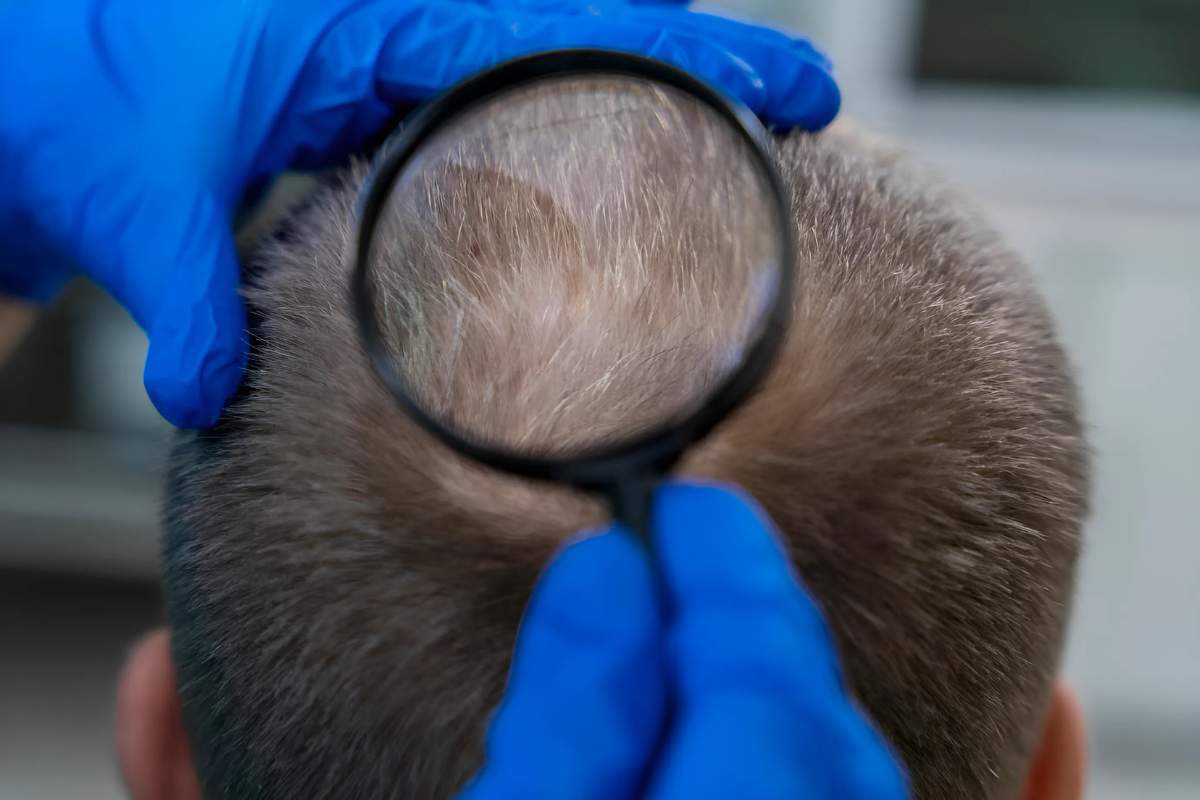
    • Physical Exam: Carefully looking at your hair loss pattern, scalp, and quality of the hair shaft. They may use a dermatoscope (a type of magnifying lens) to take a closer look at the follicles and scalp skin.
    • Pull Test: Lightly tugging a short section of hair (about 40-60 hairs) to observe how many fall out with ease. A number greater than a few hairs could indicate active shedding (such as in TE).
    • Blood Tests: To identify underlying conditions such as thyroid disease, iron deficiency (anemia), hormonal imbalances, or vitamin deficiencies.
    • Scalp Biopsy: In a few instances, particularly if scarring alopecia or an inflammatory process is suspected, a small piece of scalp skin (typically 4mm) is taken under local anesthesia and viewed under the microscope.

    Treatment Options for Hair Loss Alopecia: Finding What Works

    The ideal treatment largely varies with the type and reason for your alopecia hair loss. It is important to be properly diagnosed before initiating treatment. Depending on your case, the following are options that vary from medications and procedures to lifestyle modifications:
    Over-the-Counter (OTC) Treatments:

    • Minoxidil (Rogaine®): A topical liquid or foam put directly on the scalp. It’s FDA-approved for androgenetic alopecia in men and women and is also said to help some individuals with alopecia areata or TE. It extends the anagen phase and perhaps enlarges follicles. It doesn’t always work, needs to be used continuously to sustain results, and takes a couple of months to become effective.  

    Prescription Medications

    • Finasteride (Propecia®): Oral medication for men with androgenetic alopecia. It is an inhibitor of the enzyme (5-alpha-reductase) that converts testosterone into DHT, the hormone causing follicle miniaturization. It is typically more effective in slowing loss and stimulating regrowth at the crown than at the hairline. Not generally used in women of childbearing age because it poses risks to the fetus if a woman were to become pregnant.
    • Spironolactone: An oral drug sometimes used off-label for female pattern hair loss. It’s an anti-androgen, which counteracts the hormonal impact on hair follicles.
    • Corticosteroids: To decrease inflammation in conditions such as Alopecia Areata and certain Scarring Alopecias. Can be administered as injections into the involved scalp areas, applied topically (creams/lotions), or orally (generally for extensive or severe cases, with more possible side effects).
    • Other Immunosuppressants (e.g., Methotrexate, JAK inhibitors): Occasionally used for resistant or severe Alopecia Areata or some inflammatory Scarring Alopecias. These need to be monitored closely because of side effects.
    • Antifungals: For fungal infection-induced hair loss, such as tinea capitis.

    Medical Procedures:

    • Hair Transplantation: A surgical operation by which hair follicles are transferred from a donor site (often the back or sides of the head, which are less susceptible to balding) to balding or thinning spots. Methods include Follicular Unit Transplantation (FUT or strip procedure) and Follicular Unit Extraction (FUE). Ideal for Androgenetic Alopecia or chronic Scarring Alopecia after the inflammatory process has been brought under control. The outcome is usually long-lasting but costly.
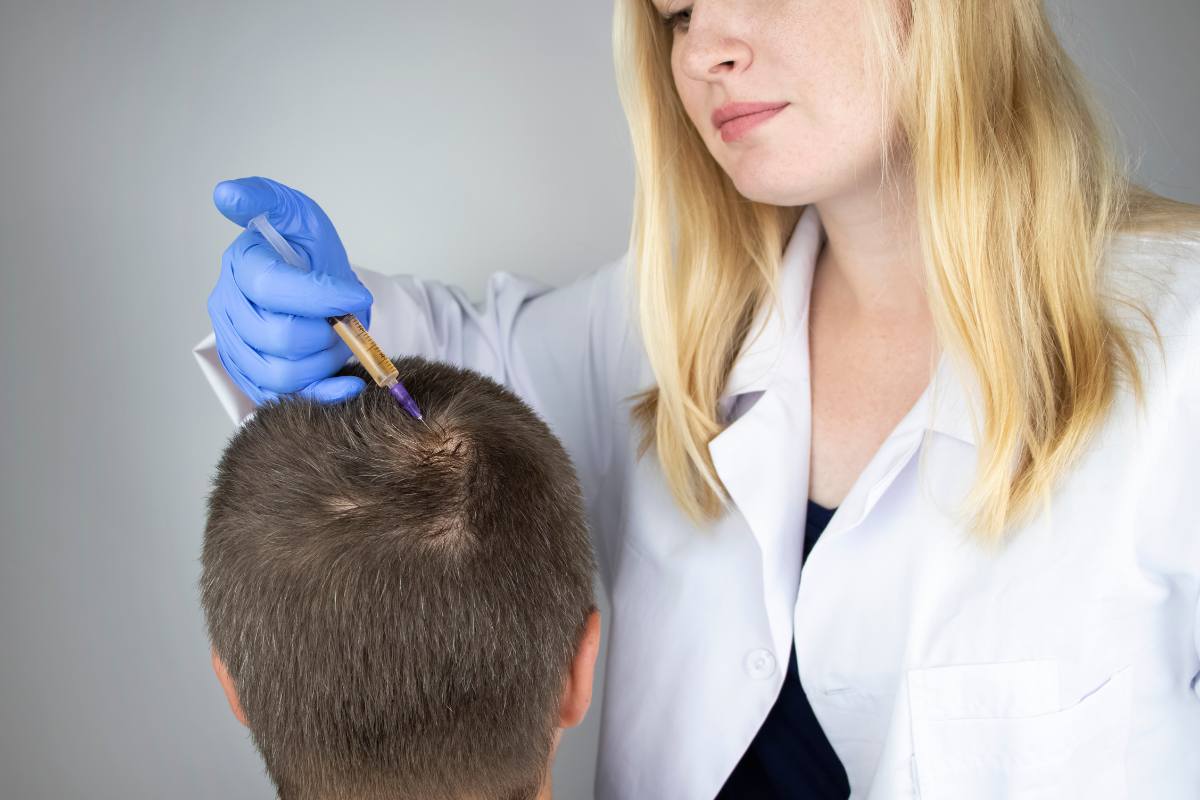
    • Platelet-Rich Plasma (PRP) Therapy: Involves taking your own blood, processing it to thicken the platelets (growth factor-rich), and injecting the PRP into the scalp. It’s believed to awaken latent hair follicles and stimulate growth. Evidence continues to develop, but it’s applied to Androgenetic Alopecia and occasionally Alopecia Areata. Repeated sessions are typically required.
    • Low-Level Laser Therapy (LLLT): Equipment (helmets, helmets, combs, bands) releases red light wavelengths believed to stimulate cellular function in follicles, which could extend the anagen phase and boost hair density. FDA cleared for Androgenetic Alopecia. Must use regularly over several months; success is variable.

    Lifestyle and Home Remedies:

    • Gentle Hair Care: Shun harsh treatments, heat, and tight styles. Use a wide-tooth comb, particularly on wet hair. Select mild shampoos.
    • Balanced Diet: Take sufficient protein, iron, zinc, biotin, omega-3 fatty acids, and vitamins. Treat diagnosed nutritional deficiencies with supplements if advised by your physician.
    • Stress Management: Methods such as yoga, meditation, exercise, or therapy can manage stress, possibly preventing TE or stress-induced worsening of other conditions.
    • Scalp Massage: Can enhance circulation to the scalp, although strong evidence for meaningful regrowth is scarce.

    Cosmetic Solutions:

    • Wigs and Hairpieces: Excellent quality in synthetic or human hair, providing instant coverage and styling flexibility.
    • Hair Fibers and Concealers: Sprays or powders that stick to the remaining hair, giving the illusion of thicker hair and covering thinning spots.
    • Strategic Hairstyling: Thin hair can be disguised by a well-cut style. Layering or texturizing will help.

    Can Hair Loss Be Prevented?

    Although genetically caused hair loss (Androgenetic Alopecia) is predetermined to a great extent, you can do much to reduce other forms or retard progress:

    • Maintain a Healthy, Balanced Diet: Essential for hair health in general.
    • Be Kind to Your Hair: Evade tight hairstyles, rough chemicals, and excessive heat.
    • Reduce Stress: Develop healthy coping skills.
    • Treat Underlying Illnesses: Early treatment of thyroid disorders, infections, or deficiencies.
    • Review Medications: If you have reason to believe a drug is triggering hair loss, speak with your doctor (do not discontinue medication without consultation).
    • Avoid Smoking: Some research indicates that smoking has been implicated as a potential factor in the risk for Androgenetic Alopecia.

    The Emotional Side of Hair Loss: Alopecia

    It is essential to note that alopecia hair loss can have a great effect on emotional well-being. Anxiety, depression, low self-esteem, embarrassment, and withdrawal from social contact are usual. Hair is frequently linked to cultural definitions of beauty and youth.

    If hair loss is impacting your mental health:

    • Seek Support: Discuss with friends, family, or support groups (online or face-to-face) for individuals suffering from hair loss. Exchanging experiences can be extremely validating.
    • Focus on What You Can Control: This could be researching treatment, experimenting with cosmetic solutions, or concentrating on other areas of your health and well-being.
    • Consider Counseling: A therapist can offer coping mechanisms and assist in working through the emotional aftermath.
    • Educate Yourself: Knowing your particular type of alopecia can empower you.

    Moving Forward with Hope

    It can be lonely, but remember that it’s a common problem with many causes and more ways to manage it every day. There are ways to move forward once you know what the problem is and have tried treatments like minoxidil, finasteride, PRP, or hair transplantation. Cosmetics and changes to your lifestyle can also help.

    The most important thing to do is to talk to a dermatologist. They will be able to help you understand the details of your case, give you personalized advice, and give you realistic hopes. Not all hair loss can be fixed, but many can be treated or managed, which will help you feel more confident and hopeful about the future.
  • Alopecia Explained:  the Different Types of Hair Loss

    Alopecia Explained:  the Different Types of Hair Loss

    That creeping fear that comes over you when you see that your part line is a little wider. Seeing a lot of hair swirling at the bottom of the shower drain makes you feel sick. A lot more than normal. When you look at old pictures and think, “Wow, things have really changed,” your heart sinks.

    It’s a lonely feeling. And one that makes you mad.

    You probably know someone who is living some version of that story. You may have spent hours, even in the middle of the night, staring into the mirror and looking at your scalp from angles you never knew existed. You typed in a lot of desperate questions into a search bar, hoping to find an answer, a solution, or a magic bullet. Anything.

    And what do you usually find? Articles that are cold and clinical and sound like they were written by robots. Or, on the other end of the spectrum, sketchy websites that promise miracle cures but don’t seem right.

    So let’s just stop. Take a deep breath.

    I want to talk to you like a person. Alopecia, or hair loss, is more than just a physical problem. It’s a journey of the heart. It can change how you see yourself, how you feel about yourself, and how you show yourself to the world. Believe it or not, the first and most important thing you can do is understand what’s going on. It’s about getting back control.

    Here’s the thing: “hair loss” isn’t just one thing. It’s a word that covers a lot of different conditions. And the kind of alopecia that shows up at your door will completely change your path forward and your story.

    So, get a cup of tea. Make yourself at home. Let’s work together to peel back the layers and find out what’s going on. We’re not going to beat around the bush. In plain English, we’re going to talk about the most important people in the world of hair loss.

    The Big One: Androgenetic Alopecia (The Slow Fade)

    Alright, let’s start with the most common culprit by a long shot. The one most people think of when they hear “baldness.” This is Androgenetic Alopecia.

    Sounds complicated, right? It’s not. Let’s break it down.

    “Andro” refers to androgens, which are male hormones (like testosterone) that everyone has, regardless of gender. And “genetic,” well, that one’s pretty self-explanatory. It’s in your DNA. This is the hair loss that runs in the family. Thanks, Mom and Dad.

    Funny thing is, it doesn’t present the same way for everyone.

    For the Fellas (Male Pattern Baldness):

    You know the script. It’s practically a cultural trope. It usually starts with a little bit of recession at the temples, creating that classic “M” shape. Or maybe it begins at the crown, the vertex, with a thinning spot that you can only see when you hold up a second mirror (a moment of true horror for many).

    For some guys, it’s one or the other. For many, it’s both, and they eventually meet in the middle, leaving that familiar horseshoe pattern of hair around the sides and back of the head.

    What’s going on here? Well, it’s all about a pesky little hormone called Dihydrotestosterone, or DHT. Your body naturally converts a certain amount of testosterone into DHT. For guys genetically predisposed to hair loss, the hair follicles on their scalp are hypersensitive to this stuff. DHT latches onto these follicles and, over time, shrinks them. It’s a process called miniaturization.

    Think of it like a healthy, thriving oak tree slowly being starved of water and nutrients until it becomes a tiny, weak little bonsai sprout. The hair that grows from these shrunken follicles becomes finer, shorter, and wispier… until eventually, the follicle just gives up and stops producing hair altogether. It’s a slow, progressive fade. Not an overnight shock, but a gradual retreat.

    For the Ladies (Female Pattern Hair Loss):

    Female Pattern Hair Loss)

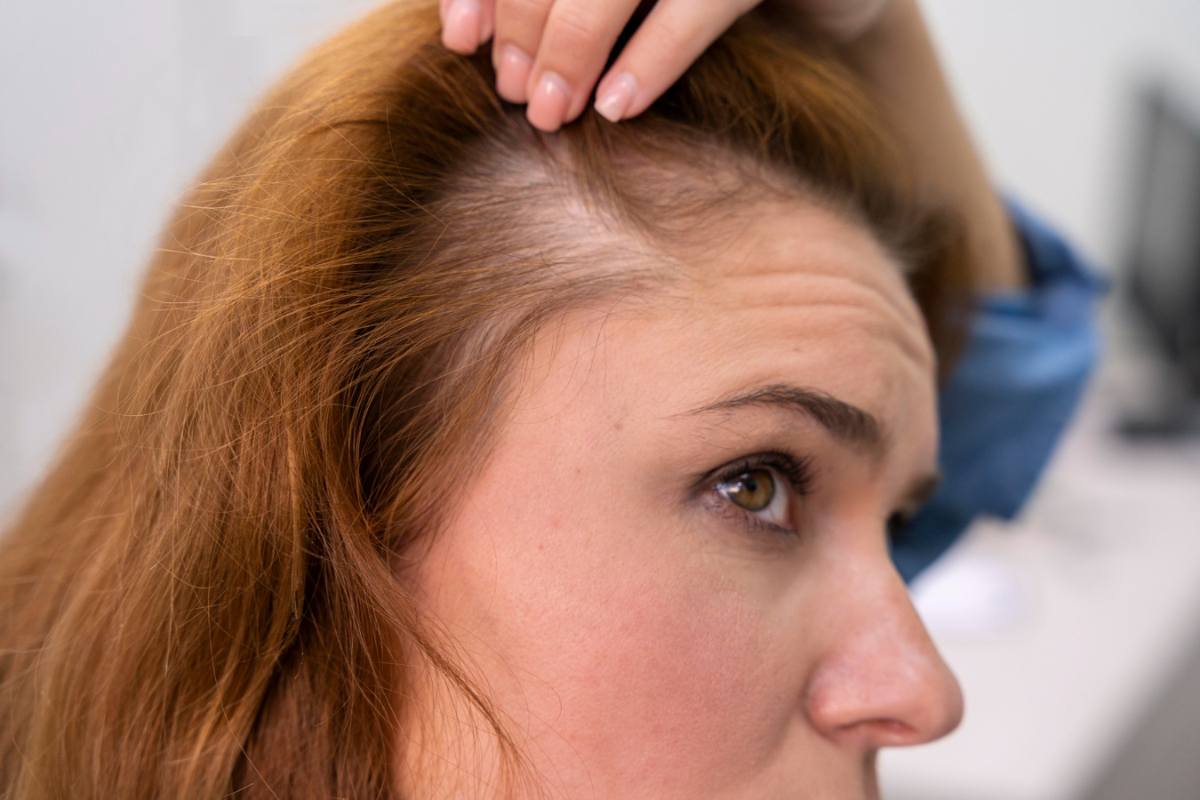
    Now, for women, the story is a bit different. While some women might see some recession at the hairline, it’s far less common. For women, Androgenetic Alopecia usually looks like diffuse thinning, primarily over the top and crown of the scalp.

    You might first notice that your ponytail feels less substantial. Or, the classic sign: your part line starts looking wider. It’s often described as the “Christmas tree” pattern, a widening part that spreads out from the center of the scalp. Unlike with men, it’s incredibly rare for women to go completely bald from this condition. But the thinning can become quite pronounced, and honestly, the emotional toll can be just as severe, if not more so.

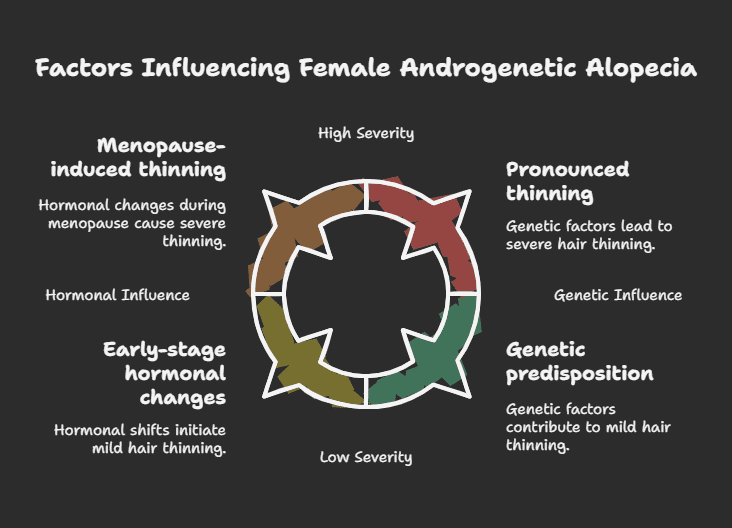
    The underlying mechanism is similar; that pesky DHT is still involved, but it’s more complex in women. Hormonal shifts during menopause, for example, can often kickstart or accelerate the process. The balance between female and male hormones changes, and those sensitive follicles suddenly find themselves under attack.

    The bottom line for Androgenetic Alopecia? It’s genetic, it’s hormonal, and it’s progressive. But the good news? It’s also the type of hair loss with the most FDA-approved treatments available. So, getting a proper diagnosis here is key.

    The Surprise Attack: Alopecia Areata (The Patchy Intruder)

    Let’s switch gears completely.

    Imagine you’re just going about your day. You’re brushing your hair, or maybe a friend or hairdresser points it out, and then you see it. A perfectly smooth, coin-sized patch of bare skin on your scalp.

    No rash. No pain. No warning. Just… gone.

    This is Alopecia Areata. And it is a whole different ballgame.

    This isn’t about shrinking follicles or genetics in the traditional sense. This is an autoimmune condition. If you want to get technical, your immune system, the very thing that’s supposed to protect you from illness, gets its wires crossed. It mistakenly identifies your hair follicles as foreign invaders, like a virus or bacteria, and launches an all-out assault.

    Think of it like friendly fire. Your body’s defense soldiers start attacking your hair-making factories. The good news? The attack is usually on the follicle, not the stem cells that create the follicle. This means the follicle isn’t destroyed; it’s just suppressed. It has the potential to wake up again.

    Alopecia Areata is wildly unpredictable.

    • Alopecia Areata: The most common form, with one or more of those quarter-sized bald patches.
    • Alopecia Totalis: In some cases, the condition progresses, and the person loses all the hair on their scalp.
    • Alopecia Universalis: This is the rarest form, where the hair loss extends to the entire body. Eyebrows, eyelashes, arm, leg, and chest hair… everything.

    Who gets it? Anyone. It can strike at any age, any gender, any ethnicity. It often first appears in childhood or young adulthood. And the triggers? Well, that’s the million-dollar question. Sometimes it’s linked to severe stress or a traumatic event, but for many people, it happens for no discernible reason at all. It just… appears.

    The emotional impact of Areata can be profound. The sheer unpredictability of it, will the patch get bigger? Will I get more? Will my hair grow back? Will it fall out again?, is a heavy burden to carry. It can feel like your body has betrayed you. If you’re experiencing this, know that your feelings are completely valid. This isn’t just “hair”; it’s a condition that can turn your world upside down overnight.

    The Great Shed: Telogen Effluvium (The Stress Response)

    Have you ever been through something… big? A major surgery, a serious illness (especially with a high fever), giving birth, a period of intense psychological stress, or even a drastic change in diet or rapid weight loss?

    And then, maybe two or three months after the event, you experience something terrifying. Your hair starts falling out. Not just a little extra shedding. We’re talking handfuls. You run your hands through your hair, and it just comes away. Your brush is full after a few strokes. The shower drain looks like a horror movie.

    This, my friend, is most likely Telogen Effluvium. And if I’m being honest, while it’s incredibly distressing, it’s a sign that your body is working correctly, in a weird way.

    Here’s a quick-and-dirty breakdown of your hair’s life cycle:

    1. Anagen Phase (The Growing Phase): Most of your hair (like 85-90%) is in this phase right now. It’s actively growing. This can last for years.
    2. Catagen Phase (The Transition Phase): A brief, 2-3 week phase where the hair follicle shrinks and detaches from its blood supply.
    3. Telogen Phase (The Resting Phase): This is where the hair just hangs out for a few months, not growing, before it eventually sheds. Normally, only about 10-15% of your hair is in this phase at any given time, which is why we all shed about 50-100 hairs a day without even noticing.

    Now, when your body goes through a major shock (physical or emotional), it hits a giant panic button. It decides, “Whoa, we have bigger fish to fry than making hair right now! We need to divert all resources to healing and survival!”

    As a result, a huge number of your hairs that were happily growing in the anagen phase are prematurely shocked into the telogen (resting) phase. They all get the signal at once. Then, they hang out there for about three months, and after that… they all shed. At the same time.

    It’s a massive, synchronized exodus.

    The shock of seeing so much hair fall out at once often causes people to panic, which (and this is the cruel irony) can create more stress, potentially prolonging the issue. But here’s the most important thing to know about Telogen Effluvium: in most cases, it is temporary. Once the initial trigger is gone and your body finds its equilibrium again, the cycle resets. The shedding slows down, and the hair almost always grows back. It takes time, and patience is an absolute virtue here, but it’s a recovery story more often than not.

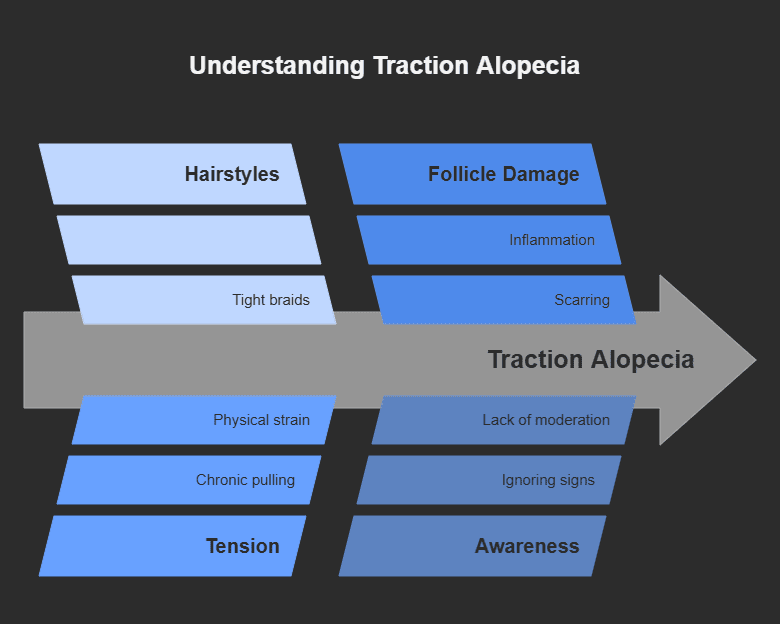
    The Style Strain: Traction Alopecia (The Pulling Problem)

    Traction Alopecia

    We all want to express ourselves. And for many, hairstyles are a huge part of that. Tight braids, sleek high ponytails, heavy extensions, intricate weaves. They can look incredible. They can be a part of your culture, your identity, your brand.

    But… there can be a dark side to all that tension.

    This is where Traction Alopecia comes into the picture. The name says it all: “traction” as in pulling. When your hair is constantly pulled tight in the same direction for long periods, it puts a tremendous amount of physical strain on the hair follicles.

    At first, you might just notice a few bumps around the hairline, or a bit of tenderness after you take your hair down. But over time, this chronic pulling can yank the hair out of the follicle. Even worse, it can cause inflammation and damage the follicle permanently.

    This isn’t an internal, hormonal, or autoimmune issue. This is a mechanical one. It’s caused by an external force. You’ll typically see it along the hairline, behind the ears, or at the nape

    of the neck, wherever the pulling is most intense. Think of ballerinas with their tight buns, or people who wear tight cornrows or dreadlocks for years.

    The crucial thing about Traction Alopecia is that in its early stages, it’s completely reversible. If you stop the hairstyle that’s causing the strain, the follicles can recover, and the hair will grow back. Give your hair a break! Wear looser styles. Let it breathe.

    But, and this is a big but, if you ignore the signs and continue with the same high-tension styles for years and years, you can cause irreversible damage. The follicles can become so scarred and damaged that they can no longer produce hair. At that point, the hair loss is permanent.

    This is a tough one, because it’s so tied to our appearance and cultural practices. No one is telling you to never rock a snatched ponytail again. But it’s about moderation. It’s about being mindful of the tension. It’s about listening to your scalp when it tells you it’s had enough.

    The Tough Stuff: Scarring Alopecias (When It’s Permanent)

    Okay, let’s take a deep breath. We’re wading into some heavier territory now, but it’s important.

    All the types of alopecia we’ve talked about so far are non-scarring. This means that even though the hair has fallen out, the hair follicle itself, the little factory under the skin, is still there. It might be shrunken, dormant, or under attack, but it still exists and has the potential to produce hair again.

    Scarring Alopecias, also known as Cicatricial (sik-uh-TRISH-ul) Alopecias, are different.

    In this group of rare disorders, the hair follicle is destroyed by inflammation and replaced with scar tissue. And once that follicle is gone… It’s gone for good. The hair loss is permanent.

    This isn’t one condition; it’s a whole family of them, with names you’ve likely never heard of, like Lichen Planopilaris, Frontal Fibrosing Alopecia (FFA), or Central Centrifugal Cicatricial Alopecia (CCCA).

    The cause is often inflammation deep in the scalp, but what triggers that inflammation is still a big area of research. The symptoms can vary. You might experience itching, burning, or pain on your scalp along with the hair loss. The skin in the affected area might look shiny, smooth, or scarred.

    Because the follicle is destroyed, the goal of treatment for scarring alopecias isn’t necessarily regrowth (though that can sometimes happen at the edges of the affected area). The primary goal is to stop the inflammation and prevent the hair loss from spreading further. It’s about halting the process in its tracks.

    This is why, if you suspect any kind of hair loss, but especially if you’re experiencing symptoms like pain or itching, getting to a dermatologist ASAP is non-negotiable. With scarring alopecias, time is absolutely of the essence.

    So, What Now?

    It’s okay if your head is spinning a little. The goal of all this isn’t to turn you into a medical expert right away. It’s not to be sure that you can diagnose yourself in the mirror.

    The point is to show you that “hair loss” is a hard problem to solve. It has a lot of different sides. And it’s not crazy to be worried or confused.

    There is a name for what you’re going through. There is a reason. There is a story.

    The first step to feeling less like a victim and more like an active participant in your health is to figure out which story is yours. A dermatologist’s correct diagnosis is where you should really start. They can look at your scalp, do a blood test, or even take a small biopsy to find out exactly what’s going on with your hair follicles.

    Knowing gives you power. It takes away the fear of the unknown and gives you a clear way to move forward. It all starts with understanding, whether that means getting treatments, changing your lifestyle, or just finding a group of people who get it.

    You are not the only one who feels this way. Not even close. Take a look around. In one way or another, a lot of us are going through this journey. So be nice to yourself. There is so much more to the person you see in the mirror than just their hair. And now is the time to start your journey to understanding. Give that to yourself..

  • How Doctors Identify & Diagnose All Types of Alopecia

    How Doctors Identify & Diagnose All Types of Alopecia

    So. You see more hair in the brush. You want to know what’s going on down there. Normal. Losing hair can feel like a punch in the gut, like an emotional wake-up call. But don’t worry, you’re not alone. There are more than a hundred kinds of hair loss. It sounds scary, doesn’t it? But the good news is that most of them can be diagnosed and treated. Let’s go over how doctors figure out what’s wrong with your hair.

    First Things First: Medical History & A Friendly Chat 

    Doctors will start by asking about you. Not in a creepy way. (Well… maybe a little.) They want to know your story:

    • When did this all start?
    • Was it sudden or gradual?
    • Any big triggers, stress, illness, new meds?
    • Family history (think: male or female pattern baldness)?
    • Other symptoms, like nail changes, itching, and flare‑ups?

    This history is gold. It feeds right into diagnosing the different types of alopecia; each has its own little backstory.

    Patterns & Symptoms: Eyes On the Scalp

    Ok, now comes the physical exam. This is where things get interesting, and maybe a bit graphic. But don’t worry, I’ll explain it in plain English.

    a. Types of Hair Loss Patterns

    Patchy loss = alopecia areata?
    Think round or oval bald spots, anywhere from the scalp to the eyebrows to the beard. Sometimes hair regrows in one spot even while another falls out. There might even be itching or a burning sensation before it appears.

    Diffuse thinning hair = telogen effluvium?
    All-over thinning, especially if you’ve had a shock to the system: major surgery, new meds, stress, or postpartum changes. Your hair follicles are going into the resting phase all at once.

    Receding hairline or crown thinning = androgenetic alopecia
    Also known as male/female pattern hair loss. In men, it’s that temple and crown combo; women usually see broad thinning across the top.

    Traction alopecia
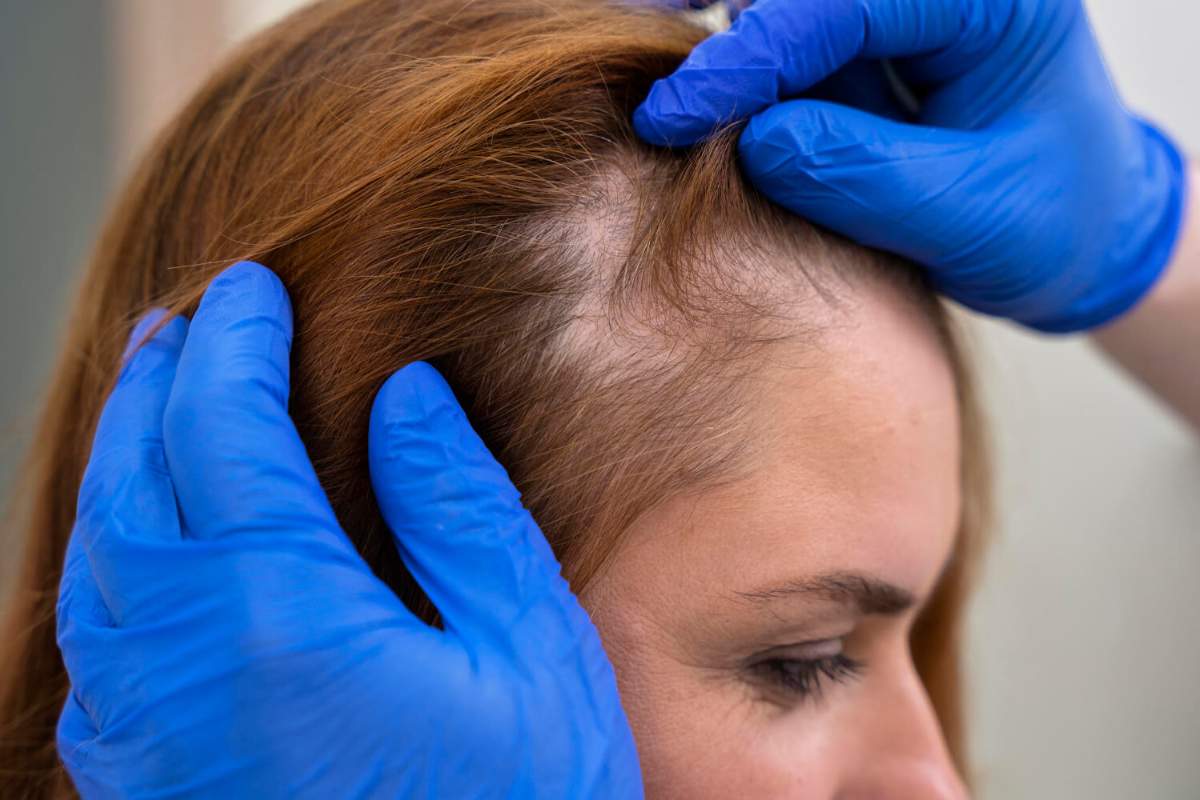
    If you wear tight hairstyles, braids, buns, or scarves, you might notice thinning or baldness along your hairline.

    Scarring alopecias (like lichen planopilaris, discoid lupus, folliculitis decalvans)…
    These are less common but more serious, leading to permanent hair loss, often accompanied by itching, redness, pain, flaking, or pustules.

    b. Other Clues: Nails & Hairs

    • “Exclamation‑point hairs,” or those short broken hairs at the edges of bald patches? That usually points to alopecia areata.
    • Nail pitting or ridges, don’t laugh, it’s a key dermatology clue often found in alopecia areata.
    • Hair shaft damage or breakage, a sign of trichotillomania (hair‑pulling disorder) or styling damage.

    The Pull Test & Magnifying Tech: Doctors Get Hands‑On

    Hair Pull Test

    The doctor gently grasps 40–60 hairs and pulls firmly. Normally, only a few hairs will come out. If many (four or more) are loose, something’s off, like telogen effluvium or active shedding.

    Dermatoscope / Trichoscopy

    This handheld magnifier lets doctors get up close to your scalp and hair follicles.

    • With alopecia areata, you might see yellow dots, black dots, and broken hairs.
    • Female pattern hair loss shows many miniaturized (thin) hairs clustered in one area.
    • Scarring alopecias show inflammation, pustules, and clear destruction of follicles.

    “Trichoscopy” is just the high‑falutin term for dermatoscopy; dermatologists do love their long words.

    Extra Help: Blood Tests, Microscopy, Biopsy

    Sometimes looking or pulling isn’t enough. Docs dig deeper:

    • Blood tests: They might check your thyroid (TSH), iron levels, B12, vitamin D, hormones, or autoimmune markers, especially if they suspect telogen effluvium or lupus.
    • Light microscopy of hair shafts: Helps identify structural damage (like trichorrhexis nodosa).
    • Scalp biopsy: A small tissue sample used to diagnose scarring alopecias and nail down exactly what’s active. Usually, one biopsy is enough.

    Yes, it might sound intense. But most of these are quick and low‑risk procedures.

    Weave It All Together: Putting Clues Into Diagnosis

    Here’s how doctors think, behind the scenes:

    ObservationLikely DiagnosisNext Steps
    Patchy bald spots + exclamation hairs + nail pittingAlopecia areata (autoimmune)Dermatoscope exam; maybe biopsy or blood tests
    Diffuse shedding 2–3 months after a stressful eventTelogen effluviumPull test, blood tests to find the trigger
    Physical exam often involves a psych evaluation, tooAndrogenetic alopeciaClinical exam, dermatoscope, check family history
    Hairline thinning from tight stylingTraction alopeciaAsk about hairstyle practices, physical exam
    Physical exam often involves a psych evaluation tooScarring alopeciaDermoscopy; scalp biopsy is essential
    Broken, uneven hairs of varying lengthsTrichotillomaniaBurning, redness, and scarring on the scalp

    Believe it or not, most of the time doctors can diagnose these types with just tools, tests, and a bit of pattern-spotting.

    5. Why It Matters: Choosing the Right Treatment

     Choosing the Right Treatment

    Here’s the kicker: each type of hair loss needs its game plan.

    • Alopecia areata: often treated with steroids (topical or injections) or newer options like JAK inhibitors; sometimes hair just regrows on its own.
    • Telogen effluvium: fix the underlying trigger, improve diet, adjust medications, and reduce stress. Hair often recovers in 3–6 months.
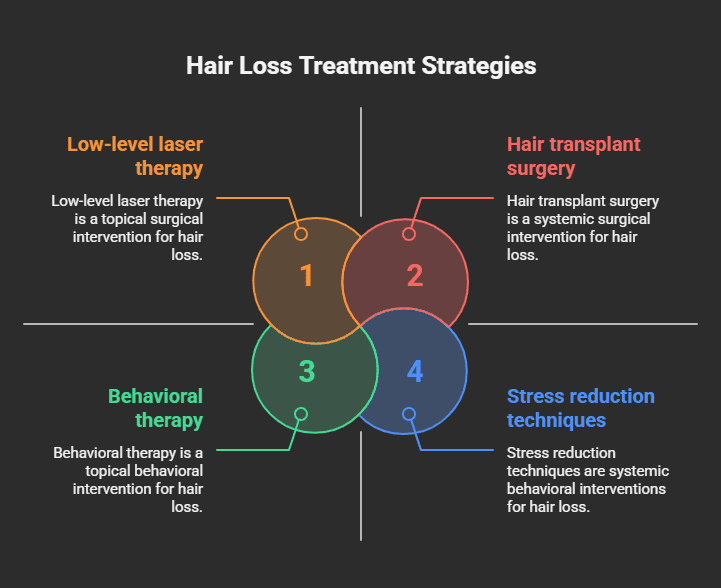
    • Androgenetic alopecia: options include minoxidil, finasteride (for men), spironolactone (for women), low‑level laser therapy, or even hair transplant surgery.
    • Traction alopecia: stop pulling on your hair. If caught early, regrowth is possible.
    • Scarring alopecias: early diagnosis is critical; treatment involves anti‑inflammatories or immunosuppressants to prevent further loss.
    • Trichotillomania: Behavioral therapy has shown better success than topical treatments.

    Funny thing is, you could drop big money on generic hair remedies, but if you don’t know why your hair is falling out, those products are mostly snake oil.

    When to See a Dermatologist vs. Just Your GP

    Your general practitioner (GP) can handle most non‑scarring concerns, like pattern baldness, telogen effluvium, or early alopecia areata.
    But you’ll want a dermatologist if:

    • Scarring alopecia is suspected.
    • You’re still unsure after the initial assessment.
    • You’ve tried over-the-counter stuff with no improvement.
    • It’s taking a real emotional toll; don’t beat around the bush; ask for help.

    Dermatologists have access to advanced tools, dermatoscopy, scalp biopsy, and targeted blood panels, so they can give you a precise diagnosis.

    Wrapping Up: What You Can Do Now

    1. Track your hair loss, note when it began, how it looks, and any triggering events. Even a simple journal helps.
    2. Book an appointment with your GP or dermatologist.
    3. Be prepared: a hair pull test might happen.
    4. Ask about tests like blood panels, biopsies, or dermatoscopy.
    5. Stick with the plan. Once you have a clear diagnosis, treatments work so much better.

    Final Thoughts: You’re Not Just Losing Hair. You’re Finding Answers.

    Hair loss isn’t just cosmetic, it’s emotional, personal, and sometimes downright scary. But here’s the thing: information is power. You can take real steps, with the help of your doctor, that will help you grow once you know what’s going on. Not just strands, but also trust.

    Believe it or not, you can figure out most hair loss with just a few simple tools: talk, scalp examination, and maybe a gentle tug. And from there? Options. Treatments. Solutions that match your hair story.

    So go ahead, share your story with a doctor. Get the full scoop. And if you want more tips on alopecia areata, telogen effluvium, pattern loss, scarring types, or just someone to rant to, I’m here for it.

    • History & patterns = your starting clues
    • Physical exam & specialist tools = identifying the type
    • Tests reserved for complicated or scarring cases
    • Treatment varies wildly depending on the diagnosis
    • Early specialist input matters most for scarring forms
    • Emotional support is key, hair is identity

    P.S. Did you think it would only be about minoxidil? Get it. But it turns out that it has a lot more layers. Don’t give up, and if you want me to explain scalp biopsies, JAK inhibitors, or ways to deal with your feelings next, just let me know.

  • Treating Alopecia: Medical & Therapeutic Options for Hair Regrowth

    Treating Alopecia: Medical & Therapeutic Options for Hair Regrowth

    Reclaim Your Confidence

    It’s not just your skin that is losing hair. Your self-esteem goes down, and mornings feel different. But here’s the thing: you’re not the only one. There are proven treatments for both patchy alopecia areata and the classic thinning of androgenetic alopecia. Let’s look at the medical options, from the ones that have been around for a while to the newest ones, so you can find the one that works for you.

    Understanding Alopecia Types

    Alopecia Areata

    An autoimmune trigger attacks hair follicles, leaving sudden bald spots. Sometimes hair grows back on its own within a year. Other times, medical intervention is the game‑changer.

    Androgenetic Alopecia (Pattern Baldness)

    Genetic and hormonal factors lead to gradual thinning, such as receding hairlines or thinning crowns. It affects a wide audience, irrespective of gender.

    Knowing which type you’re dealing with is step one in crafting your tailored regrowth plan.

    1. Minoxidil (Topical & Oral)

    What Is It?

    A vasodilator repurposed from blood pressure medicine, now a topical staple that widens vessels, nourishes follicles, and prolongs the growth phase.

    Forms & Use

    • OTC topical foam or liquid (2% or 5%), applied twice daily
    • Low‑dose oral versions (off‑label) available by prescription

    Results Timeline

    Expect to wait 4–12 months. Stick with it, or you’ll lose any progress.

    Side Effects

    Scalp irritation is common. Rare side effect: excessive facial hair, especially with tight caps increasing uptake. Oral use ups the risk of unwanted hair elsewhere.

    2. Finasteride (Oral/Desktop Combo)

    How It Works

    Blocks DHT, the hormone that shrinks follicles and triggers male pattern hair loss.

    Usage

    1 mg daily, men saw 80% improvement after a year versus 52% with topical minoxidil alone.

    Side Effects

    Some men report mild libido dips or other sexual side effects, but these reversed once treatment stopped.

    For Women?

    Not FDA-approved for women in pill form. Topical trials are ongoing but still experimental.

    3. Low‑Level Laser Therapy (LLLT)

    The Device

    Comb-based, helmet-style, or cap devices shine red/infrared light onto the scalp to stimulate follicles.

    Does It Work?

    Studies report improved density and thickness over 3–12 months. It’s safe and side‑effect‑free, but consistency and patience are key.

    4. Corticosteroids & Topical Immunotherapy (For Alopecia Areata)

    Corticosteroid Injections/Topicals

    Injected directly into bald spots, helping to quiet the immune reaction and trigger regrowth.

    Immunotherapy

    Topical irritants like diphencyprone distract the immune system. Results vary, but it’s a solid option for stubborn spots.

    5. JAK Inhibitors (Breakthrough for Alopecia Areata)

    What They Do

    Target specific immune pathways, shutting down the autoimmune attack at its source.

    Approved Options

    • Baricitinib (Olumiant): FDA-approved June 2022, effective in moderate to severe cases
    • Ritlecitinib (Litfulo): Approved June 2023 for ages 12+, delivering significant regrowth in many
    • Deuruxolitinib (Leqselvi): Approved July 2024 for adults with severe cases

    Risks & Timeline

    Hair regrowth often appears within 4–6 months. Side effects can include infections, blood clots, and high cholesterol, so medical monitoring is essential.

    6. Platelet‑Rich Plasma (PRP)

    The Process

    Your blood is drawn, spun down, and the liquid with growth factors injected into your scalp.

    Regrowth & Routine

    Three sessions, one month apart, then periodic follow‑ups. Many see density improvement, though long‑term proof is still in progress.

    7. Other Systemic Immunosuppressants

    Drugs like Methotrexate or Cyclosporine

    Reserved for stubborn alopecia areata cases. They can work, but carry significant risks (e.g. liver, kidney, infection), usually paired with steroids.

    8. Combination Therapies

    Why Combine?

    Multiple approaches often deliver better results. For example:

    • Minoxidil + Finasteride = stronger together
    • Add LLLT or microneedling to enhance results
    • PRP + topicals = powerful synergy

    Choosing What’s Right for You

    1. Identify your alopecia type and severity
      • Autoimmune? Focus on JAK inhibitors, steroids, immunotherapy, PRP
      • Pattern baldness? Start with minoxidil ± finasteride ± LLLT
    2. Set expectations
      • These are long‑term plans, think months, not weeks
    3. Weigh the side effects
      • Topicals: irritation or stray facial hair
      • Orals: systemic risks
      • JAKs: serious monitoring required
    4. Consider cost & accessibility
      • OTC options are generally affordable
      • Prescription meds, injections, and specialized devices are pricier

    Emotional & Practical Support

    Hair loss isn’t just cosmetic, it’s emotional. Combine your medical journey with psychological support, peer groups, or supportive counseling. Many find healing in shared stories and hands‑on guidance.

    Treatment details

    Treatment TypeBest ForTimelineNotes & Side Effects
    Topical MinoxidilBoth types4–12 monthsScalp irritation, possible facial hair growth
    Oral MinoxidilOff‑label for both4–12 monthsPotential body hair growth, dose-dependent effects
    FinasterideMale pattern baldness3–12 monthsDHT blocker; mild sexual side effects possible
    LLLT devicesBoth types3–12 monthsSafe, requires consistency
    CorticosteroidsAlopecia areataWeeks–monthsLocal effects, injection discomfort possible
    JAK InhibitorsSevere alopecia areata4–6 monthsEffective but requires monitoring; costly
    PRP injectionsBoth typesMonthsMild, periodic sessions; long‑term data building
    Systemic ImmunosuppressantsSevere alopecia areataVariableSignificant risks; usually in combination therapy

    Final Takeaway

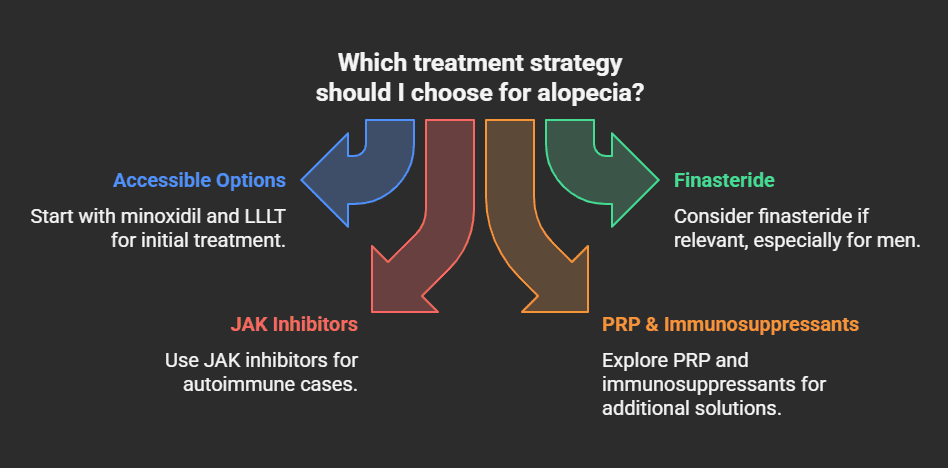
    Treatment strategy-alopecia

    It’s not about miracles when it comes to treating alopecia; it’s about having a plan. Begin with easy-to-get options like minoxidil and LLLT. If it makes sense, move up to finasteride (especially for men). JAK inhibitors are changing the way autoimmune cases turn out. People who want more options can also try PRP and immunosuppressants.

    Every time, consistency wins. You might notice that your hair gets thicker over time and that you feel more confident.

    Your Next Steps

    • Book an appointment with a board‑certified dermatologist
    • Confirm your diagnosis and create a treatment roadmap
    • Start with one or two options, then adjust based on results
    • Track progress with photos and revisit your plan every 3–6 months
  • Natural Remedies for Alopecia: Can Diet & Lifestyle Combat Hair Loss?

    Natural Remedies for Alopecia: Can Diet & Lifestyle Combat Hair Loss?

    It starts out slowly. A few more strands in the brush. A part that is a little wider. Then one day, in the bright light of the bathroom, you see a spot. A patch. A thinning that wasn’t there before.

    And the world sort of stops.

    That cold, quiet dread that settles in your stomach is something that a lot of us know all too well. It’s not just about losing hair. It has to do with who we are, how we feel about ourselves, and how we deal with the world. Or how we think the world is treating us. It can feel like your body is betraying you and you have lost control. You do what anyone would do: you look for answers. You go down the late-night internet rabbit hole, scrolling past clinical-looking sites and ads for miracle cures until your eyes hurt.

    The conventional route is there, of course. Steroid shots, creams that go on the skin, and drugs… and for a lot of people, they are a necessary and helpful part of the journey. But what if you want something else? Something that feels less like a fight and more like… making something. Creating a strong base of health from the inside out.

    That’s the question we need to ask. Can the decisions we make every day, like what we eat, how we deal with stress, and how we live our lives, really have an effect? Can we work with our bodies to stop hair loss?

    Let’s talk about it. Not in cold, clinical terms, but like people. People who’ve stared at their reflection and wondered, “What now?”

    Because there is a “what now?” And it’s more hopeful than you might think.

    First Things First: What Are We Even Dealing With?

    Before we get started, let’s all agree on something. The medical term for hair loss is “alopecia.” But it doesn’t work for everyone.

    Alopecia Areata is what most people think of. It’s an autoimmune disease that makes your immune system attack your hair follicles. It looks like those smooth, round patches of hair loss that are so common. Sometimes it can be worse, causing hair loss all over the body (Alopecia Universalis) or just on the scalp (Alopecia Totalis). This kind is known for being hard to predict. A real wild card.

    Androgenetic Alopecia is another type of hair loss that affects both men and women. This one has more to do with hormones and genes. Over time, it gets thinner at a slower, more predictable rate.

    And don’t forget about Telogen Effluvium, which is when your hair suddenly falls out all over your body after a big shock to your system, like giving birth, having major surgery, going through a lot of stress, or being sick.

    What does this mean? Because knowing what you’re up against helps you plan your approach. Hormonal thinning might not work as well on an autoimmune trigger as other treatments. But here’s the catch: a lot of the basic, natural methods we’re going to look at next? They help all of them. Because they’re not just about hair. They are about bringing the body into balance.

    The Elephant in the Room: Can You Really ‘Cure’ Hair Loss with Food?

    Okay, let’s be brutally honest. Is there a magic salad that will make your hair grow back overnight? No. Of course not. And anyone who tells you otherwise is probably selling something.

    But to dismiss diet and lifestyle is to miss the entire point.

    Think of your body as a garden. If the soil is depleted, lacking nutrients, and overrun with pests (hello, inflammation and stress), how can you expect anything beautiful to grow? You can’t just sprinkle some “hair growth” seeds on top and hope for the best. You have to tend to the soil. You have to nourish it, protect it, and give it what it needs to thrive.

    The food you eat, the air you breathe, the stress you carry… that’s your soil. And your hair follicles are the seeds. So, let’s get our hands dirty and start tending to that garden.

    The Anti-Inflammatory Kitchen: Your First Line of Defense

    Inflammation is a word we hear all the time. But what is it? In the short term, it’s your body’s heroic response to injury or infection. A good thing. But when it becomes chronic, a low-grade, simmering fire that never goes out, it can lead to all sorts of trouble. And for those with autoimmune conditions like alopecia areata, that fire is a major, major problem.

    Your mission, should you choose to accept it, is to become a firefighter. And your tools are in your kitchen.

    • Go Green. And Red. And Orange. Think of colors. Deep, vibrant colors. Dark leafy greens like spinach and kale are packed with antioxidants. Berries, blueberries, raspberries, and strawberries are little antioxidant powerhouses that fight off cellular damage. Sweet potatoes, carrots, bell peppers… eat the rainbow. Seriously. It’s not just a cute saying; it’s a strategy.
    • Embrace Healthy Fats. Not all fats are created equal. The fat in a greasy takeaway burger is not the same as the fat in an avocado or a handful of walnuts. You’re after Omega-3 fatty acids, the ultimate inflammation-busters. Find them in fatty fish like salmon, mackerel, and sardines. If you’re plant-based, flaxseeds, chia seeds, and walnuts are your best friends. These fats don’t just cool inflammation; they are part of the structure of your cell membranes. They’re foundational.
    • Spice Up Your Life. Certain spices are ridiculously potent anti-inflammatories. Turmeric is the king here, with its active compound curcumin. (Pro tip: always have it with a pinch of black pepper, which dramatically increases its absorption). Ginger is another giant, great for calming the gut and the immune system. Sprinkle them into your cooking, sip them in teas… get creative!

    The Gut-Hair Connection… No, Really.

    If you’d told someone 20 years ago that the bacteria in their gut could affect the hair on their head, they’d have laughed you out of the room. But believe it or not, this is one of the most exciting frontiers in health research.

    Your gut is home to trillions of microorganisms, your microbiome. This internal ecosystem is like a command center for your immune system. About 70-80% of your immune cells live in your gut. When your gut microbiome is out of whack (a state called “dysbiosis”), your immune system can get confused. It can become overactive and trigger-happy. And for someone with a predisposition to alopecia areata, that’s like pouring gasoline on a fire.

    So, how do you cultivate a healthy gut garden?

    • Probiotics Are Your Pals. These are the good guys, the beneficial bacteria. You’ll find them in fermented foods like plain yogurt, kefir (a fermented milk drink that’s even more potent than yogurt), sauerkraut, kimchi, and kombucha. Introducing these foods helps to repopulate your gut with friendly microbes.
    • Feed the Good Guys with Prebiotics. Probiotics need to eat, too. Their favorite food is fiber, specifically, prebiotic fiber. Think of it as fertilizer for your inner garden. Amazing sources include garlic, onions, leeks, asparagus, bananas, and oats.
    • Ditch the Sugar. If prebiotics are fertilizer for the good guys, sugar is junk food for the bad guys. Pathogenic yeasts and bacteria love sugar. It helps them multiply, crowd out the good microbes, and contribute to that chronic, simmering inflammation. I know, I know. It’s tough. But cutting back on refined sugar and processed foods might be one of the most powerful things you do for your gut, and by extension, your hair.

    The Building Blocks: Are You Getting Enough of the Good Stuff?

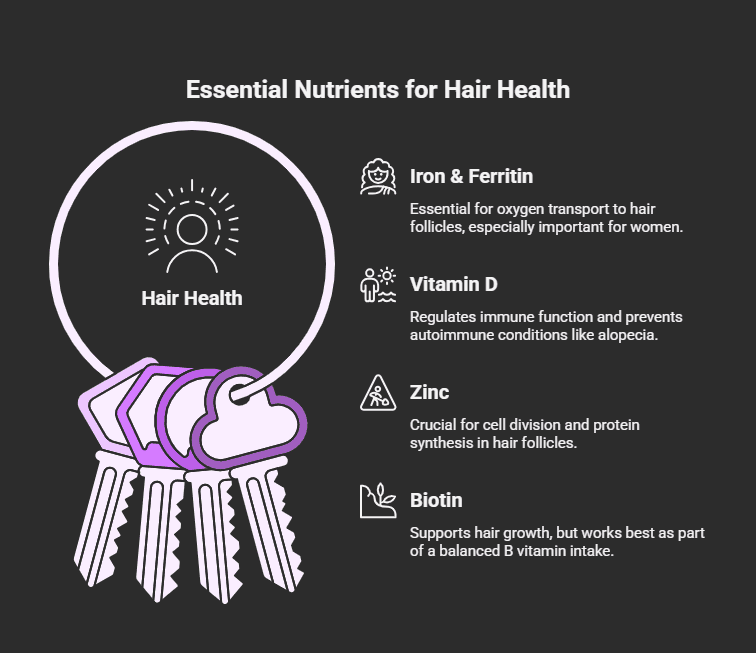
    Nutrients for Hair Health

    Beyond the big picture of inflammation and gut health, there are specific micronutrients that are non-negotiable for healthy hair follicles. A deficiency in any one of these can, at best, prevent healthy growth and, at worst, actively cause shedding.

    • Iron (and its friend, Ferritin): This is a big one, especially for women. Iron is essential for producing hemoglobin, which carries oxygen in your blood. And your hair follicles? They need a lot of oxygen to thrive. But it’s not just about your iron level; it’s about your ferritin level. Ferritin is the protein that stores your iron. Think of it as your iron savings account. Many doctors see ferritin levels within the “normal” lab range and say you’re fine, but many trichologists (hair specialists) will tell you that for optimal hair growth, you want that ferritin level to be well above 50, even closer to 70 ng/mL. Get it checked! If it’s low, focus on iron-rich foods like red meat (if you eat it), lentils, spinach, and tofu. And always pair them with Vitamin C (like a squeeze of lemon juice on your lentils) to boost absorption.
    • Vitamin D (The Sunshine Vitamin): This isn’t just a vitamin; it’s a hormone that plays a massive role in immune function. Low levels of Vitamin D are strongly linked to a whole host of autoimmune conditions, including, you guessed it, alopecia areata. It helps to regulate the immune system, hopefully telling those confused T-cells to stand down. We get it from the sun, but many of us are still deficient. Fatty fish and fortified foods have some, but supplementation is often necessary. Again, get your levels checked. Don’t just supplement blindly.
    • Zinc (The Master Mineral): Zinc is like the hardworking foreman on a construction site. It’s involved in hundreds of enzymatic reactions in the body, including cell division and protein synthesis. Hair follicles have a very high rate of cell turnover, so a zinc deficiency can bring that process to a screeching halt. It’s also crucial for a healthy immune system. Find it in oysters (the richest source by far!), beef, pumpkin seeds, and lentils.
    • Biotin (The Famous One): Ah, biotin. It’s marketed as a hair vitamin. And while a true biotin deficiency (which is very rare) can cause hair loss, just taking massive doses of it probably won’t do much if your levels are already normal. It’s one piece of a much larger puzzle. Your body needs all the B vitamins working in concert. So instead of just a biotin pill, think about foods rich in B vitamins, like eggs, salmon, and leafy greens.

    It’s Not Just What You Eat… It’s How You Live

    You could be eating the most perfect, anti-inflammatory, nutrient-dense diet on the planet, but if you’re a walking ball of stress who sleeps four hours a night, you’re still fighting an uphill battle. A massive one.

    Lifestyle isn’t the icing on the cake. It is the cake.

    The Stress Spiral: Breaking Up with Cortisol

    Let’s talk about stress. Not just “I have a deadline” stress, but the deep, chronic stress that comes from worry, anxiety, and, well, losing your hair. It’s a vicious cycle, isn’t it? You stress about your hair, and that stress makes your hair situation worse.

    When you’re chronically stressed, your body is marinating in a hormone called cortisol. In the short term, cortisol is life-saving. But long-term? It wreaks havoc. It disrupts your immune system, messes with your gut, and can prematurely push your hair follicles from the growing phase (anagen) into the shedding phase (telogen).

    You can’t eliminate stress. But you can change your relationship with it. You can build resilience.

    • Breathe. Just Breathe. This sounds so simple, it’s almost insulting. But it’s profound. When you’re anxious, your breathing becomes shallow and rapid. Taking slow, deep belly breaths activates the vagus nerve, which is the superhighway of your parasympathetic nervous system, the “rest and digest” system. It’s a physiological off-switch for the stress response. Try it right now. A four-second inhale, a seven-second hold, and an eight-second exhale. Do it three times. Feel that? That’s you taking back control.
    • Mindfulness & Meditation: This isn’t about emptying your mind. It’s about noticing your thoughts without getting swept away by them. It’s about creating a space between you and your anxieties. Apps like Calm or Headspace are fantastic starting points. Even five minutes a day can begin to rewire your brain’s response to stress. It’s exercise for your mind.
    • Move Your Body (Gently): Intense, grueling workouts can be another stressor on the body. But gentle movement? It’s magic. Think yoga, with its combination of movement, breathing, and mindfulness. Or Tai Chi. Or simply a long walk in nature, which studies have shown can measurably reduce cortisol levels. It’s about circulation, yes, but it’s more about tranquility.

    Sleep: The Unsung Hero of Hair Health

    Sleep is when your body does its repair work. It’s when you produce growth hormone, when your cells regenerate, when your brain detoxifies. If you’re skimping on sleep, you are robbing your body of its most critical healing time. Period.

    Aim for 7-9 hours of quality sleep. This means practicing good sleep hygiene:

    • Make your room dark, cool, and quiet.
    • No screens (phone, TV, laptop) for at least an hour before bed. The blue light messes with your melatonin production.
    • Try to go to bed and wake up around the same time every day, even on weekends. Your body loves a routine.

    Exploring the Path Less Traveled: Alternative Approaches

    Okay, so we’ve tended the soil with diet and managed the weather with lifestyle. What else is in the toolkit? This is where we venture into complementary therapies. The key word here is complementary; they work alongside, not necessarily instead of, other approaches.

    Scalp Love: Massage and Essential Oils

    This feels good, and it might do good, too. Gently massaging your scalp for a few minutes every day can help to increase blood flow to the follicles, bringing all those lovely nutrients you’re eating right to their doorstep.

    You can supercharge your massage with a few drops of certain essential oils diluted in a carrier oil (like jojoba or coconut oil).

    • Rosemary Oil: This is the star player. Some fascinating studies have shown it to be as effective as 2% minoxidil (the active ingredient in Rogaine) for androgenetic alopecia, without the side effects of an itchy scalp. It’s thought to work by improving circulation and inhibiting a hair-unfriendly hormone called DHT.
    • Peppermint Oil: Ever used it? That cool, tingling sensation is from the menthol increasing circulation in a big way. More blood flow = happier follicles.
    • Lavender Oil: Known for its calming properties, it can help with the stress component, and some studies suggest it may have properties that promote cell growth.

    Crucial caveat: Never, ever apply essential oils directly to your scalp. They are incredibly potent and can irritate. Always dilute a few drops into a tablespoon of a carrier oil and do a patch test on your skin first. Think of this less as a “treatment” and more as a ritual of self-care. A moment to connect with your body in a positive, nurturing way.

    Ancient Wisdom: A Nod to Acupuncture

    Acupuncture, a cornerstone of Traditional Chinese Medicine, is all about restoring the flow of energy, or “qi,” in the body. From a Western perspective, it’s thought to work by stimulating nerves, reducing inflammation, and increasing blood flow. For alopecia areata, an acupuncturist might focus on points related to immune function and stress reduction. Some people find it incredibly relaxing and see it as a way to re-establish balance in a body that feels out of control.

    Tying It All Together: This Is a Marathon, Not a Sprint

    Whew. That’s a lot. If you’re feeling a little overwhelmed, take a deep breath. (Do you remember? Four, seven, eight.

    You don’t have to do all of this tomorrow. You shouldn’t.

    This isn’t about making a frantic, perfect change. That’s just another kind of stress. It’s about making a choice. Only one.

    You might decide to add a big handful of spinach to your smoothie every morning this week. Great. That’s a win.

    You could promise to do a five-minute breathing exercise before you check your phone in the morning next week. Wow.

    This is a long journey with many small steps. It’s important to be patient, consistent, and, most importantly, kind to yourself. There will be good and bad days. Some days you eat the cake and some days you eat the kale salad. It’s fine. The goal is to make progress, not to be perfect.

    And the most important thing is to talk to a professional. It’s very important to get an accurate diagnosis from a good dermatologist. A registered dietitian or a naturopathic doctor can help you make a plan that works for you and make sure you are getting enough nutrients. Make a team. You don’t have to do this by yourself.

    Losing your hair can be very personal and painful. But the journey to get your health back can give you strength. It’s a chance to pay attention and hear what your body has been trying to tell you. It’s about taking back control, not by fighting your body, but by giving it what it needs to heal, supporting it, and feeding it.

    And who knows? As you work on growing this beautiful, healthy inner garden… You might see some new growth that you really like start to show up.

  • Androgenetic Alopecia: Understanding Male & Female Pattern

    Androgenetic Alopecia: Understanding Male & Female Pattern

    The Hair Today, Gone Tomorrow Dilemma

    Have you ever looked in the mirror and seen your hairline moving back? Or maybe you saw a part that was getting bigger that wasn’t there before. It’s not just your mind playing tricks on you; you might have androgenetic alopecia, which is also known as pattern hair loss. And let’s be honest: it hurts your confidence in a way that’s hard to put into words if you haven’t been through it.

    But before you start to panic, take a deep breath. Your follicles won’t die because of this. It’s more like a light on your dashboard that tells you to be careful. And yes, there are things you can do about it (more on that in a minute).

    Let’s make it all clear.

    What Exactly Is Androgenetic Alopecia?

    Think of it as your hair’s “genetic timer.”

    Androgenetic alopecia is a hereditary condition. That means it runs in families, so if your dad or mom had it, there’s a good chance you might too. It affects both men and women, just differently.

    It’s all about your hormones, specifically androgens like DHT (dihydrotestosterone). These little guys bind to your hair follicles and slowly shrink them. The result? Thinner, shorter, weaker hair… until one day, the follicle taps out completely.

    Now, here’s the twist: this doesn’t happen overnight. It sneaks up on you. Slowly. Quietly. Until boom, you’re suddenly Googling “how to regrow hair” at 2 a.m. (We’ve all been there.)

    Men vs. Women: Different Patterns, Same Heartache

    For Men: The Classic “M” and the Bald Spot Saga

    Men usually notice a receding hairline first, which often forms a shape that looks like the letter “M.” Then comes the crown (that dreaded bald spot at the back). Eventually, those two zones may join forces, leaving a horseshoe-shaped ring of hair.

    Not exactly the look most guys are going for.

    For Women: The Widening Part and the Volume Vanish

    Women, on the other hand, rarely go completely bald from androgenetic alopecia. Instead, they experience a diffuse thinning, mostly on the top and crown. The center part widens, volume disappears, and the ponytail gets skinnier by the month.

    And the emotional toll? Massive. Because hair isn’t just hair, it’s identity, femininity, control.

    Funny how those little strands carry so much weight, isn’t it?

    What Triggers It?

    Okay, so genetics plays the starring role here. But they’re not the only culprit. Sometimes, it’s like the perfect storm of internal and external chaos.

    • Hormonal fluctuations, like those during menopause, pregnancy, or thyroid disorders.
    • Stress – yep, chronic stress can send your hair into a tailspin.
    • Nutrition gaps – lack of iron, protein, or biotin? Your scalp notices.
    • Age – the older we get, the less active our follicles become.
    • Medications – some drugs have hair loss as a side effect.

    Point is, it’s not always a simple “blame your parents” story. There are layers to this.

    The Emotional Fallout (Because It’s Not Just About Hair)

    This is the part no one talks about enough.

    The panic you feel when you see a clump in the shower drain. The awkward attempts to hide thinning spots with a clever combover or messy bun. The constant, exhausting math of “how many strands did I lose today?”

    It’s draining. And isolating. And downright unfair.

    Especially because most people brush it off. “It’s just hair,” they say. But it’s never just hair.

    So if you’re reading this and nodding through tears or frustration, know this: your feelings are valid. You’re not vain. You’re human.

    Diagnosis: Don’t Just Guess, Get It Checked

    Before you assume it’s androgenetic alopecia, here’s a tip: get a proper diagnosis. Because other conditions, like alopecia areata, telogen effluvium, or even scalp infections, can mimic the symptoms.

    Dermatologists usually do a combo of:

    • Scalp examination
    • Medical history review
    • Hair pull test
    • Sometimes a biopsy (don’t worry, it’s not as scary as it sounds)

    Bottom line? Don’t self-diagnose on Instagram. Let the pros do their thing.

    Treatment: The Sooner You Start, The Better the Odds

    Here’s the silver lining: hair loss from androgenetic alopecia can be managed. Not always reversed, but slowed, sometimes even improved.

    Topical Minoxidil (Rogaine):

    A cult favorite for a reason. Available over the counter. It works by improving blood flow to hair follicles and extending the growth phase. But patience is key; it takes months to show results.

    Finasteride (Propecia):

    Only for men (usually). It blocks DHT, the bad guy in this story. It’s taken orally and can help halt progression, sometimes even regrow hair. Side effects? Yeah, a few. Talk to your doctor.

    Low-Level Laser Therapy (LLLT):

    Think of it as red light therapy for your scalp. Painless. Some people swear by it. Others don’t see much change. Jury’s still out, but it’s worth exploring.

    Platelet-Rich Plasma (PRP) Injections:

    Here’s where science meets sci-fi. Your blood is drawn, spun to concentrate growth factors, and then injected into your scalp. Expensive? Very. But promising for many.

    Hair Transplant Surgery:

    The big guns. It’s permanent (if done right), natural-looking (if done really right), and pricey. But for those who’ve tried everything else, it can be life-changing.

    Supplements & Nutrition:

    Think iron, zinc, biotin, and omega-3s. But here’s the thing, they’re supportive, not a cure. So don’t expect miracles from a gummy.

    Can Lifestyle Help? (Short Answer: Absolutely)

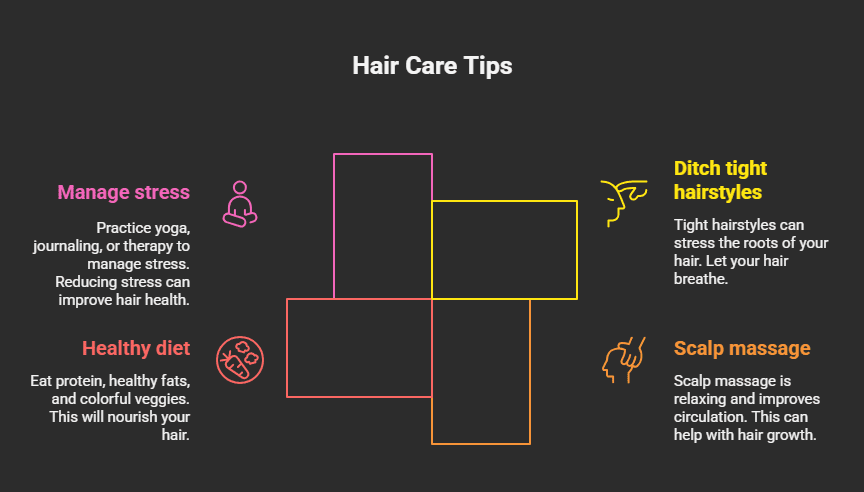
    Hair Care Tips

    Your daily habits impact your follicles more than you think.

    • Ditch tight hairstyles – they stress the roots. Let it breathe.
    • Scalp massage – weirdly relaxing and improves circulation.
    • Eat like you love your hair – protein, healthy fats, colorful veggies.
    • Manage stress – yoga, journaling, therapy… whatever works for you.

    Tiny changes, but over time? They matter. A lot.

    The Myth Busting Moment

    Let’s kill a few myths, shall we?

    • “Wearing hats causes baldness.” Nope.
    • “Shaving makes hair grow back thicker.” Total nonsense.
    • “Only old people go bald.” Not even close, early 20s cases are super common.
    • “It’s just cosmetic.” Tell that to someone who’s been avoiding mirrors for months.

    So don’t let these lies mess with your head (or your healing).

    You’re Not Alone, And You’re Not Powerless

    This journey? It’s tough. Frustrating. Sometimes even humiliating. But there’s hope.

    Modern science, new treatments, and support communities are changing the game. Whether you choose meds, laser caps, wigs, or just radical self-acceptance, there’s no wrong way to deal with hair loss.

    You do what makes you feel like you again.

    And hey, if no one’s told you this today: you’re not defined by your hairline. You’re still strong. Still beautiful. Still you.

    Even if your strands have other plans.

    One Last Thought

    It’s okay to grieve. To cry over the brush. To feel the sting when someone says, “You’re losing hair.” But don’t let it break you.

    Let it rebuild you, wiser, kinder, more resilient. Because healing doesn’t always mean getting every strand back. Sometimes, it means learning to love the reflection that’s changing… and owning it anyway.

    Now go, flip that part, toss on that cap, or schedule that consultation. Whatever you do, just don’t give up.

  • When to See a Doctor About Hair Loss: Recognizing Signs of Alopecia 

    When to See a Doctor About Hair Loss: Recognizing Signs of Alopecia 

    Losing hair. Annoying. Even scary. But believe it or not, it’s normal to lose a few hairs every day. The kicker? When that little bit of hair every day turns into a full-blown cascade, you should pay attention. Who doesn’t want a full head of healthy hair? But for millions of people around the world, it’s not about looks; it’s about health. Alopecia. A word that means something and gives you hope (yes, hope). Being able to tell when you need to see a doctor can make a big difference, like seeing a small crack before the dam breaks..

    What Is Alopecia?

    Alopecia sounds like a fancy Greek thesis topic. But it’s simpler: it’s an umbrella term for hair loss. Sometimes patchy. Other times diffuse. (And yes, you’ll love this bit of trivia: “alopecia” literally means “fox mange,” since foxes can get hair loss too.)

    Common Types of Alopecia

    • Alopecia Areata: Sudden, patchy bald spots. Out-of-nowhere clumps of hair on your pillow.
    • Androgenetic Alopecia: Also called male- or female-pattern baldness. Gradual thinning at the temples or crown.
    • Alopecia Totalis: All head hair, gone.
    • Alopecia Universalis: Every hair on your body, eyebrows, eyelashes, everything, disappears.
    • Traction Alopecia: Caused by tight ponytails or braids (so, worth thinking twice about that daily topknot).

    Normal Hair Loss vs. Red Flags

    Funny thing is, we shed around 50–100 hairs a day. No biggie. Your scalp has about 100,000 follicles, losing some is like a city’s population ebb and flow. But when does that trickle become a flood? Here’s where we draw the line.

    Normal Shedding

    • Daily Brushes & Showers: A few strands in the drain.
    • Seasonal Changes: More in spring and autumn. Nature’s reset button.
    • Postpartum Loss: Hormones rebounding after pregnancy—hair says “see ya” in

    Warning Signs

    • Sudden, Noticeable Thinning: You run your fingers through your hair and feel more scalp than usual.
    • Patchy Bald Spots: Circular or irregular patches on the scalp (sometimes itchy, sometimes tingling).
    • Receding Hairline: More forehead showing in the mirror? A classic sign.
    • Excessive Hair in Brush/Comb: More than the usual sprinkle.
    • Hair Falling Out in Clumps: Not a few here and there, but fistfuls.
    • Changes in Nails: Pitting, ridges, brittleness (odd connection, yes, it happens with alopecia areata).
    • Scalp Irritation: Inflammation, redness, scaling. Could hint at an underlying condition.
    • Family History: If your mom, dad, or siblings have pattern baldness (or an autoimmune history), you might be predisposed.

    Why Early Diagnosis Matters

    Here’s the lowdown: Catching alopecia early can open doors. Doors to treatments that might slow progression, or, in some cases, reverse it. Waiting? You risk deeper hairline retreats. Or even total loss of certain patches. And let’s not forget the emotional toll: anxiety, low self-esteem, that sinking “what if” feeling. See a doc sooner rather than later.

    Hidden Culprits

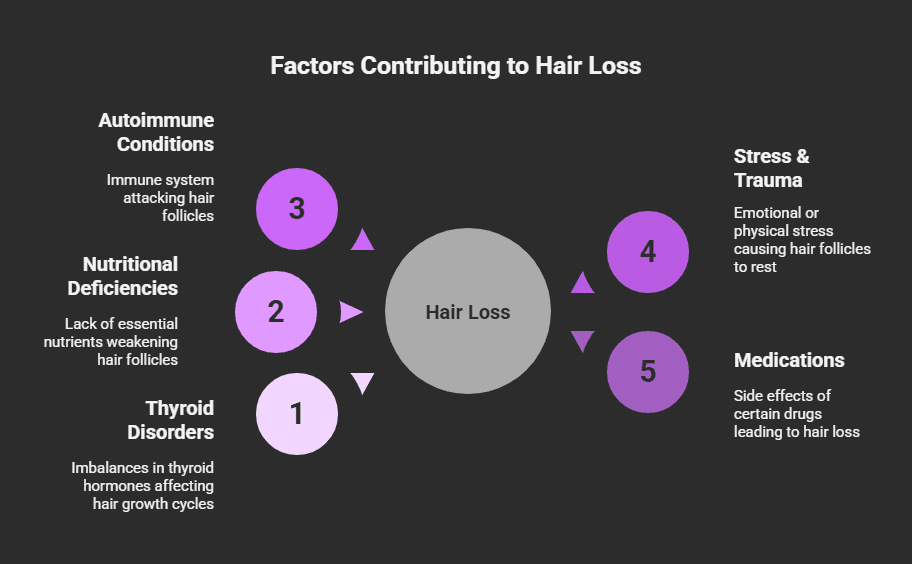
    Factors Contributing to Hair Loss

    Sometimes, hair loss comes hand-in-hand with other health issues:

    • Thyroid Disorders: Hypo- or hyperthyroidism can throw hair-growth cycles out of whack.
    • Nutritional Deficiencies: Iron, vitamin D, biotin, and vitamin B12. If you’re low, your follicles suffer.
    • Autoimmune Conditions: Alopecia areata itself is autoimmune. Other conditions like lupus fit the bill, too.
    • Stress & Trauma: Physical or emotional stress can shock follicles into a resting phase, telogen effluvium, to drop another fancy term.
    • Medications: Chemotherapy? Blood thinners? Some drugs list hair loss as a side effect; read those labels.

    When to Book That Appointment

    Okay, you’ve spotted some red flags. Now what? Here’s a guide to knowing exactly when you should dial your doctor’s office, or click “book now” on that telehealth app.

    1. Patches That Won’t Quit

    By the time you notice, those round spots have already scooched across a few inches. If they don’t shrink in a month? Time to call.

    2. Clumps in Your Hand

    A few hairs are expected. But if your palm looks like a mini haystack, schedule that appointment. No ifs, ands, or buts.

    3. Sudden, Total Shedding

    You wake up, run a brush, and whoosh, drastic. That’s not normal, friend. Seek help, pronto.

    4. Associated Symptoms

    Itching, burning, scalp redness, nail changes? These often accompany alopecia areata. And if you’re seeing them, see a professional.

    5. Emotional Toll

    Under duress? Feeling down, anxious, and avoiding mirrors? Hair loss can chip away at mental well-being. You deserve support, medical and emotional.

    What to Expect at Your Doctor’s Visit

    Walking into that clinic, palms sweaty. But here’s the reassuring part: most dermatologists are hair-loss pros. They’ve seen it all. Here’s a peek behind the curtain.

    Treatment Options: From A to Z

    There isn’t a one-size-fits-all. Treatments pivot on your type of alopecia, its severity, and your personal preferences. Let’s spill the beans on some common ones.

    Topical Therapies

    • Minoxidil (Rogaine): Over-the-counter. Applied twice daily. Stimulates follicles (with a side of itching for some).
    • Corticosteroid Creams/Gels: Anti-inflammatories to quiet autoimmune attacks.
    • Anthralin: A tar-like paste that tweaks immune response, messy, but sometimes effective.

    Oral Medications

    • Corticosteroids (Prednisone): Systemic, for more severe cases. Watch out for side effects: weight gain, mood swings.
    • Immunosuppressants: Methotrexate, cyclosporine, reserved for stubborn alopecia areata.
    • Finasteride & Spironolactone: For androgenetic alopecia. (Women usually get spironolactone; men get finasteride.)

    Procedural Treatments

    • Corticosteroid Injections: Directly into bald patches, ouch, but might work like a charm.
    • Platelet-Rich Plasma (PRP): Your own blood, spun down, injected back into the scalp. Science-y, but early studies show promise.
    • Hair Transplant Surgery: For pattern baldness. Takes hair from one part of your head, plants it where it’s sparse. Expensive. Invasive. Yet lasting.

    Alternative & Complementary Approaches

    • Laser Therapy: Low-level lasers to stimulate follicles.
    • Acupuncture & Traditional Medicine: Some swear by it (look, if it relaxes you, it can’t hurt, right?).
    • Nutritional Supplements: Biotin, iron, and vitamin D, but only if tests show deficiencies.

    Self-Care & Lifestyle Tweaks

    Who says medical visits are the only answer? Small daily habits add up.

    Gentle Hair Care

    • Soft Brushes: No wire bristles.
    • Loose Styles: Ditch the daily topknots.
    • Cooler Styling Tools: Lower heat settings preserve hair integrity.

    Diet & Nutrition

    • Protein-Rich Foods: Eggs, fish, legumes. Hair is mostly protein.
    • Iron Sources: Spinach, lean red meat, lentils (especially if you’re vegetarian).
    • Omega-3s: Walnuts, flaxseeds, fatty fish. Nourish follicles from the inside out.

    Stress Management

    • Mindfulness & Meditation: Even five minutes a day can help.
    • Exercise: Boosts circulation, to your scalp included.
    • Support Groups: Online communities, safe havens to share fears, tips, triumphs.

    Questions to Ask Your Doctor

    Walking out with a head full of questions? Jot these down:

    1. “What type of alopecia do I have?”
    2. “Is my condition temporary or permanent?”
    3. “Which treatments do you recommend first?”
    4. “What are the risks and side effects?”
    5. “How long before I see results?”
    6. “Are there lifestyle changes I should make?”
    7. “Can we monitor progress with photos or measurements?”

    Emotional Well-Being: The Hidden Battle

    Hair loss isn’t just superficial. It hits confidence, self-image, sometimes harder than the follicles themselves.

    Understanding the Impact

    • Self-Esteem Dips: Feeling “less than.”
    • Social Anxiety: Avoiding gatherings.
    • Depression & Anxiety: When every mirror becomes an enemy.

    Building Resilience

    • Therapy: Cognitive behavioral therapy (CBT) can reframe negative thoughts.
    • Mindset Shifts: Embrace what you can control, your attitude, and self-care routines.
    • Community: Alopecia support groups (in-person or virtual) can remind you: you’re far from alone.

    Real Stories, Real Hope

    By the way, stories matter. Like Sarah’s. Diagnosed at 25 with alopecia areata, she tried creams, injections, and still saw bald spots. But after joining a support group, she found a dermatologist who recommended PRP. Six months later? New hair growth in places she thought were gone forever. Curious? That’s hope. And hope can be catalytic.

    Key Takeaways

    • Shedding vs. Alarm: A few hairs, normal. Clumps and patches, get them checked.
    • Early Bird Advantage: Catching alopecia early broadens treatment options.
    • Holistic Approach: Meds, procedures, lifestyle, all play a part.
    • Emotional Health: Equally crucial. Seek support, share your journey.

    Conclusion

    Losing hair is more than just what you see in the mirror; it’s something you go through. One that can make you doubt yourself, make you anxious, and leave you unsure of what to do next. But here’s the good news: you don’t have to let fate decide what happens to you. Knowing when to see a doctor, asking the right questions, and looking into treatments (both medical and self-care) can change the story. Not quite perfect. Enjoy the journey, celebrate the little victories, and remember that help is only a phone call away. Try it out. Your future self, who may have a fuller hairline, will be grateful.