Tag: Stress

  • Why Am I So Stressed? 12 Surprising Reasons Why

    Why Am I So Stressed? 12 Surprising Reasons Why

    Stress is everywhere now, to be honest. Even after eight hours of sleep, you wake up tired. Your shoulders are always tense. And that feeling that something is always wrong? It won’t go away.

    But what if the things that are really causing you stress aren’t what you think they are?

    Of course, we all know about deadlines at work and problems in our relationships. Those are clear. We don’t always notice the sneaky, hidden things that add to our stress without us even realizing it.

    The Stress Epidemic No One Knows About

    Let’s be honest: Americans are more stressed out than ever before. Recent studies show that almost 75% of adults have had symptoms of stress in the last month. That’s three out of four people who are out and about feeling stressed, anxious, or just not right.

    Stress isn’t always a big deal, though. It doesn’t always show up with panic attacks or trouble sleeping. It sometimes whispers. It can even look like something else completely.

    Why Stressors That Are Hidden Are So Bad

    Here’s why these sneaky stress triggers are so bad: they add up. Picture your stress tolerance as a bucket. You can see the big rocks going into the bucket, like job stress and money worries. But what about these hidden ones? They’re like sand, slowly filling in all the gaps until one little extra stress makes everything overflow.

    12 Hidden Stress Triggers and How to Deal With Them

    Too Much Digital Stuff Without Limits

    Your phone vibrates. Your laptop makes a sound. Your smartwatch shakes.

    Does this sound familiar? People check their phones an average of 96 times a day, which is once every ten minutes when they’re awake. But here’s the kicker: we don’t even know we’re doing it anymore.

    Researchers call this “continuous partial attention” because of how connected we are all the time. Your brain never really focuses on one thing because it’s always waiting for the next notification. What happened? A low-level stress response that never quite goes away.

    What you can do:

    • Make sure you have certain hours when you don’t use your phone
    • Start small, like only during meals or the first hour after you wake up
    • Your nervous system needs real breaks from digital stimulation

    Not Getting Enough Sleep Even Though You Have Enough Hours

    You could be in bed for seven to eight hours, but are you really getting a good night’s sleep? Not getting enough good sleep can be a big stressor that you don’t even know about.

    Things like the temperature in your room, the amount of light you get, or even that glass of wine before bed can break up your sleep cycles. Your body makes more cortisol, the stress hormone, when you don’t get enough deep sleep. This makes the cycle worse.

    Things to look out for:

    • Waking up feeling tired
    • Needing more than one alarm
    • Feeling sleepy all morning

    Solutions:

    • Keep your bedroom between 65 and 68 degrees Fahrenheit
    • Use blackout curtains
    • Stay away from screens for at least an hour before bed
    • That wine you had that night might help you fall asleep, but it will definitely make your sleep worse later on

    High Standards That Are Really Perfectionism

    This is a tough one because our culture values perfectionism. We say “having high standards” or “paying attention to detail.”

    But being a perfectionist is not the same as being excellent. Excellence means, “I want to do this right.” Perfectionism says, “I’m a failure if I don’t do this perfectly.” That constant pressure from within? It’s tiring.

    Perfectionism makes you stressed out by:

    • Putting things off (because starting means risking not being perfect)
    • Overthinking decisions
    • Always feeling like you haven’t done enough
    • Being afraid of making mistakes

    The fix: For low-stakes situations, think “good enough.” You don’t have to write a book in that email to your coworker. If the content is good, that presentation slide doesn’t have to be perfect in every way.

    Long-Term Dehydration

    This may sound silly, but please bear with me. Even losing 2% of your body’s water can raise cortisol levels and make you feel more stressed.

    A lot of the time, we don’t even know we’re a little dehydrated. We drink more coffee than water, we don’t change how much we eat when we exercise or when it’s hot, and we think we’re hungry when we’re thirsty.

    Quick check: Check the color of your pee. You need more water if it’s darker than pale yellow.

    Easy fix: Put a water bottle on your desk where you can see it. Sometimes it’s better to have a simple reminder than a complicated tracking app.

    The Comparison Trap of Social Media

    Social media makes a kind of stress that wasn’t there even 20 years ago. It happens automatically, without you even thinking about it. It’s called “compare and despair.”

    When you look at carefully chosen highlight reels of vacation photos, job announcements, and perfect family moments, your brain doesn’t realize that these are edited pictures. It takes them as real and sees your own life as lacking in comparison.

    The stress response kicks in: “Why isn’t my life like that?” What am I doing that is wrong?

    The cure:

    • Choose your feeds carefully
    • Stop following accounts that always make you feel bad about yourself
    • Follow people who inspire you and don’t make you feel bad about yourself

    Messy Living Areas

    You might not know how much your surroundings affect your mental health. Your brain has to constantly process and filter out the visual chaos that clutter creates.

    A study from UCLA found that people who lived in messy homes had higher levels of cortisol all day long. The mess doesn’t have to be big; even a stack of papers on your desk or clothes hanging over a chair can add to your stress.

    Why it matters: Your brain needs things to be in order and predictable. When your physical space is messy, it gives you a subtle but constant sense of being out of control.

    Begin small: Pick one surface, like your kitchen counter or bedside table, and keep it completely clear. Pay attention to how it feels to have one area in your space that is perfectly organized.

    Tired of Making Decisions

    You make thousands of small choices every day. What to wear, what to eat, which way to go, and how to reply to that text message. Every choice you make, no matter how small, takes mental energy.

    By the afternoon, you won’t be able to make any more decisions. This is when you spend too much time choosing what to watch on Netflix or staring at the fridge for ten minutes without being able to decide what to eat.

    When you have decision fatigue, your brain is working too hard on things that shouldn’t be hard, which makes you stressed.

    Strategic solutions:

    • Make routines that get rid of small choices (like having the same breakfast every day or laying out your clothes the night before)
    • Group together similar choices (like planning meals on Sundays and picking out clothes for the whole week)
    • Give yourself a time limit for low-impact choices (no more than two minutes to decide what to watch)

    Problems with Other People’s Boundaries

    This is a big one, and people often don’t see it because setting limits can seem “mean” or “selfish.”

    Boundary problems can cause stress by:

    • Making other people’s problems your own
    • Saying yes when you mean no
    • Feeling responsible for how other people feel
    • Not being clear about what you need

    The friend who always calls to complain but never listens to what you have to say. The family member who shows up without warning. The coworker who often asks you to do their work for them.

    Every time you cross a line, you add a little stress to your system.

    Practice this: Begin with situations that don’t matter much. “I can’t talk right now, but we can talk this weekend.” Or, “I can’t help with that project right now.” Keep in mind that saying no doesn’t mean the world ends.

    Financial Stress, Even When You Have Money

    Not having enough money isn’t the only thing that causes financial stress. It can also come from:

    • Not knowing where your money goes
    • Not planning your finances
    • Keeping money secrets from your partner
    • Comparing your financial situation to others
    • Being afraid of not having “enough” (even when your needs are met)

    More money isn’t always the answer; more clarity is. A lot of people feel less stressed when they make a budget, even if it shows that they have less money to spend than they thought. It’s better to know than to guess and worry.

    Multitasking All the Time

    People have told us that multitasking is a good way to get things done, but studies show that it is actually stressful and counterproductive.

    Your brain doesn’t really do two things at the same time when you multitask. It quickly switches between tasks, and each switch takes mental energy. What happened? You feel frazzled, and everything takes longer.

    Signs that you are a chronic multitasker:

    • Reading emails while on the phone
    • Eating while working
    • Trying to focus on other things while listening to podcasts
    • Always having a lot of browser tabs open

    Give this a shot: Choose one thing to do and do it for 25 minutes. There are no exceptions. Pay attention to how different it feels to give something your full attention.

    No Routine That Matters

    People do best when their schedules are predictable, but a lot of us have schedules that are always changing. Your brain has to work harder to get through each day if you don’t have regular routines.

    This doesn’t mean you have to plan out every minute of your life. Having a few regular things to do, like waking up at the same time every day, working out at the same time every day, or preparing meals once a week, can help you deal with daily stress.

    Why routines are important: They make things easier for your brain, which is what psychologists call “cognitive ease.” When you do things automatically during the day, you have more mental energy for things that are important.

    Feelings That Haven’t Been Processed

    This could be the most important hidden stressor on the list. A lot of us learned to push through hard feelings instead of really feeling and dealing with them.

    Anger that is not expressed turns into tension. Sadness that isn’t dealt with turns into depression. Panic sets in when you don’t deal with your anxiety.

    Unprocessed feelings don’t go away; they build up in your body as stress.

    Things to look for if your feelings need help:

    • Physical problems that don’t have a clear cause, like headaches, stomach problems, and muscle tension
    • Not feeling anything or being emotionally “numb”
    • Getting too upset over small things
    • Trouble sleeping because of racing thoughts

    What helps: Let yourself feel things all the way through, even if it’s hard. You might need to cry, talk to a therapist, or just admit that you’re angry instead of acting like everything’s fine.

    The Compound Effect: How Stressors You Don’t Know About Build Up

    These hidden stressors are especially dangerous because they don’t work alone. Researchers call the cumulative wear and tear on your body from chronic stress “allostatic load.” This is what happens when they stack on top of each other.

    You wake up thirsty (stressor #1), check your phone right away (stressor #2), rush around because you didn’t lay out your clothes the night before (stressor #3), and eat breakfast while scrolling through social media (stressors #4 and #5). And you haven’t even left your house yet.

    By the time “real” stressors like traffic, work deadlines, and tough conversations come up, your stress bucket is already half full.

    Making Your Own Stress Audit

    So how do you find out what hidden stressors are bothering you? Give this simple task a try:

    Keep a short stress journal for a week. Not a full diary, just short notes about when you feel stressed, overwhelmed, or “off.”

    Note:

    • What time of day did it happen
    • What were you doing
    • How were you feeling physically?
    • What thoughts were going through your mind

    Find patterns. Do you always feel nervous after looking at social media? Do you feel like you’re all over the place on days when you don’t eat breakfast? When decision fatigue sets in in the afternoon, does your stress level go up?

    The 80/20 Rule for Dealing with Stress

    You might be surprised to learn this, but you don’t have to fix everything at once. In fact, trying to deal with all of your hidden stressors at once will probably make things worse.

    Use the 80/20 rule instead. Find the two or three hidden stressors that are affecting your daily life the most and deal with those first.

    For you, it could be better sleep and digital boundaries. For someone else, it could be getting rid of things and planning meals. The most important thing is to choose what will give you the most value for your time and effort.

    When to Get Professional Help

    These hidden stressors are common and normal, but sometimes stress gets too much for you to handle on your own. If you think you might need to talk to a professional:

    • Your stress is getting in the way of work, relationships, or daily tasks
    • You’re using alcohol, food, or other drugs to cope
    • You’re having physical symptoms that won’t go away (headaches, digestive issues, sleep problems)
    • You feel hopeless or like nothing will help
    • You’re thinking about hurting yourself

    It’s okay to ask for help. An outside view can sometimes help you see stress patterns that you can’t see from the inside.

    Making Your Life Strong Against Stress

    It’s not about making your life perfect and stress-free when you manage hidden stressors. That’s not possible, and to be honest, it would probably be boring. Instead, it’s about building resilience, or your ability to deal with stress when it comes up.

    It’s like being physically fit. You don’t work out to never get tired. You work out so that your body can handle climbing stairs or carrying groceries without getting tired.

    Stress resilience works in the same way. You’re not getting rid of all the stress in your life when you deal with these hidden stressors. You’re making room so that when real problems come up – and they will – you’ll be able to deal with them without feeling completely overwhelmed.

    When you feel stressed for no reason, look at this list again. The things that stress us out the most are sometimes the ones we don’t see coming. But once you know what to look for, you can start making the small changes that will make your life much calmer and easier to handle.

    Which hidden stressor hit home the most for you? Which one will you work on first?
    When you feel stressed for no reason, look at this list again. The things that stress us out the most are sometimes the ones we don’t see coming. But once you know what to look for, you can start making the small changes that will make your life much calmer and easier to handle.

    Which hidden stressor hit home the most for you? Which one will you work on first?

  • The Best Stress Management: Scientific Approaches Unpack What Actually Works

    The Best Stress Management: Scientific Approaches Unpack What Actually Works

    Isn’t the modern world a constant source of stress? Financial concerns, relationship problems, and work deadlines. Numerous wellness fads promise immediate relief, but scientific research shows which approaches actually produce long-lasting effects.

    The Science of Stress Reduction

    Methods Based on Evidence That Truly Work

    Studies consistently show that mindfulness-based interventions enhance emotional regulation and successfully lower cortisol levels. Participants who used evidence-based practices demonstrated statistically significant improvements in both psychological and physiological markers, according to a thorough 2024 analysis of stress management interventions.

    One of the most proven methods is Mindfulness-Based Stress Reduction. More than 3,000 participants in several randomized controlled trials demonstrated that MBSR has moderate to large effect sizes in lowering depression and anxiety. These advantages last for at least six months.

    The intriguing aspect of mindfulness? In fact, it alters the structure of your brain. Research shows:

    • A decrease in amygdala reactivity – your brain’s stress warning system
    • An increase in gray matter in regions linked to emotional regulation

    Progressive Muscle Relaxation: The Underappreciated Hero

    You might be surprised to learn that progressive muscle relaxation routinely works better than a lot of popular methods. When compared to control groups, a head-to-head comparison study revealed that PMR produced immediate physiological benefits with linear trends toward relaxation.

    Muscle groups are systematically tensed and released as part of the technique. Sounds easy, doesn’t it? However, the outcomes are significant. Both measurable physiological changes and psychological relaxation states significantly improved for the participants.

    Deep Breathing: Not Just Hot Air

    The parasympathetic nervous system, which is your body’s natural “rest and digest” response, is activated by deep breathing exercises. There is especially compelling evidence that the 4-7-8 technique reduces stress reactivity:

    • Breathe in for four counts
    • Hold for seven
    • Exhale for eight

    The speed at which this works is amazing. Attention span can be protected and improved with just 12 minutes of practice per day for five days. Deep breathing results in quantifiable physiological relaxation, according to studies that use electrodermal activity and heart rate monitoring.

    Common Approaches Under Scientific Examination

    Yoga: Traditional Practice, Contemporary Approval

    Yoga creates the ideal environment for stress relief by fusing physical postures, mindful breathing, and awareness. A 2025 bibliometric analysis showed that yoga’s benefits for treating stress-related illnesses are becoming more widely acknowledged, including:

    • Anxiety management
    • Depression relief
    • Burnout prevention

    The study goes into detail regarding the physiological advantages of yoga. Yoga has been shown to improve cardiovascular health in studies that track blood pressure and heart rate variability. According to one comparative study, yoga performed the best in terms of classification when it came to differentiating between states of stress and relaxation.

    Nature-Based Stress Reduction: The Ignored Answer

    Time spent in nature regularly improves mood and well-being while lowering stress and anxiety. Even virtual reality simulations of nature can significantly reduce stress. Exposure to nature is currently advised by the American Heart Association as a valid stress-reduction technique.

    Sound Science in Music Therapy

    Playing or listening to music can help:

    • Divert the mind
    • Ease tense muscles
    • Lower stress hormones

    Though more research is required to establish optimal protocols, the physiological mechanisms are well-documented.

    Popular Methods: Where’s the Proof?

    Digital Solutions and Apps: Practicality vs. Efficiency

    Compared to conventional guided mindfulness practices, mobile mindfulness apps show promise but have lower success rates. The advantages of planned, in-person interventions might not be replaced by digital solutions, despite their convenience.

    Depending on the algorithm, the classification accuracy for stress reduction through mobile apps varied from 51 to 94%, whereas traditional yoga had an accuracy of 72 to 97%. This implies that although apps can be useful, you shouldn’t rely solely on them to manage your stress.

    Other Methods: Contradictory Outcomes

    Although the effects of aromatherapy, especially lavender, on stress vary greatly from study to study, there are some benefits. There is currently little data supporting acupuncture’s ability to manage stress in general, but it does show some modest effects on blood pressure in hypertensive patients.

    Although the effectiveness of guided imagery techniques varies greatly from person to person, they do produce quantifiable relaxation benefits. The method is most effective when used in conjunction with other evidence-based strategies.

    Advice from Medical Experts

    The Best Methods Are Integrated

    Instead of depending solely on one intervention, healthcare providers are increasingly advocating for the combination of several evidence-based techniques. The most successful programs incorporate:

    • Relaxation methods
    • Exercise
    • Mindfulness
    • All-encompassing stress management regimens

    Incorporating stress management training into routine rehabilitation led to significantly higher stress reduction and, importantly, lower rates of adverse cardiovascular events over the years, according to a seminal study of 151 cardiac patients. This illustrates that achieving quantifiable health results from stress management is more important than simply feeling better.

    Consistency and Duration Are Important

    Conventional MBSR programs consist of eight weeks of:

    • Body scanning
    • Sitting meditation
    • Gentle yoga

    Shorter interventions might work for some people, according to research, but longer programs usually yield more long-lasting effects.

    It seems that daily practice is necessary. Research continuously demonstrates that individuals who practice regularly reap more advantages than those who practice infrequently.

    Physiological Mechanisms: The Reasons These Techniques Are Effective

    The System of Stress Reaction

    Prolonged stress raises cortisol and triggers the sympathetic nervous system, which:

    • Impairs immune function
    • Raises blood pressure
    • Quickens the heartbeat

    In order to counteract these negative effects, evidence-based stress management techniques activate the parasympathetic nervous system.

    Effective methods result in quantifiable changes in blood pressure, stress hormone levels, and heart rate variability, according to studies employing cutting-edge monitoring equipment. There is observable physiological improvement in addition to psychological benefits.

    Long-Term Changes and Neuroplasticity

    The brain is actually rewired by regular application of evidence-based practices. Studies using neuroimaging reveal:

    • Elevated activity in the prefrontal and anterior cingulate cortices – critical regions for controlling emotions
    • Your brain’s stress center, the amygdala, gradually becomes less reactive

    Formulating Your Plan for Evidence-Based Stress Management

    Begin With Tested Bases

    Start with the methods that have the most scientific backing:

    • Progressive muscle relaxation
    • Mindfulness meditation
    • Consistent exercise

    These are the cornerstones of efficient stress reduction.

    Instead of attempting several methods at once, think about beginning with just 10–20 minutes a day of one technique. When it comes to stress management, consistency is more important than intensity.

    Track Your Development

    When feasible, keep track of both objective indicators and subjective metrics, such as your feelings. Concrete indicators of your progress include:

    • Overall energy levels
    • Blood pressure (if you have any concerns)
    • Quality of your sleep

    When to Get Expert Assistance

    Even though self-management of stress can be very successful, there are some circumstances in which professional assistance is necessary. Clinical assistance may be necessary for:

    • Persistent stress
    • Anxiety that interferes with day-to-day functioning
    • Depression that affects daily activities

    The evidence is unmistakable: scientific research identifies the strategies that actually work, despite popular culture’s many claims of stress relief. Regular physical activity, progressive muscle relaxation, mindfulness-based techniques, and systematic breathing exercises have all been shown to have quantifiable positive effects on mental and physical health.

    Selecting evidence-based techniques that work for your lifestyle and using them regularly is more important than trying to find the “perfect” method. Science, not fads, should be the foundation of your stress management toolkit.

  • Quick Ways to Relieve Stress for Busy People in 2025

    Quick Ways to Relieve Stress for Busy People in 2025

    Life today doesn’t stop for stress relief. When deadlines pile up, meetings run late, and personal obligations need your attention, it can be hard to find time for traditional self-care. But managing stress doesn’t mean spending hours meditating or going to expensive wellness retreats. It means finding ways to fit it into your busy life.

    The Need for Stress Management Right Now

    In 2025, stress at work is higher than it has ever been. Almost 40% of workers have cried at work in the last month, and 66% of workers are burned out at work, which is the highest number ever. The youngest generation has some unique problems. Young adults aged 18 to 24 are the most likely to need time off for mental health problems caused by stress.

    The effects go beyond just making you feel bad. Long-term stress can lead to high blood pressure, heart disease, and a weakened immune system. Every year, depression and anxiety cost the world $1 trillion in lost productivity and 12 billion working days. This isn’t just a problem for you; it’s a public health and economic crisis that needs to be dealt with right away.

    Quick Stress Relief Methods That Work

    Studies show over and over again that short interventions can lower stress levels. More than 200 research trials show that mindfulness-based methods work to lower stress, even in short sessions. Guided imagery, deep breathing, and progressive muscle relaxation all make people feel much more relaxed in just 20 minutes.

    Breathing Techniques for Combat

    Box Breathing (2 to 4 Minutes)

    Military personnel use this method in high-stress situations. It involves breathing in a certain way that triggers the body’s relaxation response. You have to breathe in for four counts, hold it for four counts, breathe out for four counts, and hold it again for four counts. Even just two minutes of box breathing can lower cortisol levels and help you control your emotions better.

    The Breathing Space Exercise (1 Minute)

    This very fast method only takes a minute and can be done anywhere. Push all other thoughts aside and concentrate only on your breath. Be aware of how it feels to breathe in and out, and bring your attention back to your breath whenever your mind starts to wander. This exercise helps you feel better right away if your mind is racing or you feel overwhelmed.

    Small Mindfulness Exercises

    The STOP Method (2 Minutes)

    STOP means:

    • Stop what you’re doing
    • Take a breath
    • Observe your surroundings and internal state
    • Proceed with purpose

    This method breaks the cycle of stress and clears your mind without needing special places or tools.

    Quick Body Scan (30 seconds to 2 minutes)

    Pick a part of your body and pay attention to it as if you were looking at it through a microscope. Pay attention to how things feel, like temperature, tension, or pressure, without trying to change them. Move this focused attention around your body slowly and see what you find.

    The Grounding Technique 5-4-3-2-1

    This method, which is based on the senses, helps keep your attention in the present. List:

    • Five things you can see
    • Four things you can touch
    • Three things you can hear
    • Two things you can smell
    • One thing you can taste

    This exercise is especially helpful when you feel like you can’t control your anxiety or stress.

    Quick Relief Through Movement

    Breaks to Walk and Talk (5–10 Minutes)

    Do some light exercise while talking to someone or thinking quietly. Choose a safe way to get around in or out of your office. To fully disconnect, walk at a comfortable pace and don’t talk about work. Moving around releases endorphins, which are the body’s natural stress relievers.

    Stretching at Your Desk (2–3 Minutes)

    Stretching can help you get rid of physical tension that builds up during busy days at work. Focus on:

    • Neck rolls
    • Shoulder shrugs
    • Gentle twists of the spine

    You can do these moves in professional clothes without getting too much attention.

    Tips for Digital Wellness

    Breaks from Screens and Time in Nature (5–15 minutes)

    Taking short breaks from screens helps your eyes and mind relax. Being outside for even 10 to 15 minutes lowers cortisol levels and makes you feel better naturally. If you can’t go outside, looking out a window or at pictures of nature can give you similar benefits.

    Managing Notifications

    Digital interruptions that happen all the time make stress levels go up a lot. Turning off phone notifications for an hour each day gives you time to focus on your work and clear your mind. This small change can make you feel much less like you’re always “on call.”

    Longer Techniques Based on Evidence (15–30 minutes)

    While quick techniques give you quick relief, longer ones give you deeper restoration for those who can make time for them.

    Relaxing Your Muscles Progressively (15–20 minutes)

    This method involves systematically tightening and loosening different muscle groups. Studies show that PMR greatly boosts both mental and physical relaxation. It’s especially good at letting go of built-up physical tension from long, stressful workdays.

    Parts of Mindfulness-Based Stress Reduction (MBSR)

    You need eight weeks of training to do MBSR the traditional way, but you can practice each part on its own. While lying down, the “body scan” technique guides your attention through different parts of your body without judging them. This helps you be more aware of and accept your body’s feelings.

    Applications for the Workplace

    Rituals for Changing Meetings (1–2 Minutes)

    Instead of jumping right into the next task, use the time between meetings to do short reset exercises. Options include:

    • Take three deep breaths
    • Think about what you want to accomplish in the next meeting
    • Do a quick body scan

    Mindful Task Changes

    Take a 30-second break before switching between projects to mentally “close” the last one and “open” the next one. This stops the mental mess that happens when tasks mix together without clear lines.

    Making the Most of Your Lunch Break

    If you can’t take a full lunch break, even eating the first few bites mindfully, paying attention to taste, texture, and temperature, can help you clear your mind.

    Creating Habits That Help You Deal with Stress in the Long Run

    Start Small and Slowly Build Up

    Start with just one method that doesn’t take more than two minutes. Duration doesn’t matter as much as consistency. Once a short practice becomes second nature, you can slowly add other techniques or make the practice longer.

    Link to Routines That Already Exist

    Add stress-relieving activities to things you already do:

    • While your coffee brews, do breathing exercises
    • While you wait for the elevator, do a body scan
    • Use your commute time to do mindfulness exercises

    Keep an Eye on What Works

    Pay attention to which methods help you the most with your own stress patterns. Some people do better with movement-based methods, while others like breathing or mindfulness techniques better.

    When to Get More Help

    Quick ways to relieve stress work well for dealing with everyday stress, but if you have long-term stress, anxiety, or signs of burnout, you may need professional help. Warning signs include:

    • Trouble sleeping
    • Trouble remembering things
    • Being more irritable
    • Feeling tense in your body
    • Feeling like you have too many choices to make every day

    Combining professional therapy with daily stress-relieving activities like mindfulness, exercise, and setting healthy boundaries greatly improves mental health and resilience. Mental health professionals can help you find ways to deal with chronic stress that are right for you and help you deal with the things that are causing it.

    In 2025, stress management needs to be based on real-life situations and use methods that can fit into real-life schedules. These quick tips won’t get rid of all the stress in your life, but they will help you stay mentally clear, emotionally stable, and physically healthy even when things are tough. It’s not about finding more time; it’s about being more mindful of the time you already have.

  • A Complete Guide to Dealing with Stress and Anxiety in 2025

    A Complete Guide to Dealing with Stress and Anxiety in 2025

    Stress and anxiety are now common problems for millions of people in today’s hyper-connected world. The pace isn’t slowing down; if anything, it’s getting faster. But here’s the thing: it doesn’t have to be impossible to deal with these problems.

    You’re not the only one who is having trouble with work deadlines, family obligations, or just trying to keep up with the demands of modern life. And even more importantly, there are proven methods that work.

    How to Tell the Difference Between Stress and Anxiety in 2025

    Let’s get started with the basics. Even though people often use these words interchangeably, they are very different.

    Stress is how your body reacts to outside pressures, like deadlines, problems in relationships, or money worries. It usually goes away once the stressor is dealt with and is usually linked to certain situations.

    Anxiety, on the other hand, is more like that annoying voice in your head that won’t go away. It can last even when there isn’t an immediate threat, which makes you feel uneasy about what might happen in the future.

    The difference is important because, well, different problems need different answers.

    The Stress Landscape Today

    One thing that makes 2025 so hard is that we’re dealing with stressors that our ancestors couldn’t have imagined. A perfect storm has formed because of:

    • Too much information on social media
    • Too many remote work boundaries
    • Worries about the climate
    • Too much technology

    Our brains haven’t quite gotten used to this yet. They are still wired to deal with the occasional saber-toothed tiger, not the constant news cycles and notifications that go off all the time.

    Stress Relief Techniques That Work Right Away

    You need tools that work quickly when you’re in the middle of a stressful time. Here are some methods that have been shown to work:

    The 4-7-8 Breathing Method

    This isn’t just new-age nonsense; science backs it up. This is how it works:

    • Take a breath through your nose for four counts
    • Count to seven and hold your breath
    • Breathe out through your mouth for eight counts
    • Do it 3 to 4 times

    When you breathe out for a long time, your parasympathetic nervous system kicks in, which tells your body to relax.

    Relaxing Your Muscles in Stages

    Begin with your toes and move up. Hold each muscle group tight for five seconds, then let go. Your body learns what “calm” really feels like by switching between tension and relaxation.

    It’s surprisingly helpful, especially when you think about how much stress you’ve been under without even knowing it.

    The 5-4-3-2-1 Grounding Method

    This method brings you back to the present when your anxiety starts to get out of control:

    • 5 things you can see
    • 4 things you can touch
    • 3 things you can hear
    • 2 things you can smell
    • 1 thing you can taste

    Easy? Yes. Is it working? Yes, for sure.

    Ways to Deal with Anxiety in the Long Term

    Quick fixes are nice, but real change happens when you make habits that last. Use these as the base for managing your anxiety.

    Cognitive-behavioral techniques for everyday life

    You don’t have to go to therapy to use CBT; you can do it on your own. The main point? Your thoughts, feelings, and actions all have an effect on each other.

    Challenge Catastrophic Thinking

    That voice in your head that says “everything will go wrong”? Ask it. What proof backs up this idea? What proof goes against it? Most of the time, the worst things that could happen are just that: scenarios, not real life.

    The Method of Keeping a Thought Record

    Write down anxious thoughts when you notice them. Include:

    • The situation
    • How you feel (1-10 scale)
    • The exact thoughts
    • Proof for and against these ideas
    • A point of view that is more balanced

    At first, it feels strange, but this practice can actually change the way you think over time.

    Developing Emotional Strength

    Being resilient doesn’t mean you can’t be broken; it means you learn how to get back up faster when life knocks you down.

    Build Your Network of Support

    People are made to connect with each other. It makes a huge difference to have people you can talk to, laugh with, or just be around. You don’t need a lot of friends; sometimes one or two real connections are all you need.

    Be kind to yourself

    Most people have a hard time being as nice to themselves as they would be to a good friend. What do you say to yourself when you make a mistake or run into a problem? If what you’re saying is harsher than what you’d say to someone you care about, you can do better.

    Changes to your lifestyle to lower stress

    Your daily habits either make your anxiety worse or help it. There is no middle ground here.

    How to Get Better Sleep for Your Mental Health

    Anxiety and lack of sleep make each other worse. Anxiety makes it hard to sleep, and not getting enough sleep makes anxiety worse. To break this cycle, you have to work hard on purpose.

    Make a Wind-Down Ritual

    Your brain needs time to switch gears. 1–2 hours before bed:

    • Turn down the lights
    • Move your devices to another room (yes, really)
    • Try stretching or reading gently
    • Keep the bedroom cool and dark

    The Two-Hour Rule

    No caffeine after 2 PM, no big meals within two hours of going to bed, and no hard exercise within three hours of going to sleep. Your body needs some time to calm down.

    How food affects stress levels

    What you eat has a direct effect on how you feel. It’s not about getting the best nutrition; it’s about making choices that are good for your mental health.

    Foods That Help with Anxiety

    • Salmon and mackerel are fatty fish that are high in omega-3s
    • Leafy greens are full of folate
    • Nuts and seeds are good sources of magnesium
    • Foods high in probiotics for gut health
    • Foods high in complex carbohydrates for stable blood sugar

    What to Cut Back On

    Too much caffeine, alcohol, processed foods, and sugar can all make anxiety worse. You don’t have to get rid of them completely, but you should use them in moderation.

    Exercise as a Natural Way to Reduce Anxiety

    Moving around is good for your mind. You don’t have to be a fitness nut; consistency is more important than intensity.

    Options with little impact

    • Walking, especially in nature
    • Yoga
    • Swimming
    • Dancing
    • Tai chi

    Benefits of High Intensity

    That also works if you like to work out harder. Running, biking, and lifting weights can all help you deal with anxiety. The most important thing is to find something you really like, because you won’t stick with something you hate.

    Digital Health and Technology

    We have to admit that technology is both good and bad for our mental health. The key is to learn how to use it on purpose.

    Making Healthy Digital Boundaries

    No Phones Allowed

    Set aside certain times or places where devices are not allowed. The bedroom is a good place to start. The first hour after you wake up is too.

    Managing Notifications

    Not every ping needs your immediate attention. Turn off notifications that aren’t necessary, and only check your messages when you want to, not when your phone tells you to.

    Mindfulness on Social Media

    It’s time to rethink whether scrolling makes you feel worse. Unfollow people who make you feel bad or compare yourself to them. Be careful about what you put in your feeds.

    Useful Apps and Tools for 2025

    Technology can also help solve the problem:

    Apps for Meditation

    For people of all skill levels, Headspace, Calm, and Insight Timer all have guided sessions. Five minutes can make a difference.

    Tracking Your Mood

    Apps like Daylio and Moodpath can help you find patterns in how you feel. Seeing the data can help you find triggers that you might not have noticed otherwise.

    Tracking Your Sleep

    Knowing how you sleep can help you see how sleep affects your mood. You can use dedicated apps or built-in sleep tracking on many smartphones.

    When to Get Help from a Professional

    It’s important to know that there is no shame in getting help from a professional. It’s normal for self-help strategies not to always work.

    Knowing the Signs

    If you have anxiety that gets in the way of your daily life, you should think about talking to a mental health professional when you experience:

    • Anxiety that gets in the way of your daily life
    • Avoiding situations out of fear
    • Physical symptoms (like headaches or digestive problems) that won’t go away
    • Sleep problems that last more than a few weeks
    • Feeling hopeless or overwhelmed most days
    • Friends or family expressing worry about you

    Different Kinds of Professional Help

    Therapists and Counselors

    Different people need different ways to do things:

    • Cognitive Behavioral Therapy (CBT) to help you change the way you think
    • Acceptance and Commitment Therapy (ACT) helps people be more flexible in their minds
    • EMDR helps people with anxiety caused by trauma
    • Mindfulness-Based Stress Reduction (MBSR)

    Doctors

    Sometimes taking medicine can help you stay stable enough to go to therapy and make changes to your life. This isn’t a sign of weakness; it’s just another tool.

    Groups for Support

    Connecting with people who understand what you’re going through, whether in person or online, can be very healing.

    Making Your Own Plan for Dealing with Stress

    This is where everything comes together. You need a plan that works for you, not for someone else.

    Finding Out What Makes You Stress

    Take some time to figure out what exactly makes you angry:

    • Stress from work?
    • Problems in your relationship?
    • Money worries?
    • Are you worried about your health?
    • Situations with other people?

    Knowing your patterns helps you get ready and respond better.

    Putting Together Your Tools

    Choose 3 to 5 of the strategies that speak to you from the list. Begin with something small:

    • One quick way to feel better
    • One thing you do every day
    • One thing you do every week
    • Check in once a month

    For instance, deep breathing can help right away, a 10-minute walk can help with daily stress, a yoga class once a week, and a monthly check-in to see what’s working.

    Keeping an eye on progress and making changes

    You can only manage what you measure. Make a simple record of:

    • Your stress levels (on a scale of 1 to 10)
    • What strategies do you use?
    • What worked best
    • What didn’t help

    Look over this every month and change how you do things as needed.

    How to Build Habits That Last in 2025

    It’s hard to change, but it’s easier if you do it in a planned way.

    The Strength of Little Changes

    Instead of making big changes to your life, focus on small ones:

    • Have herbal tea instead of one coffee
    • Use the stairs instead of the elevator
    • Before bed, think about what you’re thankful for for two minutes
    • Before stressful meetings, take three deep breaths

    These little changes add up over time.

    Making the environment more helpful

    Make the healthy choice the simple choice:

    • Keep a water bottle on your desk
    • Set out your workout clothes the night before
    • Keep healthy snacks in your kitchen
    • Make your bedroom a calm place to sleep

    The Importance of Being Accountable

    Tell your friends or family about your goals. When your willpower is low, having someone check in on your progress or just knowing that they care can help you stay motivated.

    Conclusion: Where to Go Next

    It’s not about getting to a perfect state of calm when you manage stress and anxiety. It’s about getting stronger, learning how to deal with problems, and knowing when to ask for help.

    The tips in this guide won’t solve all your problems. They’re tools, and like any other tool, they work best when you use them often.

    Begin with what you have and where you are. Choose one or two techniques that seem doable and give them a real shot. Take your time as you work on these new habits.

    Don’t forget that asking for help doesn’t mean giving up; it means taking charge of your health. Every step you take to get better is important, whether it’s talking to a friend, trying a new way to relax, or getting help from a professional.

    You should care about your mental health just as much as you care about your physical health. They’re not two different things; they’re two sides of the same coin.

    It’s a journey to learn how to deal with stress and anxiety better. Some days will be good and some will be hard. The most important thing is to have the right tools and know how to use them when you need them.

    You can do this. One breath, one step, and one day at a time.

  • 15 Proven Ways to Deal with Stress and Feel Better

    15 Proven Ways to Deal with Stress and Feel Better

    Stress has become an unwanted friend for millions of people around the world. It affects everything from how well they sleep to how much work they get done. The good news is that strategies that have been shown to work can really help you take back control and become more resilient in the face of life’s stresses.

    Let’s look at fifteen proven ways that scientists and mental health professionals swear by. Managing stress isn’t just about feeling better; it’s also about keeping your health and well-being safe in the long run.

    Understanding Modern Stress: Why We Need Better Ways to Deal with It

    Before we start looking for solutions, we should know what we’re up against. We have to deal with things that our ancestors never had to deal with, like always being connected, too much information, money problems, and comparing ourselves to others on social media.

    Dr. Sarah Chen, a clinical psychologist at Stanford Medical Center, says it simply: “Our brains are still wired for threats from the past, but we’re dealing with problems in the present. That difference causes long-term stress.”

    The numbers tell a sad story. Recent surveys by the American Psychological Association show that almost 75% of adults say stress has caused them to have physical symptoms. Well, that’s most of us.

    But here’s the thing: there isn’t one way to deal with stress that works for everyone. What works for your coworker might make you even more angry. That’s why it’s important to have a lot of evidence-based strategies on hand.

    Real Ways to Deal with Physical Stress

    Deep Breathing Exercises: Your Reset Button

    When you’re under a lot of stress, your breathing gets shallow and fast. It happens on its own. But you can change the story.

    This is how the 4-7-8 method works: you breathe in for four counts, hold your breath for seven, and then let it out for eight. Easy? Yes. Does it work? Yes, for sure. Harvard Medical School research shows that this turns on your parasympathetic nervous system, which tells your body to relax.

    Dr. Michael Rodriguez, a pulmonologist, says, “I use this with patients who have panic attacks.” “Most people notice their heart rate going down in less than two minutes.”

    Do it now. For real. Four in, seven hold, and eight out. Do you feel that change? That’s your nervous system getting back on track.

    Progressive Muscle Relaxation: Letting Go of Physical Stress

    Your body stores stress in strange places. Your shoulders, jaw, and even your toes. When you do progressive muscle relaxation, you learn how to tense and relax groups of muscles in a planned way.

    Start with your toes. Squeeze them tight for five seconds, then let go. Go up from your calves to your thighs, stomach, and all the way to your scalp. Your body remembers what “relaxed” feels like better when you switch between tense and relaxed.

    Studies in the Journal of Clinical Psychology show that doing this technique regularly can lower cortisol levels by up to 25%.

    Regular Exercise: Getting Your Mind Clear by Moving Your Body

    Working out isn’t just about how good you look in jeans. It’s all in the brain chemistry.

    Your body makes endorphins, which are natural mood boosters, when you work out. But that’s not all. Exercise also raises levels of brain-derived neurotrophic factor (BDNF), which helps your brain deal with stress better.

    You don’t have to go to the gym all the time. A 20-minute walk can do a lot of good. It’s okay to dance in your living room, too. The most important thing is to be consistent, not intense.

    Good Sleep: Your Brain’s Nightly Maintenance Plan

    There is a complicated link between sleep and stress. Stress makes it hard to sleep, and not getting enough sleep makes stress worse.

    To break this cycle, you need to practice what sleep researchers call “sleep hygiene.” That means:

    • Going to bed at the same time every night (yes, even on weekends)
    • Making the bedroom cool and dark
    • Staying away from screens for at least an hour before bed
    • Not drinking caffeine after 2 PM

    “People often treat sleep like a luxury,” says Dr. Lisa Park, a sleep medicine expert. But it’s when your brain sorts through feelings and stores memories. “Don’t do it, and stress will get out of hand.”

    Ways to Relieve Mental and Emotional Stress

    Mindfulness Meditation: How to Train Your Mind to Pay Attention

    A lot of people talk about mindfulness these days, but what does it really mean? It’s about being aware of the present moment without judging it.

    You can start with small things. Five minutes of paying attention to your breath. When your mind starts to wander (and it will), gently bring it back. That’s not failing; that’s just the way it is.

    Johns Hopkins University looked at more than 19,000 studies on meditation and found that mindfulness programs can help with anxiety, depression, and pain. Not too bad for being quiet.

    Cognitive Restructuring: Changing the Way You Think

    Sometimes, the way we see things, not the things themselves, causes us stress.

    Cognitive restructuring is the process of finding negative thought patterns and questioning them. Say “I’m learning this skill” instead of “I’m terrible at this.” Instead of saying “Everything’s falling apart,” try saying “This is a hard time I can get through.”

    It may sound silly, but studies of cognitive-behavioral therapy show that this method lowers stress and makes people more resilient.

    Writing in a Journal: Getting Your Thoughts Out of Your Head

    Writing about stressful events can help you deal with your feelings and see things from a different angle. You don’t have to write like Shakespeare; stream-of-consciousness writing is fine.

    Studies on expressive writing show that writing about hard times for 15 to 20 minutes a day can help your mental and physical health. Dr. James Pennebaker’s research at the University of Texas discovered that individuals who documented their traumas exhibited enhanced immune function and sought medical attention less often.

    Time Management: Working Smarter, Not Harder

    Bad time management makes stress that isn’t real. You know what it’s like to be up against a deadline that you could have easily met if you had planned better.

    The Eisenhower Matrix is helpful here. Put tasks into groups based on how important and urgent they are:

    • Important and urgent (do first)
    • Important but not urgent (make a plan)
    • Urgent but not important (delegate)
    • Not important or urgent (get rid of)

    This isn’t about getting more done; it’s about cutting down on the chaos that makes you stressed.

    Ways to Deal with Stress in Your Social Life and Daily Life

    Making Strong Social Connections

    People are social animals. We need to connect with other people, just like we need food and water.

    Having a lot of friends and family around can help you deal with stress. When things go wrong, it’s easier to deal with them when you have people to talk to – really talk to.

    The Harvard Study of Adult Development, which followed people for more than 80 years, found that having good relationships makes us happier and healthier. Quality is more important than quantity in this case.

    Making Healthy Limits

    Boundaries aren’t walls; they’re rules for how you want to be treated and what you can handle.

    It’s important to learn how to say “no” without feeling bad. A “yes” to one thing means a “no” to another. Make sure that your “yeses” match your goals and how much energy you have.

    Dr. Amanda Foster, a therapist, says, “Setting boundaries is self-care, not selfishness.” “You can’t pour from a cup that is empty.”

    Doing Things That Are Creative

    Creativity is a way to let out feelings and take a break from thinking logically. Creative activities like painting, cooking, playing music, or making things use different parts of your brain.

    Studies on art therapy show that being creative lowers cortisol levels and makes you feel better. You don’t need to be good at something; you just need to want to play and explore.

    Things About Food and Living That Can Help with Stress

    Keeping a Balanced Diet

    What you eat can change how you feel. Blood sugar spikes and drops can make stress symptoms worse or make them look like they are getting worse.

    Pay attention to:

    • Complex carbohydrates (whole grains and vegetables)
    • Lean proteins
    • Eating healthy fats like nuts, avocados, and olive oil
    • Eating at the same time every day

    Cut back on caffeine and alcohol, which can make anxiety worse and mess up your sleep.

    Being Outside

    Being in nature is more than just nice; it also calms you down. Environmental Science & Technology research shows that spending just five minutes in green spaces can make you feel better and boost your self-esteem.

    “Forest bathing,” or shinrin-yoku, is a Japanese practice that involves being aware of nature through all of your senses. Research shows that it lowers stress hormones and boosts the immune system.

    Can’t get to a forest? It helps to look at pictures of nature or have plants in your office.

    Advanced Ways to Handle Stress

    Professional Help and Therapy

    It’s okay to feel like stress is too much sometimes. It’s not weak to ask for help from a professional; it’s smart.

    Different types of therapy work for different people:

    • Cognitive-behavioral therapy (CBT) for altering thought patterns
    • Acceptance and Commitment Therapy (ACT) for living according to your values
    • Eye Movement Desensitization and Reprocessing (EMDR) for stress caused by trauma

    Don’t put it off until you’re in trouble. A therapist can help you learn how to deal with stress before it gets too bad.

    Learning How to Be Resilient in the Long Term

    Resilience doesn’t mean avoiding stress; it means being better able to deal with it when it happens. To build resilience, you need to:

    • Developing hope (realistic, not blind)
    • Learning how to solve problems
    • Getting better at understanding your own and other people’s feelings
    • Keeping things in perspective when things get tough
    • Finding meaning in problems

    Dr. Martin Seligman’s work on positive psychology shows that people can learn and get better at being resilient over time.

    Making Your Own Plan for Dealing with Stress

    The thing is, just knowing these techniques won’t help unless you use them. Start with something small. Choose two or three strategies that speak to you.

    The 4-7-8 breathing technique might help right away, and journaling might help you sort through your thoughts. Or maybe better sleep habits and regular walks. The best plan is the one you will really follow.

    Keep track of what works. Pay attention to patterns. Do you feel more stressed on some days? At certain times? Knowing what makes you stressed helps you use the right techniques at the right times.

    Keep in mind that it takes time to form new habits. It takes an average of 66 days for a behavior to become second nature, according to research. As you try new things and make changes, be kind to yourself.

    The Science Behind How to Handle Stress Well

    What makes these methods work? It all depends on how stress affects your body and mind.

    Stress that lasts a long time keeps your sympathetic nervous system active, which is the “fight or flight” response. This fills your body with cortisol and adrenaline, which are good for short periods of time but bad for a long time.

    The “rest and digest” response is activated by stress management techniques. This helps with healing, getting things back to normal, and controlling emotions.

    Evidence-based strategies are great because they work with your body instead of against it.

    Moving Forward: Your Future Without Stress

    To manage stress, you don’t have to get rid of all the pressure in your life. That’s not possible or healthy. It’s about learning how to deal with problems in a way that makes you stronger and more flexible.

    Begin today. Choose one of these methods and promise to use it for a week. Pay attention to how you feel. Your future self will be grateful that you took this step to handle stress better.

    Keep in mind that managing stress is a skill that takes time to learn. It’s normal for some days to be harder than others. It’s not about being perfect; it’s about making progress.

    Having the right tools and knowing you can handle anything life throws at you is what matters most. Because you can. These fifteen strategies based on evidence prove it.

  • Stress Less, Think Clearer: Practical Mindfulness & Stress-Reduction Techniques for Optimal Brain Health

    Stress Less, Think Clearer: Practical Mindfulness & Stress-Reduction Techniques for Optimal Brain Health

    We’ve all been there: our hearts racing, our shoulders hunched, and our minds racing with a million things to worry about. Stress seems like a necessary evil in our fast-paced world. A little bit of stress can give you energy, but constant, unending stress can have a big effect on your brain, which is the most important organ. The good news is? We can do something. We can proactively work to Stress Less, Think Clearer by learning how stress affects us and using useful strategies. This will help us stay mentally sharp and improve our overall health. This article goes into detail about the science of stress and how it affects brain health, focusing on the effects of the stress hormone cortisol. More importantly, we’ll talk about practical, evidence-based ways to be mindful and reduce stress, like meditation, deep breathing, and spending time in nature. You can use these techniques in your daily life to become calmer, clear your mind, and make your brain stronger.

    The Brain Under Siege: How Chronic Stress Sabotages Your Mind

    Our bodies possess an extremely advanced mechanism for coping with perceived threats – the “fight-or-flight” response. When under threat (whether it’s an ancient predator or a deadline looming on your calendar), the brain invokes the release of hormones, including mainly adrenaline and cortisol, which are controlled by the Hypothalamic-Pituitary-Adrenal (HPA) axis.

    • Adrenaline: Provides that quick energy rush, boosting heart rate and wakefulness.
    • Cortisol: The major stress hormone of the body raises blood sugars (glucose), boosts your brain’s glucose use, and makes substances available that repair tissues. Cortisol also suppresses functions that would be unnecessary or even harmful in a fight-or-flight situation, such as modifying immune system functions and dampening the digestive system, reproductive system, and growth processes.

    This system is great for survival in the short term. The issue is when the stressor is not a temporary danger but an ongoing presence – financial stress, work pressure, relationship tension, information overload, or even chronic negative thought patterns. When the HPA axis is continuously stimulated, we have chronic stress, which means we have prolonged exposure to high levels of cortisol.

    The Cortisol Effect: Slow Damage to Key Brain Areas

    Slow Damage to Key Brain Areas

    Though needed in brief spurts, chronically elevated cortisol levels become brain-toxic, affecting structure, function, and health in several important ways:

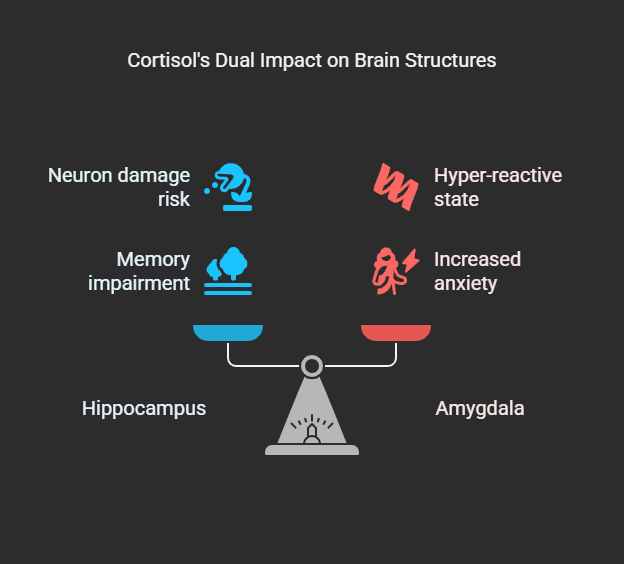
    • Reducing the Hippocampus: This seahorse-shaped structure, far within the brain, plays a vital role in learning, the formation of memories (particularly the transfer of short-term to long-term memories), and spatial orientation. Studies repeatedly indicate that long-term exposure to elevated cortisol levels can harm and kill hippocampal neurons and inhibit the growth of new neurons (a process referred to as neurogenesis). This can result in problems with recalling memories, learning new things, and even cause mood disorders such as depression.
    • Expanding the Amygdala: The amygdala is the fear center of the brain, involved in processing fear, anxiety, and aggression. Ongoing stress can make the amygdala larger and more active. This hyper-sensitizes the brain to stress, making it go into a hyper-reactive mode where you get easily triggered, anxious, and afraid. It conditions the brain for an increased stress response, producing a self-reinforcing cycle.  
    • Damaging the Prefrontal Cortex (PFC): Located in the front of the brain, the PFC is our executive control hub. It directs sophisticated cognitive skills such as decision-making, planning, problem-solving, working memory, attention, social conduct, and emotional self-regulation. Elevated cortisol damages weaken ties to the PFC while energizing ties to the more basic amygdala and hippocampus. This adaptation can appear as:
      • Difficulty sustaining concentration and attention
      • Poor judgment and impulsive decision-making
      • Decreased working memory capacity (easier to forget information).
      • Troubles with managing emotions and impulses.
      • Trouble with planning and organization.
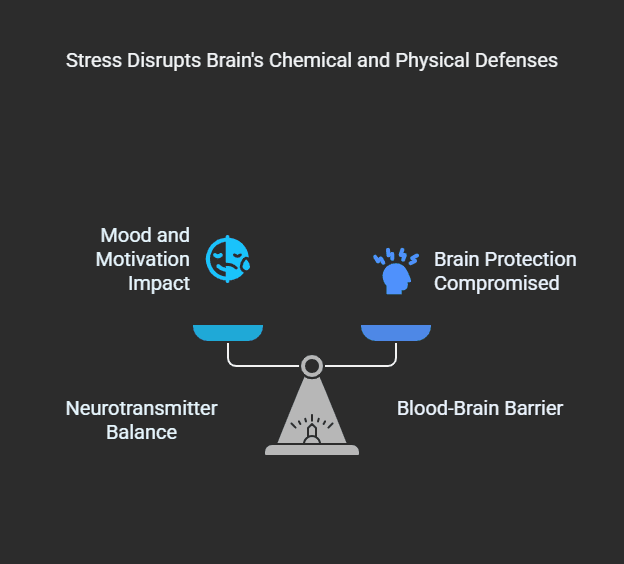
    • Interfering with Neurotransmitter Balance: Long-term stress can get in the way of the subtle balance between brain chemicals (neurotransmitters) such as serotonin (mood), dopamine (reward and motivation), and GABA (anxiety-reducing effect), and cause anxiety, depression, and decreased feelings of pleasure or motivation.
    • Increasing Inflammation: Chronic stress promotes low-grade inflammation throughout the body, including the brain. Neuroinflammation is increasingly linked to cognitive decline, neurodegenerative diseases like Alzheimer’s, and mental health disorders.
    • Disrupting the Blood-Brain Barrier (BBB): The BBB is a barrier that protects and regulates what is passed from the blood to the brain. Its integrity can be impaired by chronic stress, allowing toxic substances to enter and lead to inflammation and further damage
     changes your brain

    .Essentially, chronic stress not only makes you feel stressed; it changes your brain in ways that erode your capacity to think, remember well. Slow Damage to Key Brain Areas. This underscores the essential value of proactive stress management for long-term brain function and mental vitality.

    Reclaiming Your Calm: Actionable Techniques to Stress Less, Think Clearer

    Understanding the issue is step one. The second, more empowering step, is action. Fortunately, many effective methods based on mindfulness and physiological regulation can counteract the adverse effects of stress, soothe the nervous system, and foster a healthier brain environment.

    1. Mindfulness Meditation: Training Your Attention Muscle
      Mindfulness is the act of bringing attention to the current moment – your thoughts, emotions, body sensations, and environment – deliberately and without judgment. Meditation is a structured method of developing this ability.

    How it Aids the Brain: Consistent meditation practice has been found to cause beneficial structural and functional changes in the brain (neuroplasticity). Research indicates it can:

    • Increase grey matter density in regions linked to learning, memory, emotional regulation, and self-awareness (such as the hippocampus and prefrontal cortex).  
    • Reduce grey matter density in the amygdala, possibly lowering reactivity to stress.  
    • Enhance connections among diverse brain regions, allowing for greater communication and efficiency.
    • Soothe the HPA axis, lowering cortisol levels. 

    Getting Started (Easy Steps):

    • Find a Quiet Space: Select a spot where you are unlikely to be bothered easily.
    • Get Comfortable: Sit in a chair with your feet on the floor, or cross-legged on a cushion. Maintain a relatively straight back but not stiff. You may also lie down if sitting is painful.
    • Center on Your Breath: Kindly bring your awareness to the feel of your breath moving into and out of your body. Attend to the movement of rising and falling of your chest or abdomen. Try not to do anything with the breath, but merely watch.
    • Acknowledge Distractions: Your mind will go astray. That’s fine. As soon as you notice thoughts, emotions, or sensations coming up, kindly acknowledge them without judgment (“Ah, thinking”) and then gently refocus your attention onto your breath.
    • Start Small: Start with only 5-10 minutes per day and lengthen the time as you get more at ease. Consistency is most important.

    Types to Investigate: Guided meditations (through apps such as Calm, Headspace, or available online free resources), unguided silent meditation, body scan meditations (bringing attention in sequence to areas of the body), loving-kindness meditation (fostering feelings of warmth and compassion).

    2. Deep Breathing Exercises (Pranayama): Hacking Your Nervous System
    Your breath is among the most potent and readily available means for changing your physiological state. Fast, shallow chest breathing is typical of the stress response. Deep, slow belly breathing, on the other hand, engages the parasympathetic nervous system – the body’s “rest-and-digest” system, which opposes the “fight-or-flight” response.

    How it Aids the Brain: Deep breathing sends a direct message of safety to your brain. It:

    • Reduces heart rate and blood pressure.
    • Relaxes muscle tension
    • Enhances oxygenation to the brain, possibly enhancing clarity.
    • Quickly alleviates anxiety and feelings of being overwhelmed by soothing the nervous system.

    Effective Techniques:
    Diaphragmatic (Belly) Breathing:

    1. Sit or lie down. Put one hand on your belly, just below your rib cage, and the other on your chest.
    2. Breathe slowly and deeply in through your nose, letting your belly push your hand outwards (your chest hand will barely move).
    3. Breathe slowly out through your nose or mouth, allowing your belly to softly tighten.
    4. Concentrate on making the exhalation just a bit longer than the inhalation. Repeat for a few minutes.

    4-7-8 Breathing (Dr. Andrew Weil):

    1. Breathe out fully through your mouth, creating a whoosh sound.
    2. Close your mouth and breathe in quietly through your nose to a count of 4.
    3. Hold your breath for a count of 7.
    4. Exhale fully through your mouth, producing a whoosh sound, to a count of 8.
    5. This is one cycle of breathing. Repeat the cycle 3 more times (for a total of 4 breaths).

    Box Breathing (Navy SEAL Technique):

    1. Exhale fully to a count of 4.
    2. Slowly inhale through your nose to a count of 4.
    3. Hold your breath lightly for a count of 4.
    4. Slowly exhale through your nose or mouth to a count of 4.
    5. Gently hold the breath (lungs empty) for a count of 4.
    6. Repeat the cycle for a few minutes.

    You can use these techniques whenever you feel stressed, anxious, or overwhelmed, or integrate them into your daily routine (e.g., before sleep, at breaks).

    3. Embracing Nature (Nature Therapy / Ecotherapy): The Ultimate Brain Reset
    Humans developed in natural environments, and being in nature has deep restorative effects on our bodies and minds.

    How it Benefits the Brain: Being in nature, even for short durations, has been associated with:
    Lower levels of cortisol.

    • Lower blood pressure and heart rate.
    • Better mood and less rumination (repetitive negative thought).
    • Improved cognitive performance, especially attention and working memory (Attention Restoration
    • Theory proposes that nature automatically captures our attention, so directed-attention fatigue can recover.
    • Boosted activity in brain regions that are linked to relaxation and good mood.

    Actionable Ideas:

    • Take mindful strolls: Take a walk through a park, woods, or along the water. Notice the sights, sounds, smells, and textures that surround you. Leave your phone at home or set it on silent.
    • Sit outside: Sit on a bench or just sit down on the lawn and take a look around you. Feel the sun or wind on your skin.
    • Gardening: Working with soil and with plants can be very grounding and stress-reducing.
    • Take nature inside: Put houseplants in your residence or office, open windows, or listen to nature sounds.
    • “Forest Bathing” (Shinrin-yoku): This Japanese practice involves simply immersing yourself in a forest atmosphere, engaging all your senses without any specific goal other than relaxation.  

    Aim to incorporate some form of nature exposure into your routine regularly, even if it’s just a 15-20 minute walk during your lunch break.

    4. Mindful Movement: Connecting Body and Mind
    Physical activity is a well-known stress reliever, but when combined with mindfulness, the benefits are amplified.

    How it Helps the Brain: Mindful movement:
    Releases tension in muscles.

    • Enhances body awareness, assisting you in identifying early warning signals of stress.
    • Releases endorphins (natural mood elevators).
    • Offers a point of attention (bodily sensations, movement) that grounds you in the present, as in body awareness during meditation.
    • Soothes the nervous system with rhythmic movement and concentrated attention

    Practices to Try:

    • Yoga: Blends physical postures (asanas), breathing exercises (pranayama), and meditation/relaxation. Pay attention to the feelings in your body as you move and hold positions.  
    • Tai Chi / Qigong: Slow, flowing movements with deep breathing and mental concentration. Great for balance, flexibility, and stress relief.
    • Mindful Walking: Notice the feeling of your feet striking the ground, the movement of your arms and legs, your breath, and what’s around you while you walk.
    • Mindful Stretching: Pay attention to stretching feelings in your muscles, breathing into places of tension.

    Even ordinary activities such as dancing or light stretching can become mindful exercises if you attend to them with focused, non-judgmental awareness.

    5. Fostering Gratitude: Refocusing Your Attention
    Consciously paying attention to and valuing the positive aspects of your life, no matter how minor, can strongly overcome the brain’s inherent negativity bias (the tendency to give more attention to threats and issues) that is frequently heightened by stress.

    How it Benefits the Brain: Cultivating gratitude is linked with:
    More activity in brain regions involved in positive emotions, reward (release of dopamine), and social bonding.

    • Lower levels of cortisol.
    • Enhanced mood and stress resilience.
    • Improved quality of sleep.

    Easy Practices:
    Gratitude Journal: At the end of each day, record 3-5 things you are thankful for. Be specific (e.g., “thankful for the hot cup of tea this morning” instead of just “tea”).

    • Gratitude Moments: Throughout the day, take a few moments to mindfully observe something good and appreciate it.
    • Express Gratitude: Express to someone that you appreciate them or send a thank-you note.

    Integrating Stress Reduction into Daily Life: Making it Stick

    Knowing these techniques is one thing; making them a consistent part of your life is another. Here’s how to weave stress reduction into your daily fabric:

    • Begin with Small Steps and Be Patient: Don’t try to do too much at the same time. Select one of the techniques that appeals to you and promise to practice it for a few minutes every day. Consistency will eventually overcome intensity, particularly initially.
    • Schedule It: Make your stress-reduction practice a valued appointment. Block time in your calendar, even if it is only 10 minutes.
    • Link to Existing Habits: Build your new habit onto an existing daily habit (e.g., meditate for 5 minutes after you brush your teeth, practice deep breathing before you check your email).
    • Mindfulness in Everyday Activities: You don’t always need a formal practice. Bring mindful awareness to routine tasks like washing dishes (feel the warm water, notice the soap bubbles), eating (savour the flavours and textures), or commuting (notice your surroundings instead of getting lost in thought).
    • Set Boundaries: Practice saying “no” to commitments that overextend you. Guard your time and energy. Set work hours and adhere to them as much as possible.
    • Prioritise Sleep: Stress frequently disrupts sleep, and sleep aggravates stress – another vicious cycle. Try to get 7-9 hours of quality sleep every night. Create a soothing bedtime routine.
    • Nourish Your Body: Eat a balanced diet with plenty of whole foods, fruits, vegetables, and healthy fats to support brain resilience and health. Avoid processed foods, too much sugar, and caffeine, which can worsen stress symptoms.
    • Be Kind to Yourself: There will be times when you miss your practice or feel more stressed. Don’t criticize yourself. Acknowledge it, and just go back to your practice the following day. Progress, not perfection, is the goal.

    Stress Less, Think Clearer: Mindfulness as a Way of Life

    Ultimately, becoming skilled at Stress Less, Think Clearer isn’t about avoiding stress altogether – that’s not possible and sometimes not even desirable. It’s about transforming your relationship with stress. It’s about developing an inner toolkit that enables you to cope with challenges with more calm, resilience, and mental clarity.
    By incorporating mindfulness, deep breathing, nature exposure, mindful movement, and gratitude into your life, you are not merely containing symptoms; you are actively investing in long-term brain health and functionality. You are cushioning yourself from the destructive impact of chronic cortisol exposure and developing a mindset that includes greater concentration, improved memory, improved emotional regulation, and greater overall well-being.

    Conclusion: Your Brain Will Thank You

    There is no doubt that chronic stress is bad for brain health. Cortisol levels that are too high can change the physical structure of important brain areas that control memory, emotion, and executive function. This makes it harder for us to think clearly and live fully. But we can do something about these effects.

    Mindfulness meditation, slow breathing exercises, spending time in nature, mindful movement, and practicing gratitude are not just things that make you feel good; they are evidence-based practices that can change the structure and function of your brain for the better, calm your nervous system, and build resilience.
    Adding these things to your daily routine will improve your mental health, emotional stability, and overall quality of life. Start today, even if it’s just for five minutes. A single deep breath, a moment of mindful awareness, or a peaceful walk outside can all help you start your journey to Stress Less, Think Clearer. Your brain will be grateful.

  • Stress and Dementia: Modern Life Affects Your Future Brain Health

    Stress and Dementia: Modern Life Affects Your Future Brain Health

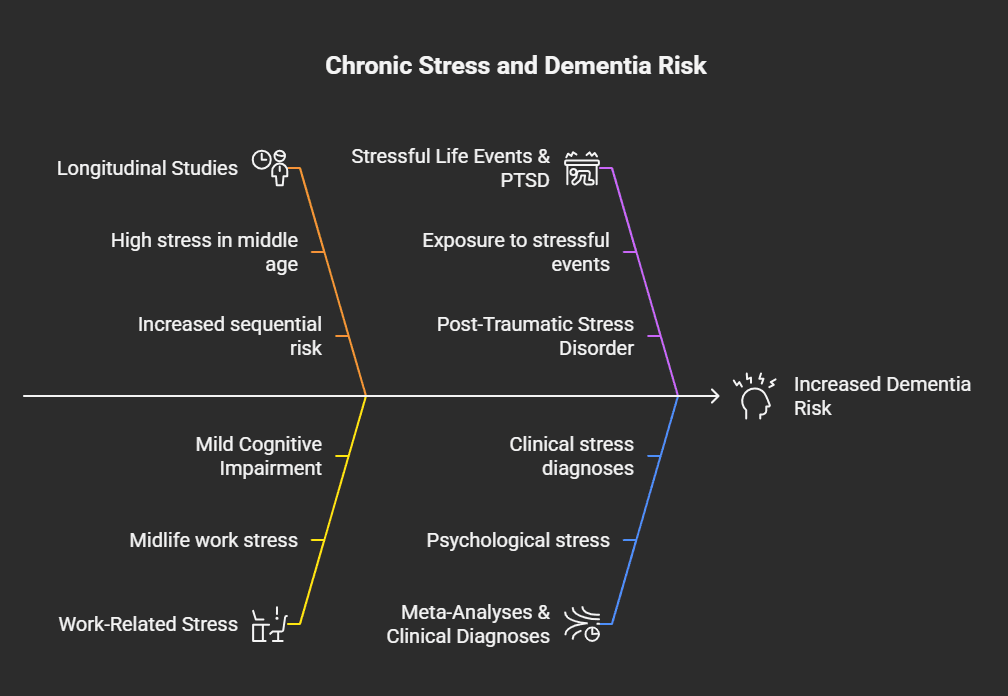
    Stress is a constant part of life for many people in today’s fast-paced, high-strung world. But what if that constant feeling of being overwhelmed and stressed out is doing more than just making your daily life hard? What if it’s quietly letting in an even worse problem down the road, like dementia? The connection between stress and dementia is becoming more and more important to study and worry about. Knowing about this connection is the first step toward keeping your brain healthy. This article goes into great detail about the complicated link between long-term stress and dementia, looking at the science, the risks, and most importantly, what you can do.

    It’s easy to think of stress as just a part of modern life that you can’t avoid. Stressors that are common include having a rough day at work, worrying about money, and having problems in a relationship. Researchers are now seeing that chronic stress, the kind that lasts day after day, is a major but hidden cause of cognitive decline and, eventually, a higher risk of getting dementia. The process from stress to dementia is long and complicated, but the evidence is strong enough to warrant further investigation.

    Getting to Know the Perpetrators: What Are Stress and Dementia, After All?

    Before we untangle their relationship, let’s first appreciate these two terms independently.

    What is Stress?

    Stress, in its simplest terms, is the body’s automatic reaction to any stress or danger. When you feel threatened – be it a physical threat or a mental one, such as an impending deadline – your nervous system goes into overdrive, releasing a cascade of hormones, including adrenaline and cortisol. This “fight-or-flight” mechanism is meant to assist you in coping with the moment at hand.

    • Acute Stress: This is temporary stress. It can be helpful, heightening your senses and giving you an energy boost when you need it most (e.g., slamming on brakes to prevent an accident). After the danger has passed, your body reverts to its normal state
    • Chronic Stress: This is chronic, ongoing stress. It happens when the cause of stress is ongoing, or when the stress response is locked in the “on” mode. Typical causes are persistent financial struggles, unhappy work arrangements, extended caregiving, or lingering trauma. It’s this chronic type of stress and dementia that scientists are most interested in.

    The body’s physiological reaction to long-term stress is having your body bathed in stress hormones all the time. This can result in:

    • Increased heart rate and blood pressure
    • Weakened immune system
    • Gastrointestinal problems
    • Sleep disturbances
    • Mental illnesses such as anxiety and depression
    • And, importantly, alterations in the brain.

    What is Dementia?

    Dementia is not a disease but a broad term for a variety of progressive neurological disorders that impair cognitive function. It’s a loss of memory, thinking, problem-solving, language, and judgment severe enough to interfere with daily life.

    Common forms of Dementia:

    • Alzheimer’s Disease: The most prevalent form, occurring in 60-80% of cases. It includes the formation of abnormal proteins (amyloid plaques and tau tangles) in the brain.
    • Vascular Dementia: Frequently develops after a stroke or from conditions that injure brain blood vessels
    • Lewy Body Dementia: Marked by unusual deposits of a protein called alpha-synuclein (Lewy bodies) in brain cells.
    • Frontotemporal Dementia: Affects the frontal and temporal areas of the brain, causing personality, behavioral, and linguistic changes.

    Symptoms of dementia are based on the type and location of the brain affected, but can be:

    • Memory loss (particularly short-term)
    • Trouble finding the right words
    • Troubles with decision-making or judgment
    • Getting lost in familiar environments
    • Mood and behavior changes
    • Trouble carrying out routine tasks

    The Scientific Bridge: How Chronic Stress and Dementia Intersect

    The notion that chronic mental stress might affect long-term brain health is not new, but new science is painting a more distinct picture of the mechanisms by which chronic stress and dementia are connected.

    The Cortisol Connection:

    When you’re under chronic stress, your body produces too much cortisol, commonly referred to as the “stress hormone.” Although cortisol is essential in limited amounts, chronically elevated levels can be harmful to the brain.

    • Hippocampal Damage: The hippocampus is one area of the brain responsible for learning and memory creation – functions both severely compromised in dementia, and specifically in Alzheimer’s disease. Studies demonstrate that excessive exposure to elevated cortisol levels can harm and shrink the hippocampus. It can decrease neurogenesis (the growth of new neurons) and result in dendritic atrophy (shrinkage of the branches of neurons responsible for communication).
    • Memory Impairment: Research has directly associated elevated cortisol levels with reduced performance on tests of cognitive function, including memory, executive function, and processing speed.

    Inflammation: The Brain on Fire:

    Chronic stress stimulates a low-grade inflammation within the body, including the brain (neuroinflammation).

    • Dysregulation of the Immune System: Stress can interfere with the proper functioning of the immune system. In the brain, immune cells known as microglia may over-activate, releasing inflammatory chemicals that cause damage to neurons and their connections.
    • Misfolding of Proteins: Chronic inflammation is considered to contribute to Alzheimer’s disease development by helping cause the misfolding and clumping of amyloid-beta and tau proteins – the disease hallmarks.

    The HPA Axis Dysregulation:

    The Hypothalamic-Pituitary-Adrenal (HPA) axis is the central stress response system of the body. Its dysregulation can be caused by chronic stress, or it does not shut off as it should.

    • Prolonged Stress Response: Continuously active HPA axis implies the ongoing release of stress hormones, fueling the deleterious impact on the brain. This dysfunction is now more often regarded as a pivotal element on the road to chronic stress and dementia.

    Effect on Brain Structure and Plasticity:

    Outside the hippocampus, other important brain areas can be influenced by chronic stress:

    • Prefrontal Cortex (PFC): It is responsible for higher-order cognitive processes such as decision-making, planning, and emotion regulation. Chronic stress can diminish PFC volume and disrupt its functions.
    • Amygdala: The fear center of the brain. Hyperactivity and even enlargement of the amygdala can occur with chronic stress, and this can make people more sensitive to anxiety and stress, which are themselves risk factors for dementia.
    • Decreased Brain Plasticity: Brain plasticity, or neuroplasticity, refers to the brain’s capacity to reshape itself through new neural connections. Chronic stress can undermine this adaptability and expose the brain to age-related changes and pathologies.

    Indirect Pathways:

    Chronic stress usually results in poor coping behaviors and lifestyle habits that are independent risk factors for dementia.

    • Poor Sleep: Stress is a significant etiology of insomnia and disrupted sleep. Sleep is essential for brain detoxification (including amyloid protein removal) and memory consolidation.
    • Unhealthy Diet: Stressed individuals are likely to consume comfort foods rich in sugar and unhealthy fats, which can lead to obesity, diabetes, and cardiovascular issues, all associated with an elevated risk for dementia.
    • Deficient Physical Activity: Stress may drain motivation for exercise. Exercise is neuroprotective.
    • Social Isolation: Withdrawal from social contacts can result from chronic stress. Social interaction is essential for cognitive well-being.
    • Risk of Depression and Anxiety: These are highly associated with stress, and they are also considered major risk factors for developing dementia.

    Chronic Stress and Dementia Risk: What Do the Studies Say?

    Chronic Stress and Dementia Risk

    The link isn’t just theoretical; a growing body of research supports the connection between chronic stress and dementia:

    • Longitudinal Studies: Longitudinal research on tracking people over decades has identified that individuals who reported high stress levels in middle age have a very high risk of developing dementia, including Alzheimer’s disease, in their old age. Increased sequential risk is indicated by some studies with more and longer experiences of stress.
    • Work-Related Stress: Research focusing on midlife work-related stress has identified links with increased risk of Mild Cognitive Impairment (MCI – usually a harbinger of dementia), dementia, and Alzheimer’s disease.
    • Stressful Life Events & PTSD: Having been exposed to a large quantity of stressful life events or having Post-Traumatic Stress Disorder (PTSD) has been correlated with a greater chance of cognitive decline and dementia.
    • Meta-Analyses: Large-scale reviews combining data from multiple studies (meta-analyses) have consistently concluded that various forms of psychological stress, including perceived stress, neuroticism (a personality trait characterized by anxiety and negative emotions), and exposure to stressful life events, are associated with an elevated risk of both MCI and all-cause dementia.
    • Clinical Stress Diagnoses: Those who are given clinical diagnoses of stress-related disorders during midlife also seem to have an increased subsequent rate of dementia.

    It should be mentioned here that studies frequently wrestle with the inherently subjective nature of stress – what is enormously stressful to one is not stressful at all to another. But the replication across types of studies and measures of stress indicates a real and alarming relationship.

    Can We Break the Cycle? Stress Management to Potentially Lower Dementia Risk

    The silver lining is that even though chronic stress and dementia are associated with each other, dementia is not a foregone conclusion of a stressful life. Many of the contributors are reversible. By taking proactive steps to manage stress, we might be able to counteract its negative impact on the brain and possibly lower our risk for dementia. These evidence-based strategies are:

    Welcome Physical Activity:

    Routine exercise is a top stress-buster and brain booster.

    • How it works: It slows down cortisol and adrenaline production, releases endorphins (natural mood elevators), increases blood flow to the brain, and fosters the growth of new neurons.
    • Aim for: A minimum of 150 minutes of moderate-intensity aerobic exercise (such as brisk walking, biking, or swimming) weekly, plus muscle-strengthening exercises two times a week.

    Prioritize Quality Sleep:

    Sleep is when your brain washes itself and fixes memories.

    • How it helps: Good sleep calms stress hormones and enables the brain to flush out metabolic waste, including Alzheimer s-related waste.
    • Aim for: 7-9 hours of quality sleep each night. Establish a consistent sleep schedule, develop a calming bedtime routine, and turn your bedroom into a sleep sanctuary.

    Practice Mindfulness and Meditation:

    These methods can assist you in becoming more present in your thoughts and emotions without judgment, which decreases reactivity to stressors.

    • How it helps: Ongoing practice can decrease cortisol, inflammation, increase attention, and even affect positive structural changes in the brain.
    • Try: Mindfulness meditation, yoga, tai chi, or deep breathing exercises. Just a few minutes each day can have an impact.

    Feed Your Brain a Healthy Diet:

    Your diet has a direct effect on your brain health.

    • How it helps: Anti-inflammatory foods high in antioxidants, omega-3 fatty acids, vitamins, and minerals may protect brain cells and oxidative damage.
    • Emphasize: Diets such as the Mediterranean diet or the MIND diet (Mediterranean-DASH Intervention for Neurodegenerative Delay), focusing on fruits, vegetables, whole grains, lean protein (primarily fish), nuts, seeds, and olive oil. Avoid processed foods, sweetened beverages, and excessive red meat.

    Nurture Strong Social Ties:

    Strong social connections and a busy social life shield against stress and mental deterioration.

    • How it helps: Social engagement activates the brain, offers emotional support, and lowers loneliness and isolation, which are stress factors.
    • Engage: Contribute to loved ones, participate in clubs, volunteer, or take courses.

    Challenge Your Brain Continuously:

    Stimulating your brain and keeping it occupied aids in the development of cognitive reserve – the brain’s resistance to damage.

    • How it works: Acquiring new knowledge and participating in mentally challenging activities may enhance neural pathways and retard the development of cognitive symptoms.
    • Activities: Puzzles, reading, studying a new language or instrument, playing strategic games, or acquiring a new hobby.

    Reduce Unhealthy Coping Behaviors:

    Reaching for alcohol, cigarettes, or too much caffeine to cope with stress can boomerang on your brain’s health.

    • Why it works: Minimizing or removing these drugs decreases their direct adverse effect on brain cells and overall health.
    • How to seek: Healthier means of stress management, like the above-mentioned techniques.

    Identify Your Stressors and Learn to Manage Them:

    Although you can’t always avoid stress, you can modify your reaction to it.

    • How it assists: Knowing what triggers your stress enables you to create plans to avoid them or deal with your response to them better.
    • Strategies: Prioritizing, boundary setting, problem-solving, cognitive restructuring, and learning to say “no.”

    Take Professional Assistance When Necessary:

    When stress becomes too much to handle or if you’re having any of the following symptoms: anxiety, depression, or ongoing memory issues, do not hesitate to seek help.

    • How it assists: Therapists can offer coping mechanisms for stress, depression, and anxiety. Physicians can eliminate other conditions and offer proper interventions or referrals. Early evaluation of cognitive alterations is also very important.

    When to be Worried: Identifying Early Warning Signs

    It is normal to experience periodic memory slips or feel uptight from time to time. Nevertheless, the following signs may prompt a consultation with a healthcare provider:

    Symptoms of Chronic Stress Overload:

    • Recurrent feelings of worry, anxiety, or irritation
    • Trouble concentrating or making decisions
    • Ongoing feelings of being overwhelmed or drained
    • Sleep changes (too much or too little)
    • Changes in appetite or weight
    • Increased alcohol or drug use to manage emotions
    • Physical complaints such as headaches, muscle tension, or stomach problems

    Early Warning Signs That Might Suggest Cognitive Decline (More Than Normal Aging):

    • Forgetting recently acquired information, important dates, or recurrent feelings of worry, anxiety, or irritation
    • Trouble concentrating or making decisions
    • Ongoing feelings of being overwhelmed or drained
    • Sleep changes (too much or too little)
    • Changes in appetite or weight
    • Increased alcohol or drug use to manage emotions
    • Physical complaints such as headaches, muscle tension, or stomach problemsepeating the same questions over and over
    • Problems with planning or problem-solving
    • Difficulty with familiar tasks at home, work, or during leisure time
    • Disorientation with time or place
    • Difficulty with visual images and visual-spatial relationships
    • New difficulty with words in conversation or writing
    • Forgetting things and losing the ability to retrace steps
    • Poor or decreased judgment
    • Withdrawal from work or social life
    • Mood and personality changes (e.g., becoming more easily confused, suspicious, depressed, fearful, or anxious)

    If you or a family member is having a number of these symptoms, seeing a doctor is a good first step. Early detection of diseases such as MCI or dementia can result in improved management and care.

    The Takeaway: Empowering Yourself Against Stress and Dementia

    The link between chronic stress and dementia is a worrying issue, yet it is also a point of prevention. By learning how long-term stress can affect our brain’s health, we become empowered to take action. Stress management isn’t merely about living better today; it is an essential investment in your mental future.

    While there are no promises in avoiding dementia, embracing a brain-healthy lifestyle that incorporates effective stress management can quite literally tip the scales in your direction. It’s about making conscious decisions every day to feed your mind and body. The path to guarding your brain against the negative impacts of chronic stress and dementia starts with awareness and is maintained by regular, positive action.