Tag: Walking

  • Walk This Way to Better Health: Exploring the Benefits of Different Walking Styles

    Walk This Way to Better Health: Exploring the Benefits of Different Walking Styles

    Without giving our gait much thought, we all fasten our shoelaces and go for a stroll. Beyond the well-established advantages of exercise, however, recent studies suggest that your gait may have some unexpectedly significant health impacts. Your walk may hold the secret to a host of unanticipated health advantages, ranging from boosting cognitive function to developing specific muscles.

    The Foundation: Advantages of Walking Daily

    We all tie our shoelaces and take a walk without really thinking about how we walk. However, new research indicates that your gait may have some surprisingly important health effects in addition to the well-known benefits of exercise. From improving cognitive function to building particular muscles, your walk could be the key to some unexpected health benefits.

    Step It Up the Intensity: The Benefits of Brisk and Power Walking

    For those who want to step up the health benefits, taking your step can pay off. Brisk walking, usually described as walking at over 100 steps per minute or approximately 3 to 4 miles per hour, has been associated with greater heart health and longevity. Studies have shown that converting a leisurely 14-minute walk to a brisk 7-minute walk may cut your risk of heart disease by 14%. In the long run, walking briskly may even result in your biological age being up to 16 years younger than that of those who walk slowly. Simply incorporating a brief, 10-minute brisk walk into daily life has been estimated to enhance life expectancy. Interestingly enough, the pace of your gait may be a better predictor of your likelihood of dying of heart disease than the usual suspects, such as blood pressure and cholesterol.

    One step further is power walking, which is usually at an average of 4 to 5.5 miles per hour. This more intense type of walking provides similar benefits to jogging, including a heightened heart rate and calories burned, but with decreased joint impact. Power walking has been found to decrease the risk of developing high blood pressure, high cholesterol, and diabetes. It can also lead to bone strength and greatly reduce the risk of hip fractures. In addition, it will tone muscles in your glutes, calves, core, arms, shoulders, and back. In addition to the physical benefits, power walking will also benefit your mental state in terms of decreased anxiety and depression, and cognitive function improvement, as well as sleep quality.

    Hiring More Muscles: The Nordic Walking Method

    For a total workout that utilizes both upper and lower body muscles, try Nordic walking. This technique consists of using specially adapted poles to push yourself along actively, working your arms, shoulders, and core as well as your legs. Research has established that Nordic walking is more efficient than fast walking without poles in heart rate, oxygen uptake, and exercise capacity. It has also proved to be advantageous for individuals with other conditions, such as reducing resting heart rate, blood pressure, and exercise tolerance. In addition, Nordic walking may reduce pain and tiredness in individuals with chronic illnesses such as back pain and fibromyalgia. It can also enhance upper-body strength, cardiovascular fitness, and flexibility, which makes it most suitable for older adults.

    The Unexpected Twist: Health Gains from Backward Walking

    In an unexpected finding, studies have uncovered distinct advantages to walking backward, or retro walking. This opposite direction of walking activates muscles differently than forward movement, including your hip flexors, glutes, quadriceps, hamstrings, and calves. Backward walking studies estimate that it strengthens back muscles and increases hamstring flexibility. It can also aid in the strengthening of ankles and enhancing balance, posture, and coordination. For lower back pain sufferers, walking backwards may provide relief and can be easier on the knee and hip joints. Surprisingly, it is connected to heightened activity in the prefrontal cortex, the part of the brain related to problem-solving and decision-making. Physiologically, it is more strenuous than forward walking, burning more calories. Backward walking has also been found to enhance gait, walking pace, and balance, particularly in recovery from an injury.

    Finding Your Inner Peace: The Benefits of Mindful Walking

    Turn your ordinary walk into a mind-body practice by practicing mindfulness. Mindful walking brings together physical movement, attentive focus, awareness of the sensations in your body, and regulated breathing. The emphasis lies in being entirely present with each step, instead of focusing on the goal of reaching somewhere. The practice has been found to help decrease stress by reducing cortisol levels. Mindful walking also activates the release of endorphins, which are natural mood elevators, and can also help lead to better sleep. By heightening your awareness of your body, you can increase self-awareness, possibly resulting in healthier lifestyle habits. Research has also shown that mindful walking can enhance metabolic health, such as maintaining blood pressure and blood sugar levels.

    Walk This Way: The Significance of Proper Technique

    No matter what kind of walking style you adopt, you must have an appropriate technique to achieve maximum benefits and avoid injuries. Professionals suggest keeping your head in a raised position, gazing forward, releasing your shoulders, swinging your arms naturally, using your core, and involving a heel-to-toe roll in every step. Steer clear of slouching, taking unusually long strides, and wearing proper shoes as well.

    Listen to Your Body: When to Exercise Caution

    Walking is generally safe, but in certain situations, precautions or adjustments may be necessary. It is important for people with neurological conditions, musculoskeletal conditions, joint disorders, arthritis, or balance issues to understand their limitations. A medical professional should always be consulted, especially when starting a new or more demanding walking technique.

    You can tailor your daily walk to target specific fitness goals and overall health by learning about the surprising health benefits of various walks. A healthier and happier you can achieve by varying your walking routine, whether you choose to increase your pace with brisk or power walking, work more muscles with Nordic walking, challenge your body and mind with walking backwards, or develop inner peace with mindful walking.

    Table: Summary of Key Health Benefits by Walking Style

    Walking StyleKey Benefits
    Regular WalkingImproved cardiovascular health, blood sugar control, weight management, sleep quality, mental well-being, and reduced risk of chronic diseases
    Brisk WalkingEnhanced cardiovascular benefits, increased calorie expenditure, reduced risk of heart disease and early death, and potential for increased life expectancy
    Power WalkingSimilar benefits to jogging, with lower joint impact, increased calorie burn, muscle toning, improved VO2 max, enhanced mental health, and cognitive function
    Nordic WalkingUpper body engagement, increased energy expenditure, improved cardiovascular fitness, benefits for chronic pain, back pain, diabetes, and cardiovascular disease, enhanced balance and posture
    Backward WalkingStrengthens specific muscle groups (quadriceps, glutes, hamstrings), improves balance and coordination, has potential cognitive benefits, increases calorie burn, and may ease knee and back pain
    Mindful WalkingStress reduction, improved mood, enhanced body awareness, potential positive impacts on metabolic health (blood pressure, blood sugar), increased sense of presence and gratitude
  • Sit All Day? Here’s Exactly How Much You Need to Move to Stay Healthy

    Sit All Day? Here’s Exactly How Much You Need to Move to Stay Healthy

    We all know that “sitting is the new smoking.” Sounds good, right? But the truth is that there is more truth there than we want to admit. Think about it: long commutes, desk jobs, and Netflix binges. Every day. It’s like putting your life on hold.

    Your health suffers when you sit still for eight hours or more. It’s not just feeling stiff; it’s a real danger. If you don’t exercise much, your risk of dying young goes up, just like if you smoke or are overweight. Moving around more and sitting less? That’s the answer.

    Okay, but what if you do exercise?

    Here’s the thing. There is still some hope. It makes me feel strong.

    This is what a lot of studies that use fitness tracker data show: doing moderate to vigorous exercise for 30 to 40 minutes a day can cancel out the risk of sitting for about 10 hours. Moderate to strong? Think of things that get your heart and breath going, like fast walks, cycling, gardening, dancing, and more.

    And yes, gardening is one of them. Who would have thought that cutting back roses would save lives?

    If you look more closely, you’ll see that 20 to 25 minutes a day can do the same thing, especially for people over 50. About 22 minutes of that Mid-level Intensity movement will get rid of the risks of sitting, even if you sit for more than 12 hours.

    So, is it 20 or 40 minutes? It depends. Some people study different things. But one thing is clear: the answer is to move around regularly, at least moderately to vigorously.

    The intensity of conversation: light, moderate, vigorous

    Let’s break it down:

    • Light activity: standing breaks, leisurely walking, light chores. Not bad, but only helpful if you’re super sedentary. Swapping even 30–60 minutes of sitting for gentle movement helps, but it isn’t enough alone.
    • Moderate activity: brisk walking (~2.5 mph), casual cycling, doubles tennis. This is your bread and butter.
    • Vigorous activity: running, fast cycling, swimming laps, jumping rope. Believe it or not, one study suggests that just 6 minutes per day of vigorous movement can offset most of that sitting-related mortality risk. Six minutes. Wow, huh?

    In practical terms, don’t want a long workout session every day? Try a short high‑intensity burst (interval sprints, jump‑ropes, stair climbs). Or go longer and steadier. Your call.

    What major health bodies recommend

    International & national guidelines

    • The World Health Organization (WHO) endorses 150–300 minutes per week of moderate activity or 75–150 minutes per week of vigorous movement. That breaks down to about 22–43 minutes daily of moderate effort.
    • The American Heart Association (AHA) aligns: 150 minutes of moderate or 75 minutes of vigorous weekly activity, plus strength training twice a week. They also stress that even light movements, standing, small walks, provide benefits when breaking up sitting.
    • The UK NHS echoes the 150-minute moderate/week guidance, adding that breaking up long sitting bouts, even with light activity, is important.

    Practical translation

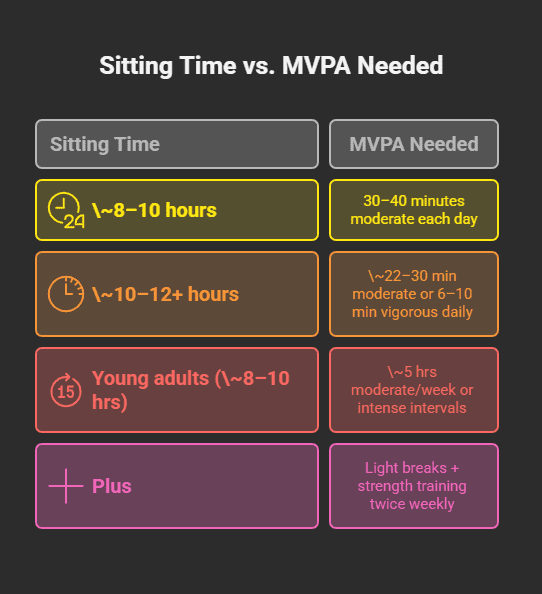
    • Sitting ~10 hrs/day? Aim for 30–40 mins of moderate activity daily, or
    • Sitting ~12 hrs/day? Roughly 22 mins moderate or 6–10 mins vigorous daily.
    • Sprinkle in light movement breaks, stand, stretch, walk every 30–60 minutes.

    Intensity vs duration: which matters more?

    Two truths:

    1. Duration of moderate-to-vigorous activity matters. Hitting 22+ minutes a day gives strong protection, even if you’re sitting a lot.
    2. Intensity packs a punch: six minutes of vigorous activity daily can deliver similar results. Condensed, but powerful.

    So, no time for 30–40 minutes? Go for a 6-minute intense session. Or chunk moderate activity throughout your day. And yes, don’t skip strength training twice weekly. Vital for bones and muscles.

    Sitting plus low activity = double trouble

    A sobering note: sitting a lot and not exercising? That combo spikes risk more than sitting without movement or exercising without sitting.

    To fight back, you need both: reduce sitting AND get enough MVPA, regular walking, or more intense activity is your protective shield.

    Younger folks vs older adults: is it different?

    It turns out younger adults aren’t exempt. Studies on people in their 20s to 40s reveal that sitting 8+ hours boosts BMI and messes with cholesterol, even for those who met the 150-minute/week guideline.

    They needed more: about 5 hours of moderate/week or 2.5 hours of vigorous/week. Or interval bursts networked through long sitting periods. So, sitting isn’t harmless at any age.

    Strategies to make it work IRL

    Here’s where we get real. Here are options that fit into human lives, busy calendars, travel days, and lazy Sundays.

    1. “Activity snacks”

    Short bursts: 5–10 minute walks, stair climbs, quick dancing between Zoom calls. It adds up. Every move counts.

    2. Stand up regularly

    Set a timer, every 30–60 minutes, stand up, stretch, and wander a bit. Light movement, yes, but better than zip.

    3. Make commute cardio

    Park farther out, walk/bus/bike part of the commute. Even 20 minutes each way stacks nicely.

    4. Sneak bursts of vigor

    A full workout sucks time. But a 6–10‑minute high‑intensity session? Doable: sprints, stair runs, jump rope. Boom, goal met.

    5. Weekend longer sessions

    Short on weekdays? Stack time on weekends, 90‑minute hikes, long bike rides, and active playdays. Weekend MVP.

    6. Strength days

    Twice weekly, lift weights or do resistance moves. Builds strength and balance, and protects bones and muscles, too.

    What does that mean for *you*, a personal take

    So if you’re already working out occasionally… good on ya. But maybe you’re unsure how much more is needed. Suggested:

    • Aim for 30 minutes of moderate‑vigorous activity, either midday or evening.
    • OR 20 minutes brisk walk morning and evening.
    • OR carve out six minutes of intense movement during the day.
    • PLUS: stand and move every 45–60 minutes if you desk a lot.

    That covers your bases, duration, intensity, and movement breaks.

    But sometimes life gets real.

    Travel, deadlines, sickness, all that. Don’t stress about perfection.

    Both the WHO and AHA say that any activity is better than none. Even standing more is progress. If zero movement today, you can still change course, stretch, stand, and walk around. Baby steps win long term.

    Common questions answered

    Q: “Can’t I just stand all day?”

    Standing helps metabolism and posture, but it doesn’t neutralize mortality risk as MVPA does. You need to exercise.

    Q: “What if I split my 30 minutes?”

    Perfectly fine. Studies show multiple shorter sessions work just as well as one solid chunk.

    Q: “Is brisk walking enough?”

    Yes, if you do enough. Go moderate for 20–40 minutes per day. If you go faster, fewer minutes work.

    Q: “I’m older or diabetic, does it change?”

    Not really. As long as you meet 150+ minutes of moderate/vigorous weekly, sitting risk fades, even for chronic health conditions.

    Quick cheat sheet

    Sitting Time/Day MVPA Needed to Offset Risk

    Sitting Time

    Bottom line

    • Sitting all day? Not great, especially without exercise.
    • Exercise, especially moderate‑vigorous, for ~20–40 min daily is your shield.
    • Intensity counts, and short, intense bursts are legit.
    • Light activity and standing? Helpful, but not enough alone.
    • Split sessions? Totally cool.
    • Strength work? Don’t skip it.

    In final words, human rhythm is included

    This is the thing. Life has its ups and downs. Some days, you really get a good workout. What else? You hardly ever get up from the couch to get food.

    That’s what people do. That’s fine. What matters is what you mean. Get moving today. Get up again tomorrow. Do something. Because even imperfect movement helps fight the risks of sitting.

    Try it out. Set a timer for 25 minutes. Walk quickly. Maybe bounce up and down. It’s not about being perfect; it’s about being there.

    Is it because you get a little boost of energy after just five minutes of moving? Your body is saying “thank you.” And it doesn’t take much to make a difference.