Water Makes Your Body Sing. Ever really think about water?
Really, give it some thought. Not just that clear stuff you swill down after working out or reluctantly take a sip when you start to get a headache. But as the unsung, silent hero of your life. A Swiss watch would appear to be a child’s toy in comparison to the master conductor of a symphony, so intricate and complex.
It’s only water. Correct? water. Easy.
To be honest, though, that simplicity is incredibly misleading. Your body’s water story is far from straightforward. It’s a vast, epic tale of physics, chemistry, and unadulterated biological magic. It’s the key component that enables you to be who you are.
Now, let’s reveal the truth. With each sip, let’s take a close look at what’s going on inside of you. Take a break from the dry, textbook explanations. This is the tour behind the scenes. The VIP pass to your internal operations.
And trust me, you won’t want to miss this show.
The Original Superhighway: Your Blood, Powered by Water
Picture this: a bustling, chaotic city. Millions of microscopic vehicles, red blood cells, scurrying around, each carrying a precious cargo of oxygen. Other trucks haul away garbage (hello, carbon dioxide), while delivery vans rush vital packages of nutrients and hormones to every last address in the metropolis that is your body.
Now, what’s the one thing this city absolutely cannot function without?
The roads. The highways, the boulevards, the tiny little back alleys.
And in your body? That superhighway system is your bloodstream. The kicker? Your blood is about 92% water.
Mind-blowing, isn’t it?
Without that high water content, your blood would be less like a free-flowing river and more like…well, sludge. A thick, gooey mess that would bring that bustling city to a grinding, catastrophic halt. Your heart, the city’s central pump, would have to work impossibly hard, straining against the friction, just to move that sludge an inch. Talk about being stuck in traffic.
But with enough water, everything just flows.
It’s this flow that allows for the almost instantaneous delivery of oxygen from your lungs to your big toe. It’s what lets those powerful hormones, the messengers that control your mood, your energy, your everything, zip from a gland in your brain to your adrenal glands in the blink of an eye. When your blood is properly hydrated, it’s a marvel of efficiency. A perfectly optimized delivery network, ensuring every single one of your trillions of cells gets exactly what it needs, right when it needs it.
Think about that next time you feel that afternoon slump. That foggy-headed, ca n’t-quite-focus feeling. It might not be a lack of caffeine. It could just be that your internal superhighway has a few traffic jams. A little gridlock in the system. A glass of water can, quite literally, get things moving again. It’s like calling in the traffic cops to clear the congestion. Suddenly, the flow is restored. The city breathes a collective sigh of relief. And you? You feel it. The energy returns. The fog lifts.
All because of water. Simple, brilliant water.
The Ultimate Climate Control System
You know that feeling. The sun was beating down on a sweltering summer day. The intense, heart-pounding heat of a spin class. Your internal temperature starts to climb, and if left unchecked, things could get dangerous. Dangerous.
So what does your body do? It sweats.
It’s one of those things we just accept, maybe even complain about. But sweating is one of the most elegant and effective feats of thermal engineering in the natural world. (And yes, you’ll love this part).
Here’s how it works: Your body, sensing the rise in your core temperature, pushes water, mixed with a few salts and electrolytes, out through tiny pores in your skin. Now, this is where the magic happens. As that water sits on your skin, it begins to evaporate. It turns from a liquid into a gas.
And that process, evaporation, requires energy. Specifically, it requires heat energy. Where does it get that heat?
From you.
It pulls the heat away from your skin, cooling you down from the outside in. It’s your own personal, built-in air conditioning unit. And the fuel for this AC? You guessed it. Water.
But it’s not just about cooling you down. Water is also a fantastic insulator. The water held within your cells (and your entire body is about 60% water, by the way) acts as a buffer. It can absorb a whole lot of heat before its temperature starts to rise significantly. This is called a high specific heat capacity, for the science nerds out there. This property helps protect you from sudden, drastic changes in external temperatures, keeping your internal environment stable and safe. It’s like a thermal blanket wrapped around your delicate organs.
So, when you’re dehydrated, you’re essentially turning down the power on your personal AC unit and throwing off your insulating blanket. Your body can’t sweat as efficiently, putting you at a much higher risk of overheating and heatstroke. A condition that is no joke.
Staying hydrated, then, isn’t just about feeling comfortable. It’s a critical safety measure. It’s giving your body the raw material it needs to maintain that perfect, life-sustaining internal thermostat. Who knew a glass of water was a masterclass in thermodynamics?
The Great Digestive Dance (and the Cleanup Crew)
Let’s talk about food. The glorious, wonderful journey it takes from your plate to, well, you know.
That whole process, from start to finish, is utterly dependent on water. It’s not just a bit player; it’s the stage manager, the lighting crew, and the cleanup crew all rolled into one.
It starts the moment food hits your mouth. Saliva, which is mostly water, begins the process of breaking down carbohydrates, making food softer and easier to swallow. A dry mouth isn’t just uncomfortable; it’s the first sign that your digestive system is already working with one hand tied behind its back.
Then, as that food travels down into your stomach and intestines, water is there every step of the way. It helps dissolve the nutrients, the vitamins, the minerals, the good stuff, so that your intestinal walls can absorb them. Think of it like making a cup of tea. You can’t get the flavor out of the tea bag without the hot water to dissolve it. Same principle. No water, no nutrient absorption. You could be eating the healthiest diet in the world, but without enough water, a lot of that goodness is just passing right on through. A total waste.
And here’s something most people don’t think about: fiber. We’re all told to eat more fiber, right? For regularity. For gut health. But here’s the kicker: without water, fiber can make things worse.
Fiber works by absorbing water in your large intestine, which adds bulk and softness to your stool, making it easier to pass. It’s a beautiful partnership. But if you’re dehydrated, there’s no spare water for the fiber to soak up. So instead of becoming soft and bulky, it just sits there. Hard. Dense. Leading to constipation, bloating, and a whole lot of discomfort. It’s a classic case of a good intention gone wrong, all for the lack of a few extra glasses of water.
And what about the cleanup? After your body has taken all the nutrients it needs, what’s left over has to go somewhere. Your kidneys are the master filtration plants of your body, and they are water-guzzling machines. They work tirelessly to filter waste products and excess ions out of your blood, creating urine.
If you’re well-hydrated, this process is a breeze. Your urine is a pale, straw-like color, and your kidneys are happy. But when you’re dehydrated, your body goes into conservation mode. It tells the kidneys, “Whoa, hold on! We can’t afford to lose this much water!” In response, your kidneys concentrate the urine as much as possible, reabsorbing more water back into the body. This is why your pee turns that dark, ominous yellow. It’s a desperate attempt by your body to hold onto every last drop. It’s also incredibly stressful for your kidneys and, over the long term, can contribute to nasty problems like kidney stones.
So, drinking water isn’t just about quenching thirst. It’s about lubricating the entire digestive dance and then making sure the cleanup crew has everything it needs to take out the trash.
The Brain’s Best Friend: Clarity in a Glass
Ever had one of those days where your brain just feels…like mush? You can’t string a thought together, simple decisions feel monumental, and your memory is on vacation.
You might be reaching for another coffee, but what you probably need is a tall glass of water.
Your brain, the command center of your entire being, is about 75% water. And it is exquisitely sensitive to its hydration status. Even a mild level of dehydration, we’re talking as little as a 2% drop in your body’s water content, can have a noticeable impact on your cognitive function.
Funny thing is, you might not even feel thirsty at that point. But the effects are already setting in.
Your focus wavers. Your short-term memory gets a bit fuzzy. You might feel more irritable or anxious. Why? Because the intricate electrical signaling that constitutes your thoughts relies on a delicate balance of electrolytes and, you guessed it, water. When that balance is off, the signals don’t fire as cleanly. The connections aren’t as sharp. It’s like trying to have a clear phone conversation with a bad signal. Full of static and dropped words.
Dehydration can also temporarily shrink your brain tissue. No, really. It pulls away from the skull. This physical change is thought to be one of the reasons we get those pounding dehydration headaches. The brain doesn’t like being cramped.
But here’s the beautiful part. This is all completely, wonderfully reversible.
Studies have shown that rehydrating can restore cognitive performance in a remarkably short amount of time. That feeling of clarity that washes over you after drinking water when you’re parched? It’s not your imagination. You are giving your brain the fluid it needs to plump back up, to restore its delicate chemical balance, and to get those electrical signals firing on all cylinders again.
So next time you’re facing a big project, a tough exam, or just need to be on your A-game, don’t just think about your preparation or your mindset. Think about your hydration. It might just be the most important and easiest thing you can do to ensure your brain is functioning optimally. Give it a try. Before you do anything else, just drink a full glass of water. See what happens.
It’s the ultimate brain food. And it costs next to nothing.
More Than Just the Big Stuff: The Silent, Everyday Miracles
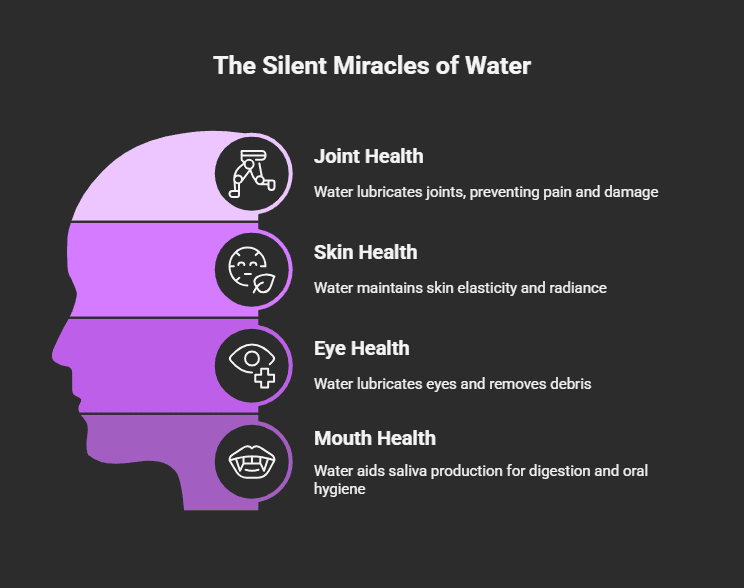
The large, life-sustaining jobs have been discussed. The sweeping, grand functions. However, there are more incredible ways that water benefits your body. By no means. In ways you may not have thought of, they are interwoven into the very fabric of your everyday existence.
Consider your joints. About 80% of the smooth, rubbery cartilage that prevents your bones from grinding against one another is made up of water. This includes the cartilage in your knees, hips, and shoulders. It serves as a natural lubricant and shock absorber. That cartilage may become less spongy when you’re dehydrated. It loses some of its ability to absorb shock. Joint pain may result from this, which may eventually lead to more serious problems. Maintaining proper hydration is similar to changing the oil in your joints. It keeps everything pain-free, silent, and in motion.
What about your skin? That lovely shield against the world? Its elasticity and plumpness are preserved from the inside out when properly hydrated. Water is the foundation of true skin health, even though moisturizers only address the surface. Your skin is one of the first areas to show signs of dehydration, becoming lifeless, parched, and more prone to fine lines. No cream can fully replace the healthy, glowing glow that comes from drinking enough water, which also helps to improve blood flow to the skin and flush out toxins. It’s the original secret to beauty.
Even your eyes and mouth need it. Water is a key component of your tears, which lubricate your eyes and wash away debris, and your saliva, which, as we saw, does so much more than just wet your whistle.
It’s everywhere. Doing everything. All the time.
This silent, tireless work is the foundation of optimal function. It’s not about grand gestures or quick fixes. It’s about consistency. It’s about providing your body with its most fundamental, most essential resource, day in and day out.
So, here’s the thing. We live in a world obsessed with optimization. Biohacking. Performance-enhancing supplements. Complicated diets. And yet, we so often overlook the simplest, most powerful tool at our disposal.
Water
It’s not trendy. It’s not expensive. It doesn’t come in a fancy bottle with a long list of unpronounceable ingredients (or at least, it shouldn’t).
But its effects are profound. Transformative, even. It’s the baseline. The foundation upon which all other aspects of your health are built. Before you worry about anything else, ask yourself a simple question:
Am I drinking enough water?
Because you’re attempting to construct a skyscraper on sand if the answer is no. It simply cannot withstand it.
Give your body what it needs. What it required to play that amazing, unseen symphony of life? Pay attention to its signals. The exhaustion, the thirst, the cloudy thinking. These aren’t bothersome things. They’re messages. A request for its most important resource from your inner city.
Respect that request. Lift a glass. And sip from your very own water-powered marvel. It’s helping you more than you could ever know. And a sip is where it all begins.