






A quick, low-dose test is helping doctors find heart disease that doesn’t show any symptoms for years. This is changing the way prevention works in the UAE.
A few minutes.
That’s all it takes.
More and more doctors in hospitals and specialist clinics across the UAE are using a short, non-invasive heart scan. They say it can show early signs of heart disease long before a person has chest pain, trouble breathing, or any other emergency-like symptoms.
It’s quick.
It doesn’t make a lot of noise.
And for many patients, it’s a wake-up call.
“This scan often shows risk that people don’t know they have,” a senior cardiologist said, taking a short break, which is something doctors do when they are being careful with their words.
“The disease has been around for years before symptoms show up, most of the time.”
The name of that scan is a coronary calcium scan. It is a CT-based test that looks for calcium deposits in the arteries that carry blood to the heart. And even though the technology itself isn’t new, its growing use in routine preventive care across the UAE is changing how heart disease is found, talked about, and, most importantly, stopped.
Why heart disease is still a hidden danger
Heart disease doesn’t usually come with a lot of drama.
It gets bigger. Not loud.
Fatty deposits accumulate in the arterial walls. Over time, calcium makes those plaques harder. The flow of blood gets smaller. The heart makes up for it, but only for so long.
Heart disease is still the leading cause of death in the world. Doctors in the UAE say the risk profile is especially bad because of a mix of genetics and lifestyle factors:
- A lot of people have diabetes or are at risk of getting it.
- People who work in an office are more likely to sit still all day.
- Young adults are more likely to use e-cigarettes and smoke.
- Eating a lot of processed foods, sugar, and salt.
- Family histories of heart disease at a young age.
This makes things harder: many people with heart disease that is getting worse feel fine.
No pain.
No warning.
They don’t think they need to see a doctor.
A cardiology consultant who works to stop heart disease said, “That’s the risk.”
“You can look and feel fine and still have a lot of plaque in your coronary arteries.”
What is the heart scan that takes five minutes?
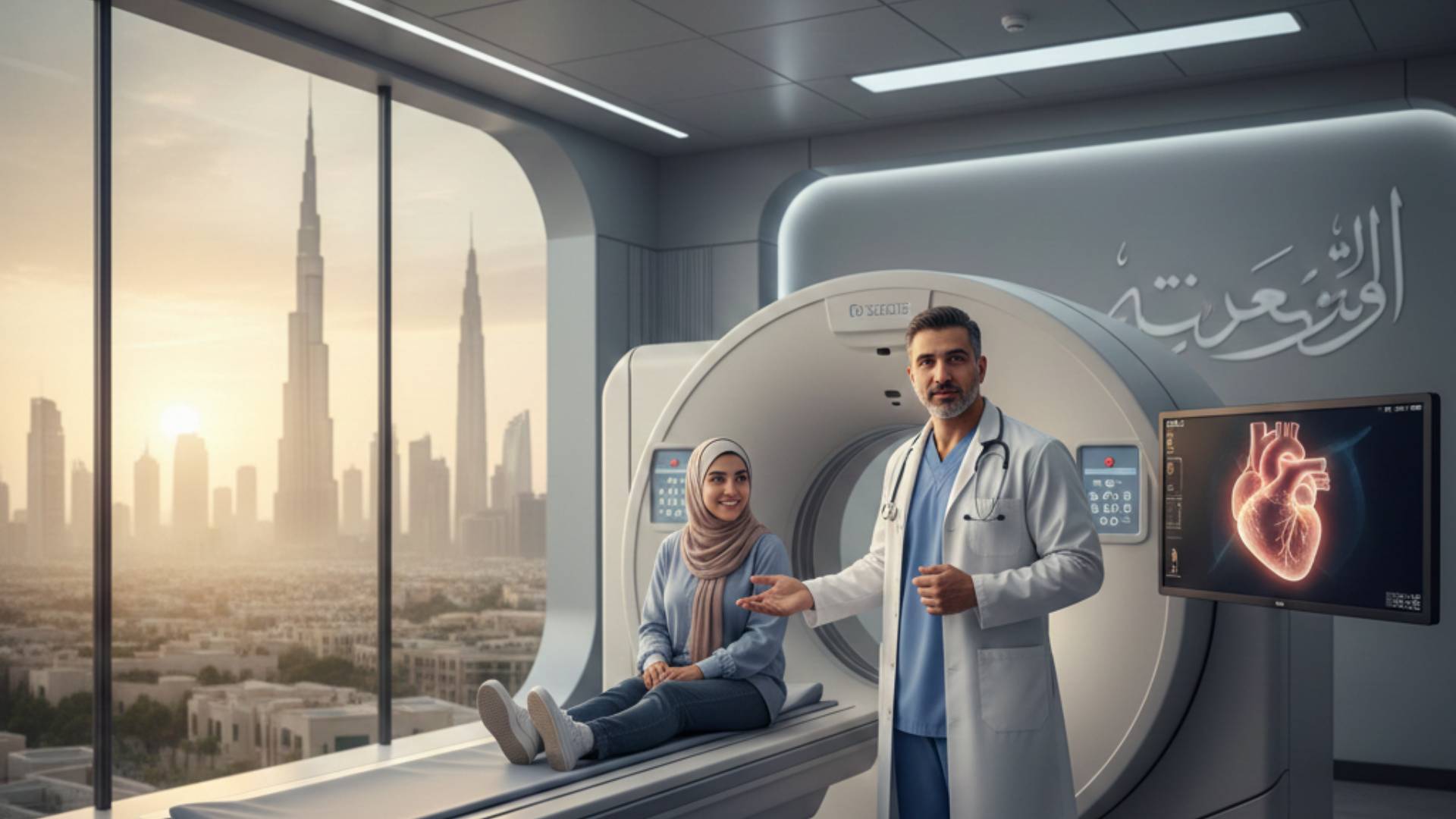
The coronary calcium scan, or “CAC scan,” uses a special CT scanner to take close-up pictures of the heart.
There are no needles.
No dyes are put into the blood.
No stress tests on the treadmill.
Patients lie down flat.
Hold your breath for a few seconds.
And the scan is done in less than five minutes most of the time.
The machine can find tiny calcium deposits in the arteries that go to the heart. These deposits are a sign of atherosclerosis, which is what leads to heart attacks and strokes.
Then, from this, doctors figure out a “calcium score.”
What the calcium score is and why it is important
The score is not an idea.
It helps.
Doctors usually break it down for you:
- Score of 0: There is no calcium to be found. There is very little chance that you will have a heart attack soon.
- Score 1–99: Plaque starts to form early. Not very likely.
- Score 100–399: Moderate plaque burden. More dangerous.
- Score 400+: Too much plaque. A good chance of having heart problems in the future.
Doctors say that the number isn’t the only thing that matters; it’s what they can do with it next.
A cardiologist from the UAE said, “This helps us make prevention more specific.”
“We’re not guessing; we’re responding to real evidence inside the arteries.”
What this scan does to change how patients act
Doctors in the UAE all say the same thing:
“Seeing the results makes it real.”
A lot of the time, patients don’t care when they hear that they might be at risk. But when they see pictures of calcium in their own arteries, like white spots lighting up a scan, it hits them differently.
A 42-year-old man from Dubai who had the scan as part of a routine check-up said,
“I thought I was fine.”
“There are no signs. I do work out sometimes. After that, they showed me the picture. That’s when it hit me.”
He was given medicine to lower his cholesterol, changed what he ate, and now he goes in for checkups regularly.
A doctor said, “This scan changes the way we talk.”
“It makes something that isn’t clear into something that is.”
Why doctors in the UAE are in favor of early screening
The UAE’s healthcare system is putting more and more emphasis on “preventive medicine,” which means finding diseases early instead of late.
Calcium scans are becoming more popular for several reasons:
- More young adults know about sudden cardiac events
- Access to advanced imaging technology
- More health screenings are paid for by companies and insurance
- Proof that calcium scoring makes it easier to guess someone’s risk
Doctors also say that traditional risk calculators that only look at age, cholesterol, blood pressure, and smoking don’t always give the whole picture, especially when they are used on groups of people from different backgrounds.
A doctor said, “We see people with normal cholesterol who still have plaque.”
“This scan fills in the blanks.”
Who needs this scan?
Not everyone needs it.
And doctors are very clear about it.
The scan is usually suggested for:
- Men over 40 and women over 45 who are at risk
- People whose family members have had heart disease at a young age
- People with diabetes, high blood pressure, or high cholesterol
- People who smoke or used to smoke
- People whose risk is borderline, and for whom treatment options are not clear
It is not usually recommended for:
- Very young adults who don’t have any risk factors
- People who already have heart disease (they need more tests)
- Pregnant women, because of the radiation exposure
Doctors say that the goal is not mass scanning but targeted screening.
Are the fears about radiation real?
You need to think about radiation when you talk about CT scans.
Doctors do say it, but they also explain why.
A coronary calcium scan gives off a very low radiation dose, which is often similar to:
- A few months of natural background radiation
- Fewer than many routine diagnostic CT scans
One radiologist said, “With today’s machines, the dose is very low.”
“For the right patient, the benefit is much greater than the risk.”
Still, it’s important to get informed consent. Patients are told to talk about the risks, benefits, and other choices before they go ahead.
How finding something early changes treatment plans
The scan doesn’t replace any other tests.
It makes choices easier to understand.
Based on the result, doctors may do the following:
- Begin or increase treatment to lower cholesterol
- Recommend stricter blood pressure control
- Push for structured lifestyle changes
- Schedule more frequent follow-ups
- Don’t give patients who are at low risk unnecessary drugs
In some cases, a score of zero means that doctors can put off giving patients medicine for the rest of their lives, which is something that many patients like.
“It’s reassurance backed by data,” said a cardiologist.
“And comfort is important.”
A new way to stop heart attacks
Heart care used to be mostly about emergencies, like ambulances, cath labs, and stents.
That’s still very important.
But now, stopping it from happening is getting just as much attention.
More and more, hospitals in the UAE, like the Dubai Health Authority and the Abu Dhabi Department of Health, are focusing on screening, lifestyle counseling, and risk assessment as important parts of heart care.
Doctors say that the calcium scan goes well with that change.
One consultant said, almost plainly,
“We’d rather stop the heart attack than treat it.”
Why timing is so important
Heart disease doesn’t happen all at once.
It takes years to happen.
That long timeline gives doctors a chance to see what’s going on early enough.
A calcium scan can find plaque years before arteries get too narrow to be safe. That window lets:
- The disease gets worse more slowly
- Less need for emergency care
- Lower long-term healthcare costs
- A better quality of life
In other words, time is no longer your enemy.
Questions to ask before getting scanned
Doctors say you should have a short talk before you schedule the test:
- Are there any risk factors that make the scan necessary?
- How will the result change how I take care of myself?
- How much does it cost, and will my insurance pay for it?
- How often should it be done again, if at all?
They want to make it clear that this isn’t a simple test; it’s a strategic one.
What does this mean for the health of the public as a whole
Heart disease is still a problem for working-age adults, so this scan and other early detection tools could help more than just the people who use them.
Not as many people are going to the hospital for emergencies.
Less stress on heart units.
A long life full of health.
That matters for a country with a lot of young people and a lot of different cultures.
A doctor in the UAE said,
“This is about staying ahead of the disease.”
“Not going after it after the damage is done.”
Stop freaking out and start stopping things from happening
Good habits won’t be replaced by the five-minute scan. Doctors understand that.
It’s still important to work out.
Your diet is still important.
Stress, sleep, and smoking are still important.
But knowledge, knowledge that is clear, visual, and impossible to deny, makes you stronger.
For a lot of people in the UAE, heart disease stops being hidden when they are in a quiet CT room, hold their breath, and scan for a few minutes.
Before the alarms went off.
Before the hospital got busy.
Before it’s too late.