






Synthetic plastic debris has penetrated global freshwater systems and municipal pipelines, but empirical testing reveals that consumers can intercept these microscopic contaminants at home. In early 2024, researchers at Guangzhou Medical University showed that a routine kitchen technique—boiling mineral-rich tap water and pouring it through a simple filter—captures up to 90 percent of microscopic plastic particles. Concurrently, independent laboratory evaluations demonstrate that certified mechanical filtration systems can eliminate more than 99.9 percent of both visible fragments and sub-micron nanoplastics before they reach the drinking glass.
The True Exposure Baseline: Tap Water Versus Bottled Water
Public discussions around plastic pollution often treat all drinking water equally, yet laboratory assessments show vast disparities in particle concentrations across water sources. In a landmark 2024 investigation published in the Proceedings of the National Academy of Sciences, researchers from Columbia University and Rutgers University used stimulated Raman scattering microscopy to evaluate popular commercial bottled water brands. The team discovered an average of 240,000 plastic particles per liter. Roughly 90 percent measured smaller than one micrometer—classifying them as nanoplastics—composed predominantly of polyamide and polyethylene terephthalate (PET) worn from packaging walls and industrial processing membranes.
Municipal tap water, by comparison, typically contains significantly fewer plastic particles per liter, generally ranging from several dozen to a few hundred fragments depending on regional infrastructure. However, municipal treatment plants remain largely unequipped to capture sub-micron particles. Because nanoplastics measure small enough to cross the intestinal epithelium, circulate through the bloodstream, and penetrate vascular walls, health researchers have turned their attention toward physical filtration at the residential tap.
The clinical stakes of systemic plastic absorption became clearer in March 2024, when a prospective clinical trial published in the New England Journal of Medicine examined 257 patients undergoing carotid endarterectomy. Researchers led by Dr. Raffaele Marfella detected polyethylene and polyvinyl chloride particulates embedded in the arterial plaque of 58 percent of participants. Patients with confirmed plastic accumulation experienced a 4.5-fold higher risk of heart attack, stroke, or all-cause mortality over a 34-month follow-up compared to those without measurable arterial plastic deposits.
The Boiling Protocol: Thermal Co-Precipitation in Hard Water
In research published in Environmental Science & Technology Letters, environmental chemists investigated whether traditional culinary practices could reduce ingested plastic volumes. The researchers spiked both soft and hard tap water with varying concentrations of polystyrene, polyethylene, and polypropylene particles, then brought the samples to a rolling boil for five minutes.
The results confirmed that boiling hard water triggers a process known as co-precipitation. When water rich in dissolved minerals heats up, soluble calcium bicarbonate breaks down into insoluble calcium carbonate (CaCO3), commonly recognized as limescale. As these chalky crystals precipitate out of solution, they trap floating microplastics and nanoplastics within their growing mineral lattices.
Pouring the boiled water through a standard paper coffee filter or a fine stainless steel mesh physically strains the mineral encrustations. In water containing approximately 300 milligrams of calcium carbonate per liter, this simple technique stripped up to 90 percent of nanoplastics and microplastics from the sample. In soft water containing less than 60 milligrams per liter, the removal rate dropped to roughly 25 percent, confirming that the mineral matrix—not the boiling temperature alone—drives the capture mechanism.
Evaluating Household Filtration Systems
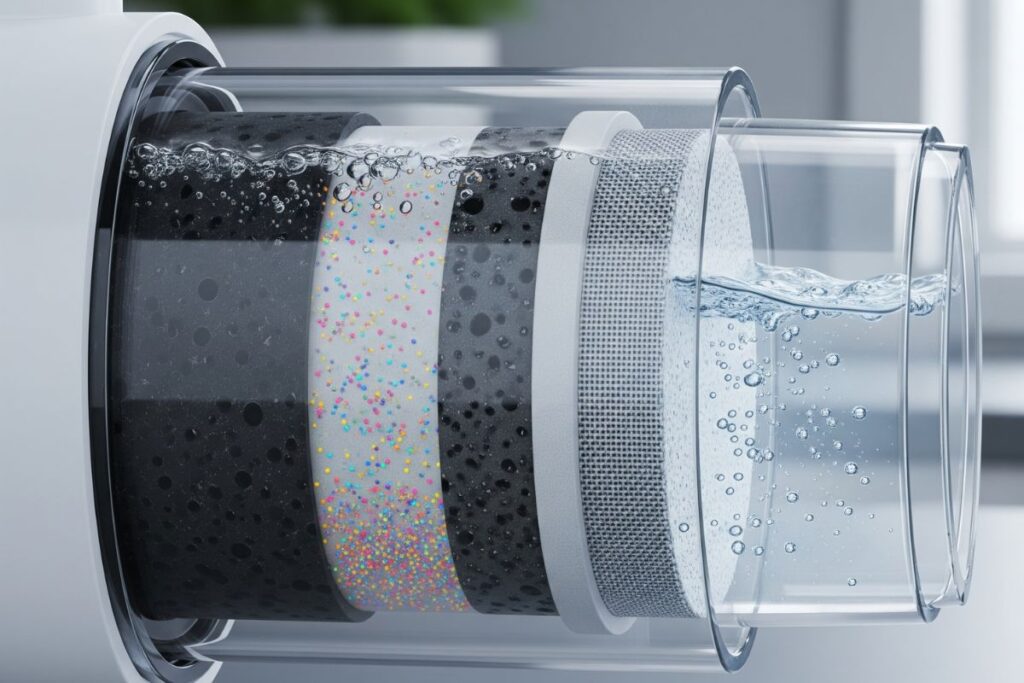
For households with soft water or those seeking continuous on-demand purification, mechanical filtration systems offer distinct performance tiers based on pore diameter and membrane design.
| Filtration Technology | Nominal Pore Rating | Microplastic Removal | Nanoplastic Removal |
|---|---|---|---|
| Reverse Osmosis (RO) | 0.0001 microns | >99.9% | >99.9% |
| Ultrafiltration (UF) | 0.01 to 0.1 microns | >99% | 85% to 95% |
| Carbon Block (Solid) | 0.5 to 1.0 microns | 80% to 90% | Poor (<20%) |
| Boil & Coffee Filter (Hard Water) | Co-precipitation (~20 microns mesh) | Up to 90% | Up to 90% |
| Standard Gravity Pitchers | Granular media (>5 to 10 microns) | Under 50% | Negligible (0%) |
Reverse Osmosis Systems
Operating under hydrostatic pressure, reverse osmosis forces water molecules across a semipermeable polyamide thin-film membrane with pores measuring roughly 0.0001 micrometers. This physical barrier blocks dissolved salts, per- and polyfluoroalkyl substances (PFAS), heavy metals, and all categorized plastic fragments. Because reverse osmosis removes beneficial trace minerals alongside contaminants, modern under-sink configurations typically incorporate a downstream calcium and magnesium remineralization cartridge before the water reaches the dedicated faucet.
Ultrafiltration Membranes
Ultrafiltration relies on hollow fiber membranes with pore sizes ranging between 0.01 and 0.1 micrometers. These systems operate on standard municipal water pressure without producing wastewater. While ultrafiltration blocks virtually all microplastics and a substantial portion of larger nanoplastics, particles under 10 nanometers can bypass the barrier. However, unlike reverse osmosis, ultrafiltration retains naturally occurring electrolytes.
Carbon Block Versus Granular Activated Carbon
Consumer confusion often centers on refrigerator water dispensers and countertop pitchers. Standard gravity pitchers use loose granular activated carbon combined with ion-exchange resin beads. Granular beds leave wide interstitial channels that easily permit microscopic particles to pass through. By contrast, compressed solid carbon blocks rated at 0.5 microns physically capture microplastics through mechanical sieving. To guarantee particle reduction, verify that the unit holds an official NSF/ANSI Standard 401 certification for emerging compounds or NSF/ANSI Standard 53 for Class I particulate reduction.
Safe Water Storage and Secondary Leaching Risks
Filtering water solves only half of the exposure equation. Purified water placed into degrading synthetic containers can rapidly reaccumulate plastic debris. Mechanical friction from twisting caps, high-temperature dishwasher cycles, and exposure to sunlight cause polymers like polyethylene and polypropylene to shed microscopic flakes directly into the fluid.
To preserve water purity after filtration, store drinking supplies in inert vessels such as borosilicate glass, 18/8 food-grade stainless steel, or lead-free ceramic. If using a thermal kettle for the boil-and-strain protocol, opt for unlined stainless steel or glass interiors rather than plastic-housed electric kettles, which can release millions of microplastic particles during the heating cycle itself.
Maintaining consistent cellular fluid balance remains central to vascular and organ health. To explore the broader physiological framework connecting water intake to cellular biochemistry, consult our detailed guide on the science of optimal hydration.