







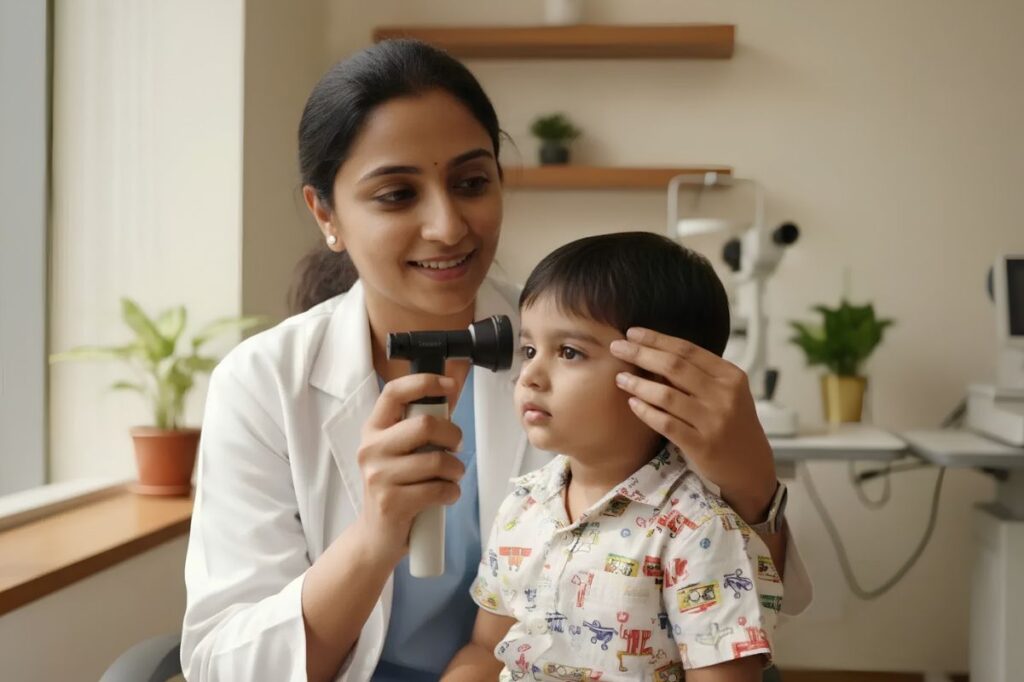
India’s new Vision Growth Card relies on generalized percentile curves drawn from foreign cohorts rather than a unified, pan-Indian longitudinal dataset, failing to account for distinct domestic ocular geometry and risking widespread over-diagnosis of myopia risk among Indian children.
Which Dataset Powers the Vision Growth Card’s Tracking Curves?
The percentile curves printed on the Vision Growth Card developed by the All India Ophthalmological Society and Mankind Pharma draw upon generalized reference standards rather than a unified, multi-center pan-Indian longitudinal cohort. According to pediatric ophthalmic epidemiologists, the expert committee adapting these tracking parameters imported normative centiles largely established on East Asian and European populations because a comprehensive, multi-regional growth study for Indian ocular biometry does not yet exist. Without a localized baseline, the card measures children against external ocular growth trajectories that may not reflect standard physiological development in India.
Why Do Indian Eyes Diverge from Global Percentile Standards?
Regional and ethnic variations in corneal curvature and axial length-to-corneal-curvature ratios make foreign or homogeneous growth centiles biologically misaligned for Indian children. Axial length is defined as the physical front-to-back distance of the eyeball measured in millimeters, which increases as progressive myopia develops. Published baseline metrics and findings from regional Indian ocular biometry studies, such as data from Sankara Nethralaya Chennai, the LV Prasad Eye Institute in Hyderabad, and the Dr. R.P. Centre at the All India Institute of Medical Sciences in New Delhi, demonstrate that distinct biometric proportions govern how Indian eyes elongate during childhood. When international centiles are applied uniformly, normal structural variants in regional biometric parameters can appear abnormal on standard distribution curves.
What Are the Clinical Risks of Uncalibrated Cutoff Thresholds?
Applying uncalibrated cutoff thresholds triggers unnecessary clinical interventions and parental anxiety for children exhibiting normal ethnic biometric variants. Senior pediatric ophthalmologists across government and private institutions note that when tracking tools flag standard physiological growth as pathological progression, families are frequently funneled into high-cost clinical interventions like low-dose atropine therapy and specialized spectacle lenses. Clinical audits evaluating how standard growth charts behave when applied outside their validated ethnic cohort parameters show that borderline centile crossings frequently lead to overtreatment in diverse demographic groups.
How Do Domestic Standards Differ from Pediatric Trackers Like the IAP?
Unlike the Vision Growth Card, established national health instruments like the Indian Academy of Pediatrics physical growth charts were built upon massive, multi-centric longitudinal studies tracking diverse domestic cohorts across socioeconomic strata. Public health documentation on standardizing height and weight percentiles shows that constructing an accurate domestic baseline requires years of multi-regional data collection across tens of thousands of subjects to account for genetic and nutritional diversity. The ophthalmic sector currently lacks an equivalent government-backed longitudinal repository for pediatric ocular metrics.
What Are the Economic and Psychological Costs for Families?
Patient intake feedback and specialist referral logs from community eye clinics confirm that when automated percentile flags misclassify normal growth variants, parents face unnecessary specialist fees and anxiety. As clinics adopt the new tracking booklet, the economic burden of false-positive risk categories falls directly on households navigating private outpatient care without institutional subsidies or insurance coverage for preventive ophthalmology.
Frequently Asked Questions
What reference dataset was used to build the Vision Growth Card’s curves?
According to pediatric ophthalmic epidemiologists, the Vision Growth Card relies on generalized percentile curves imported from East Asian and European cohorts rather than a unified pan-Indian longitudinal dataset.
Why do international growth centiles fail to match Indian pediatric eye metrics?
Regional variations in corneal curvature and axial length-to-corneal-curvature ratios mean that Indian eyes possess distinct biometric proportions that do not align with homogenous foreign centiles.
What happens when normal physiological growth is flagged as pathological myopia?
Children with normal ethnic biometric variants are frequently misclassified as high-risk, leading to unnecessary specialist fees and costly interventions like low-dose atropine therapy.
How do Indian Academy of Pediatrics growth charts differ from the new vision card?
IAP physical growth charts are built upon massive longitudinal studies tracking diverse domestic cohorts across India, whereas the ophthalmic sector currently lacks an equivalent government-backed longitudinal repository.
Who bears the financial burden of false-positive risk classifications?
Households navigating private outpatient care bear the full economic burden through unnecessary specialist consultation fees and out-of-pocket diagnostic costs without institutional subsidies.