






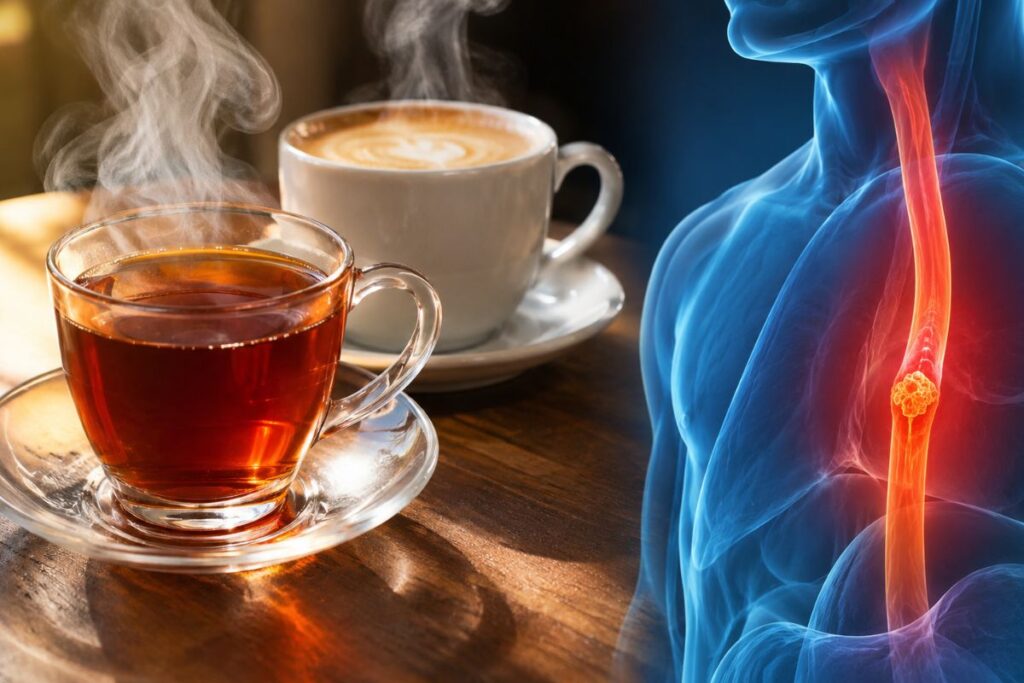
If you drink hot coffee or tea without smoking, heavy alcohol use, or chronic malnutrition, your personal risk of esophageal cancer remains vanishingly low. Thermal scalding acts not as an independent cancer-causing agent, but as a physical catalyst that lets outside chemical mutagens breach the body’s protective mucosal lining.
How Does Thermal Scald Actually Damage the Esophagus?
Scalding liquids do not mutate genes directly; they destroy physical tissue barriers, multiplying how deeply outside toxins penetrate the food pipe. When liquid above 65°C hits the squamous epithelium, the protective multi-layered lining of flat cells lining the upper digestive tract, it causes thermal necrosis, sloughing off surface cells and triggering emergency basal cell division.
Cellular biology indicates that rapid cell division by itself rarely initiates malignant tumors in otherwise healthy tissue. For cancer to begin, permanent genetic alterations must disrupt cellular regulatory genes. High heat breaks physical bonds between proteins and membranes; it does not alter DNA sequences the way chemical mutagens or ionizing radiation do.
Instead, thermal injury acts as an epithelial door-opener. Laboratory assays published in the Journal of Neurogastroenterology and Motility reveal that thermal and acid stress degrades tight junction proteins, specifically claudins and occludins, which form the intercellular seals that anchor adjacent mucosal cells together against external toxins.
Once these tight junction seals break, the tissue loses its trans-epithelial resistance. Luminal chemicals that would normally wash harmlessly down the digestive tract now seep directly into the basal stem-cell layer below. The scald opens the barrier; external chemical mutagens supply the carcinogenic trigger.
What Chemicals Were Hidden in the Original Cohort Studies?
The famous historical links between hot drinks and esophageal cancer arose from populations exposed to concentrated chemical mutagens alongside high beverage temperatures. The core epidemiological evidence cited by health agencies comes from three specific areas: the Golestan province of northeastern Iran, the Taihang Mountain region of northern China, and the Southern Cone of South America.
These populations faced significant chemical hazards that health reporting routinely omits. In South America, where regular consumption of hot yerba mate through a metal straw was tied to esophageal squamous cell carcinoma, a malignancy of the flat surface cells lining the upper and middle food pipe, leaves were historically cured through the barbacuá process. This method channels direct wood smoke through drying foliage over several days.
Toxicological chromatography published in Foods confirmed that wood-smoke curing leaves behind substantial levels of polycyclic aromatic hydrocarbons (PAHs), including benzo[a]pyrene, a potent Group 1 human carcinogen produced by incomplete organic combustion, ranging from 8.03 to 53.3 nanograms per gram of dried leaves. Modern air-dried yerba mate varieties, by comparison, carry only fractional trace amounts of these combustion mutagens.
Drinkers in historical South American cohorts were not simply consuming hot water. They were pulling a hot solvent laced with combustion-derived carcinogens directly against scalded tissue through a conductive metal straw.
A parallel exposure pattern appears in the prospective Golestan Cohort Study in northern Iran. Baseline demographic tables published by the study team show that participants experienced routine exposure to indoor biomass smoke from unvented heating, drank untreated surface water, and frequently ingested sukhteh, the scraped dross residue from opium pipes, which contains dense polycyclic mutagens.
Thermal scalding occurred on tissue already battling persistent, daily chemical carcinogens.
How Did the IARC “Probably Carcinogenic” Rating Get Misunderstood?
The International Agency for Research on Cancer classified very hot beverages as a hazard to identify biological potential, not to forecast everyday personal risk. In 2016, the International Agency for Research on Cancer (IARC), an agency of the World Health Organization, assembled a working group of 23 scientists to evaluate coffee, mate, and hot drinks.
As recorded in the IARC Monograph 116 evaluation, the panel reached two distinct conclusions:
- Coffee reclassification: The panel down-classified coffee from Group 2B (“possibly carcinogenic”) to Group 3 (“not classifiable as to its carcinogenicity”), citing absent evidence of harm.
- Temperature classification: The panel classified drinking very hot beverages, defined as liquids at or above 65°C, as Group 2A, or “probably carcinogenic to humans.”
An IARC monograph performs hazard identification, which asks whether an exposure can cause cancer under any conceivable circumstance or dose. It does not measure everyday absolute risk for the general population. Mainstream health coverage flattened that distinction, transforming a narrow hazard identification into an alarmist headline for ordinary coffee drinkers.
Why Do Western Studies Show Negligible Risk for Non-Smokers?
Large-scale European cohort studies demonstrate that when baseline tobacco and alcohol exposures are removed, the statistical cancer risk from hot drinks drops toward zero. In a collaborative analysis published by researchers at the University of Oxford tracking nearly one million adults across the Million Women Study and the UK Biobank, scientists recorded beverage drinking temperatures against long-term cancer incidence.
The data showed that drinking beverages “very hot” versus “warm” had no association with esophageal adenocarcinoma risk, yielding a relative risk of 0.92 (95% confidence interval: 0.76 to 1.12). For esophageal squamous cell carcinoma, the relative risk was 3.17 (95% confidence interval: 2.49 to 4.03).
Yet the underlying incidence of squamous cell carcinoma in modern Western populations was exceptionally low: just 799 cases appeared across 14 years among the entire million-person cohort. Tripling an extremely rare absolute probability leaves an individual’s lifetime risk near zero.
Epidemiologists who defend thermal scald as a standalone carcinogen point to cell-division biology. Dr. Dana Loomis, an epidemiologist who led the IARC Monograph 116 working group, noted during panel proceedings that continuous thermal burns force chronic compensatory cell division in the basal epithelial lining. Under that model, decades of repeated thermal repair could theoretically increase the odds of spontaneous DNA replication errors, even without external mutagens.
That spontaneous mutation model remains biochemically plausible. But observational health registries show that when outside mutagens and nutritional deficits are absent, spontaneous thermal replication errors rarely produce clinical tumors.
How Do Micronutrients Like Zinc Protect the Food Pipe from Heat?
Adequate nutritional levels provide the biochemical tools necessary to repair thermal scalds cleanly before cellular errors can accumulate. In the high-risk cancer corridors of northern Iran and northern China, regional soil and blood surveys identified endemic micronutrient deficiencies, particularly in zinc and selenium.
Zinc is a vital mineral cofactor for zinc-finger transcription factor proteins, which coordinate DNA repair enzymes and stabilize p53, the critical tumor-suppressor protein that halts cell division when DNA sustains damage. Nutritional oncology research indexed by the National Institutes of Health indicates that zinc deficiency impairs the cell’s enzymatic capacity to mend oxidative lesions and maintain chromosomal stability during division.
When a thermal scald strikes tissue in a zinc-deficient patient, basal cells attempt to divide rapidly without the molecular equipment required to repair genetic transcription errors. Mutations slip through unchecked.
In well-nourished consumers with consistent access to dietary minerals, mucosal cells shed, basal stem cells divide, proofreading enzymes repair errors, and the squamous barrier heals without triggering neoplastic changes.
What Is Your Real Absolute Risk of Food Pipe Cancer?
Your actual lifetime risk depends on which cell type is involved: squamous cell carcinoma linked to thermal burns, or adenocarcinoma linked to acid reflux.
- Esophageal Squamous Cell Carcinoma (ESCC): Arises in the flat squamous cells of the upper and middle esophagus, driven by tobacco, heavy alcohol, and thermal scald co-exposures.
- Esophageal Adenocarcinoma (EAC): Arises in mucus-secreting glandular cells near the stomach junction, driven primarily by chronic acid reflux (GERD) and obesity.
According to data from the National Cancer Institute Surveillance, Epidemiology, and End Results (SEER) program, the lifetime risk of developing any esophageal cancer in the United States is roughly 1 in 125 for men and 1 in 417 for women. Adenocarcinoma accounts for more than 70% of those diagnoses; squamous cell carcinoma accounts for less than 30%.
For an individual who smokes tobacco or drinks heavy spirits, scalding liquids present an authentic biological danger by breaking the epithelial barrier that keeps dissolved carcinogens out of basal cells. For a non-smoking, well-nourished person, hot tea and coffee deliver heat to tissue that possesses the full molecular machinery to repair it.
Frequently Asked Questions
Does drinking hot tea or coffee directly cause esophageal cancer? No, heat alone is not an independent complete carcinogen. Thermal injury above 65°C degrades tight junction proteins in the esophageal lining, acting as a physical gateway that allows external carcinogens like tobacco smoke, alcohol metabolites, or smoked herb residues to penetrate basal cells.
What did the IARC Group 2A rating actually mean for hot drinks? The International Agency for Research on Cancer classified beverages over 65°C as Group 2A (“probably carcinogenic”) under a hazard identification framework, which determines whether an exposure can theoretically cause cancer under specific conditions. It does not calculate absolute personal risk for average consumers living with modern nutrition and low mutagen exposure.
Why did Iranian and South American studies show such high cancer rates from hot drinks? Those study cohorts experienced heavy background exposure to independent chemical mutagens alongside boiling liquids. South American mate drinkers consumed leaves cured with wood smoke that contained high levels of carcinogenic polycyclic aromatic hydrocarbons, while Iranian cohorts in Golestan experienced widespread exposure to biomass smoke and opium dross alongside severe regional zinc deficiencies.
Should non-smokers in Western countries worry about beverage temperature? For non-smoking, well-nourished individuals, the absolute lifetime risk of developing esophageal squamous cell carcinoma is exceptionally low. While letting boiling drinks cool below 65°C prevents acute tissue scalding, hot beverages without accompanying chemical mutagens do not produce the cancer spikes seen in historical high-incidence regions.