







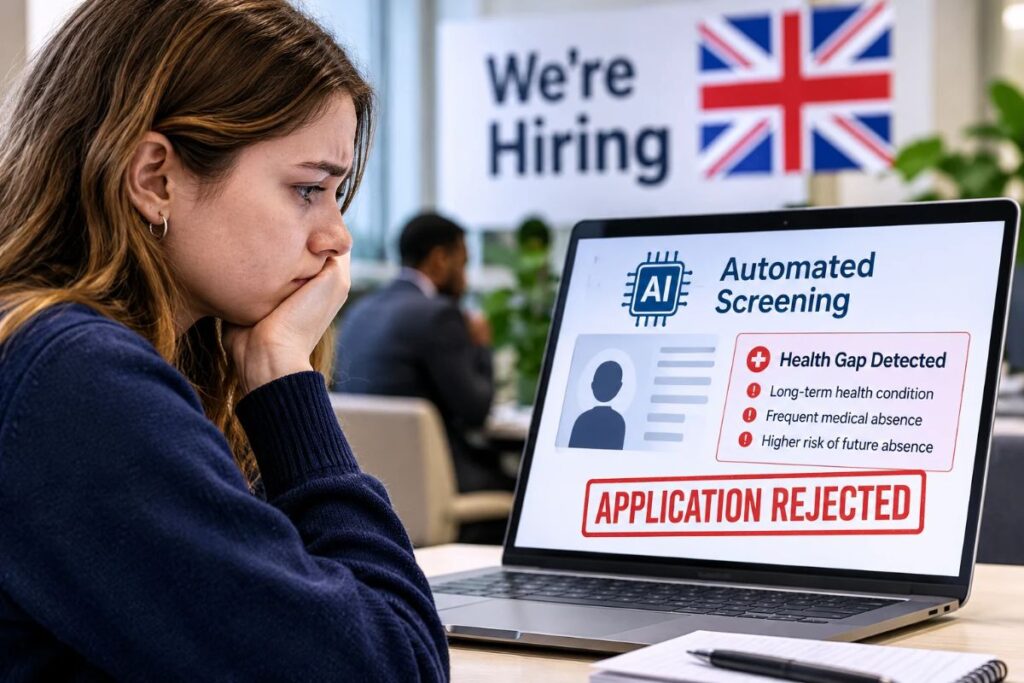
Automated hiring software rejects many young UK jobseekers with health conditions before a human ever reads their name. Entry-level employers in retail, logistics, and hospitality use automated hiring filters to block work-history gaps, rigid shift preferences, and slower video responses, turning software settings into what policymakers treat purely as a youth health crisis.
How Does Automated Hiring Filter Out Young UK Applicants?
Automated hiring software applies preset knockout rules that reject applicants within minutes if they fail a single threshold, such as continuous work dates or unrestricted shift availability. When an 18-to-24-year-old applies for an entry-level shift in a British supermarket, warehouse, or restaurant chain, the first gatekeeper is rarely a store manager.
It is an applicant tracking system (ATS), software used by large employers to sort, score, and reject job applications automatically. These systems process hundreds of applications per vacancy.
According to a September 2026 study by the workplace inclusion group Fair Play Talks and the Reject the Rejections campaign, 34% of surveyed jobseekers were rejected within an hour of applying, and 9% within five minutes. Nearly two-thirds (64%) suspected their application was rejected without a person ever seeing it.
Inside these platforms, hiring teams configure automatic “knockout” rules. As recruitment software documentation on automated knockout logic explains, these are binary pass-or-fail filters that immediately move non-compliant profiles straight to rejection before any human review takes place.
For young people recovering from ill health, standard automated settings create immediate barriers. Resume parsers, software tools that extract CV text into searchable database fields, flag gaps in employment chronology, and legal analysis of UK AI recruitment tools warns that automated scoring models routinely downgrade candidates with disability-related employment breaks. A 20-year-old who spent six months out of school or work managing a chronic illness or mental health condition often lacks the unbroken timeline required to clear the initial filter.
The Chartered Institute of Personnel and Development (CIPD) Resourcing and Talent Planning Report 2026 found that while 32% of UK organizations now use an ATS, driven primarily by large multi-site employers, only 7% of employers track the predictive validity of their assessment methods.
What Does the UK Policy Debate Miss About Entry-Level Job Demand?
Westminster policymakers focus almost exclusively on young people’s health and benefit rules while overlooking a 20-year drop in entry-level jobs and automated hiring barriers. Figures from the Office for National Statistics (ONS) August 2026 NEET bulletin show an estimated 981,000 people aged 16 to 24 in the UK, 13.0% of that age group, were not in education, employment, or training (NEET) between April and June 2026, up by 30,000 from the same period a year earlier.
Most political commentary treats that figure as a crisis of youth health or welfare dependency. Yet analysis of UK labor market trends reported by The Guardian notes that over the past 20 years, the British economy has lost roughly 1.6 million mid- and lower-skilled jobs while higher-skilled roles grew by 6.3 million, shrinking the exact entry-level rungs where young people with health barriers once gained a foothold.
In his 2026 Young People and Work Review for the Department for Work and Pensions, former health secretary Alan Milburn acknowledged that the UK labor market “does not provide enough early entry opportunities.” Even when entry-level vacancies open, automated screening dictates who gets through the door.
Why Does Automated Hiring Escape Equality Act Enforcement?
Automated hiring filters rarely face legal challenges because candidates rejected within minutes are almost never told an algorithm disqualified them. Under Section 19 of the UK Equality Act 2010, employers are barred from indirect disability discrimination, applying a blanket rule or criterion that puts disabled people at a particular disadvantage unless the employer can prove it is a proportionate means of achieving a legitimate aim.
Under Section 20 of the Equality Act 2010, employers also carry a legal duty to make reasonable adjustments during recruitment. Since 5 February 2026, Articles 22A to 22D of UK GDPR, introduced via the Data (Use and Access) Act 2025, also require employers making solely automated recruitment decisions to inform candidates, provide a route for human intervention, and allow applicants to contest the outcome.
In its March 2026 Recruitment Rewired investigation, the Information Commissioner’s Office (ICO) warned that many employers and recruitment platforms were deploying automated decision-making without those statutory safeguards. According to the September 2026 Fair Play Talks survey, 42% of rejected candidates wanted to challenge a rejection but could not find a way to do so, and among those who requested a human review, only 28% received one.
UK employment law guidance on AI recruitment tools notes that legal liability rests with the employer even when a third-party software vendor supplies the filter. Because applicants seldom know whether a person or a software rule rejected their file, systemic screening rarely reaches an Employment Tribunal.
How Do Shift-Flexibility Checkboxes and Attendance Points Trap Young Workers?
Even when young applicants pass CV screening, mandatory 24/7 shift checkboxes and automated absence-point formulas screen them out during hiring or probation. High-volume entry-level application forms routinely embed binary schedule questions, such as mandatory weekend, late-night, or rotating shift availability, directly into their pre-screening stage.
As standard retail and warehouse knockout templates illustrate, selecting “no” on rigid shift-window checkboxes removes an applicant from the active pool immediately. For a 21-year-old managing epilepsy, Crohn’s disease, or severe depression that requires predictable sleep patterns, fixed medication times, or regular hospital appointments, declining unrestricted shift flexibility triggers an instant digital rejection.
Those who do get hired face a second automated hurdle during probation: rigid attendance-scoring formulas such as the Bradford Factor, a formula that squares the number of separate absence spells and multiplies by total days missed (SSD). As UK HR absence-management benchmarks show, ten separate one-day absences for medical flare-ups generate a score of 1,000 points, whereas a single 10-day absence produces just 10 points.
In its official guidance on absence trigger points and disability-related absence, the Advisory, Conciliation and Arbitration Service (Acas) states that trigger points must not lead to automatic disciplinary action and that disability-related absences should be recorded separately or discounted as a reasonable adjustment. The Employment Appeal Tribunal reinforced that principle in Miss A Russell v College of North West London (UKEAT/0314/13/MC), ruling that tribunals must scrutinize whether Bradford Factor thresholds disproportionately disadvantage disabled staff.
Yet in high-turnover warehousing and retail sites, automated HR dashboards frequently flag probationary workers for formal warnings or dismissal the moment they cross a preset point score, pushing young workers with episodic conditions straight back into the out-of-work figures.
Why Do Employers Use Automated Screening, and What Happens When They Remove It?
Employers use automated screening to cope with AI-generated application floods, yet trials that replace software filters with brief work placements show strong job retention. According to 2026 UK recruitment data from Jobtrain and graduate hiring research from Whali, roughly 65% of jobseekers now use generative AI tools to write or polish applications, enabling candidates to mass-apply to dozens of vacancies in an afternoon.
The Chartered Institute of Personnel and Development’s 2026 survey found that 58% of employers reported an increase in unsuitable applications compared with 52% two years earlier, while 26% expect to recruit fewer workers overall due to rising employment costs under the Employment Rights Act 2025. Store and depot managers operating on tight staffing budgets say they lack the hours to read hundreds of CVs manually for a single part-time vacancy and require predictable shift coverage to keep sites running.
Yet evidence from supported-employment programs indicates that bypassing automated filters does not saddle employers with higher turnover. In its Individual Placement and Support (IPS) impact report, the UK employment charity Shaw Trust, which matches people managing mental and physical health conditions directly with employers outside standard ATS funnels, reported that 68% of participants who entered work sustained their employment beyond 26 weeks, exceeding its 60% benchmark.
Similarly, the employer-led charity Movement to Work uses structured two-to-six-week work placements in retail, hospitality, and logistics to let young NEET candidates demonstrate capability on the job rather than through an automated CV screen. The House of Commons Work and Pensions Committee’s June 2026 report on Connect to Work noted that person-centred, supported pathways consistently outperform standard job-search models for disabled people, provided local delivery is matched by employer willingness to adapt entry routes.
Whether the government’s upcoming youth employment reforms address how corporate hiring software screens out health gaps, or focus solely on benefit rules and clinic waitlists, will determine if those entry-level rungs reopen.
Frequently Asked Questions
How fast do automated hiring systems reject UK job applicants?
According to a September 2026 study by Fair Play Talks and the Reject the Rejections campaign, 34% of surveyed jobseekers were rejected within one hour of applying, and 9% were rejected within five minutes. Nearly two-thirds (64%) suspected an automated system rejected their application before a human read it.
Is it legal for UK employers to use automated filters that screen out health gaps?
Under Sections 19 and 20 of the UK Equality Act 2010, blanket recruitment rules that disadvantage disabled applicants are unlawful unless justified, and employers must provide reasonable adjustments. Since 5 February 2026, Articles 22A to 22D of UK GDPR also require employers to disclose solely automated hiring decisions and offer human review, though the Information Commissioner’s Office warned in March 2026 that many employers fail to provide those safeguards.
How does the Bradford Factor penalize young workers with fluctuating health conditions?
The Bradford Factor squares an employee’s separate absence spells and multiplies by total days missed (SSD), meaning ten one-day absences for medical flare-ups score 1,000 points compared with 10 points for a single 10-day absence. In high-turnover retail and warehouse roles, automated attendance dashboards often trigger probationary warnings or dismissal once a preset score is hit.
What happens when UK employers replace automated CV screening with work placements for young people?
Supported-employment trials show high job retention when employers bypass automated screening. Shaw Trust’s Individual Placement and Support program reported that 68% of participants with mental and physical health conditions sustained work beyond 26 weeks, beating its 60% benchmark, while Movement to Work uses two-to-six-week placements to evaluate young NEET candidates on the job.