






Strand Life Sciences does not hold a product-specific Indian drug regulator license for its CancerSpot blood test, yet it can legally sell the test to consumers today because India’s medical device laws regulate physical diagnostic kits, not proprietary laboratory services performed inside a single accredited facility, whereas the US Food and Drug Administration mandates multi-year clinical outcome trials before commercial clearance.
Why is Strand Life Sciences CancerSpot approval split between India and the US?
CancerSpot is sold directly to Indian consumers as a clinical laboratory service exempt from product licensing, while in the United States it requires federal medical device clearance before commercial marketing.
Consumers and hospital patients across India can already order CancerSpot directly through Strand Life Sciences’ Genomic Wellness portal for ₹25,000, using a 20-milliliter blood draw collected at home or at a partner clinic. At the same time, Bengaluru-based Strand Life Sciences, backed by Reliance Industries Limited, is preparing a regulatory submission in the United States, aiming for a US Food and Drug Administration (FDA) milestone by February or March 2027, according to company statements reported by Business Standard.
This two-track status reflects a statutory divergence in how India and the United States classify diagnostic tests.
In remarks accompanying Strand’s November 2026 hospital expansion, Chief Executive Officer Dr. Ramesh Hariharan stated that pre-market regulatory clearance is not required to launch such assays in most jurisdictions.
“In most regions of the world, one doesn’t [require regulatory approval to operate],” Dr. Ramesh Hariharan, CEO of Strand Life Sciences, said in a November 20, 2026 Business Standard report explaining why the company is pursuing US FDA clearance for export markets while already operating commercially in India.
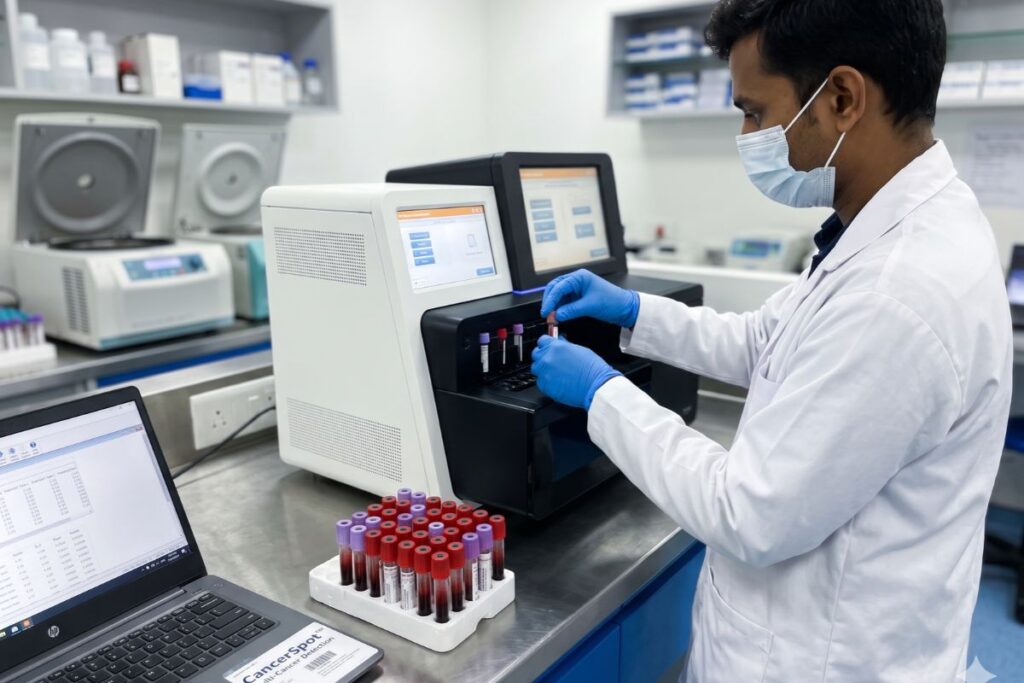
A review of India’s Central Drugs Standard Control Organisation (CDSCO) regulatory framework, administered through the CDSCO Online System for Medical Devices, shows why no product-specific in vitro diagnostic (IVD) manufacturing or import license is required for CancerSpot to operate in India: the test is not sold as a commercial diagnostic kit to outside laboratories. Instead, blood samples are shipped to Strand’s single central laboratory in Bengaluru.
How do the CDSCO Medical Devices Rules 2017 regulate liquid biopsy tests?
Under the CDSCO Medical Devices Rules 2017, Indian regulators license physical diagnostic kits distributed across laboratories, leaving proprietary liquid biopsy assays processed inside a single central facility outside pre-market product approval.
The Medical Devices Rules, 2017, notified under India’s Drugs and Cosmetics Act, 1940, govern the manufacture, import, and sale of medical devices and in vitro diagnostics, which are tests performed on biological samples such as blood or tissue outside the human body.
Under Rule 4 and Part II of the First Schedule of those rules, CDSCO classifies in vitro diagnostic devices, reagents, calibrators, control materials, and test kits manufactured or imported for sale or distribution into four risk tiers, from Class A (low risk) to Class D (high risk). Under CDSCO’s published IVD risk-classification framework, cancer biomarker assays and diagnostic interpretative software fall under Class C or Class D, requiring a central license from the Drugs Controller General of India (Form MD-9 for manufacturing or Form MD-15 for import) backed by performance evaluation data before a manufacturer can sell the kit to hospitals or third-party labs.
That licensing regime governs physical diagnostic products placed on the market for distribution. It does not capture a proprietary testing workflow performed entirely inside a company’s own reference laboratory.
When a genomics company collects whole blood in stabilizing tubes, ships the specimens to its central facility in Bengaluru, and analyzes circulating DNA using general-purpose sequencing instruments and in-house software, regulators treat the offering as a clinical laboratory service, known internationally as a laboratory-developed test (LDT), rather than a distributed medical device.
Oversight in this model relies on laboratory accreditation rather than product-level drug regulator approval. Strand notes on its Genomic Wellness corporate profile that its Bengaluru facility is accredited by India’s National Accreditation Board for Testing and Calibration Laboratories (NABL) and the College of American Pathologists (CAP). Those accreditations audit technical procedures, equipment calibration, and quality management, not whether a screening test reduces cancer mortality in healthy people.
What does US FDA Premarket Approval require for multi-cancer screening tests?
The US FDA classifies asymptomatic multi-cancer early detection tests as Class III medical devices, requiring Premarket Approval (PMA), its strictest regulatory review, backed by longitudinal prospective screening trials in healthy populations rather than case-control hospital studies.
While the US FDA has historically exercised enforcement discretion over certain single-lab tests certified under the Clinical Laboratory Improvement Amendments (CLIA), commercial authorization to market an asymptomatic multi-cancer screening assay requires Class III Premarket Approval.
The clinical bar required for that pathway was detailed on September 23, 2026, when the FDA’s Molecular and Clinical Genetics Panel convened to evaluate GRAIL’s Galleri, the most extensively studied multi-cancer blood test globally.
According to the FDA’s September 2026 Executive Summary prepared for that advisory panel, retrospective case-control studies, where blood from already-diagnosed cancer patients is compared against healthy donors, are insufficient on their own to prove screening effectiveness. Instead, the FDA evaluated two longitudinal prospective studies, PATHFINDER 2 (25,125 analyzable participants) and the UK’s NHS-Galleri randomized trial (roughly 142,000 participants), which tracked asymptomatic adults over time to measure real-world performance.
The prospective trial data reviewed in the FDA’s September 23, 2026 panel presentation showed why regulators insist on longitudinal screening cohorts before granting clearance:
- 12-month episode sensitivity: The share of cancers actually detected within a year of a blood draw was 35.0% in PATHFINDER 2 and 31.6% in NHS-Galleri, according to FDA panel records.
- Stage I sensitivity: Dropped to 21.4% in PATHFINDER 2 and 13.6% in NHS-Galleri, compared with 60.0% to 63.2% for Stage IV cancers in the same cohorts.
- Primary endpoint: In the NHS-Galleri trial, the test did not meet its primary goal of a statistically significant combined reduction in Stage III and Stage IV diagnoses across three annual screening rounds, according to GRAIL’s clinical trial disclosures.
Strand’s published evidence sits at the earlier case-control stage. Its November 2026 peer-reviewed study in the Proceedings of the National Academy of Sciences (PNAS), indexed on PubMed, analyzed 1,480 participants recruited across 43 Indian hospitals, comprising 950 clinically detected cancer patients across 14 solid tumor types, 80 individuals with symptomatic benign lesions, and 450 healthy controls.
What did Strand Life Sciences announce in November 2026?
In November 2026, Strand Life Sciences announced a wider hospital rollout for CancerSpot alongside a two-to-three-year plan to cut the test’s price from ₹22,000–₹25,000 to around ₹10,000, citing validation data from its 1,480-participant PNAS study.
Details of the expansion, reported in Pharmabiz coverage of the launch, center on CancerSpot’s enzymatic DNA methylation sequencing, a laboratory technique that reads chemical tags on DNA fragments shed into the bloodstream. According to the PNAS study, the test achieved an overall sensitivity of 72% and a false-positive rate of 1.4% (98.6% specificity) on a held-out validation set from the EMERGE cohort. The researchers also reported that rising levels of total circulating cell-free DNA, largely derived from immune cells, tracked with stronger cancer-associated methylation signals.
Who carries the clinical risk when commercial sales precede prospective trials?
When a liquid biopsy validated on symptomatic hospital patients is sold directly to healthy buyers before prospective screening trials conclude, patients absorb both the out-of-pocket cost of confirmatory scans after false alarms and the risk of missed early-stage tumors.
Proponents of laboratory-developed testing point to operational benefits in India’s single-lab service model. Running all samples inside one NABL- and CAP-accredited facility eliminates kit-to-kit manufacturing variability across outside labs, lets bioinformaticians update machine-learning classifiers as new data accumulates, and gives Indian clinicians access to multi-cancer blood testing years before a lengthy device approval cycle concludes.
On its CancerSpot consumer product page, Strand includes clinical disclaimers stating that “most cancers in the study were identified after symptoms appeared, so performance in screening-age adults without symptoms may differ,” and notes that “CancerSpot has not yet been tested in a prospective screening trial or shown to reduce cancer deaths.”
Still, pitching a hospital-validated assay to asymptomatic consumers, promoted on Strand’s portal as screening for 10 cancer types that lack standard screening methods, places clinical uncertainty on the buyer.
Based on Strand’s published 1.4% false-positive rate in PNAS, screening 1,000 healthy adults generates 14 false alarms. Because CancerSpot returns a molecular signal rather than a definitive diagnosis, every positive result requires confirmatory medical evaluation, including targeted imaging, endoscopy, or tissue biopsy, arranged through an oncologist. Meanwhile, a 72% overall sensitivity in a hospital case-control group means the test misses 28 out of every 100 cancers even in clinically detected cases, with miss rates typically higher in asymptomatic Stage I disease where tumor DNA shedding is lowest.
Until Strand completes longitudinal prospective trials ahead of its 2027 US FDA regulatory milestone, or India updates the Medical Devices Rules, 2017 to bring high-complexity laboratory-developed genomic assays under CDSCO pre-market review, Indian consumers remain early adopters in a market where commercial access arrives years ahead of regulatory proof of screening benefit.
Frequently Asked Questions
Is Strand Life Sciences’ CancerSpot test approved by CDSCO in India?
No, CancerSpot does not hold a product-specific Central Drugs Standard Control Organisation (CDSCO) manufacturing or import license because India’s Medical Devices Rules, 2017 regulate physical diagnostic kits distributed across laboratories rather than proprietary tests run inside a single accredited lab. Strand operates the test from its Bengaluru facility, which holds NABL and CAP laboratory accreditations.
Why does Strand Life Sciences need US FDA approval if CancerSpot is already sold in India?
In the United States, marketing an asymptomatic multi-cancer early detection blood test requires Class III Premarket Approval (PMA) from the US Food and Drug Administration, which demands prospective clinical trials showing real-world screening performance. Strand is targeting a US FDA regulatory milestone by February or March 2027 to enter the US market.
How accurate is CancerSpot according to its PNAS study, and what are its limits?
According to Strand’s November 2026 study in the Proceedings of the National Academy of Sciences (PNAS), CancerSpot showed 72% overall sensitivity and a 1.4% false-positive rate across 1,480 hospital participants. However, Strand’s own consumer disclosures state that most cancers in the study were diagnosed after symptoms appeared, and the test has not yet been evaluated in a prospective trial of healthy adults.
What happens if a healthy person gets a positive result on CancerSpot? A positive CancerSpot result indicates a molecular cancer signal rather than a confirmed diagnosis, requiring follow-up tests such as targeted imaging, endoscopy, or a tissue biopsy through an oncologist. At a 1.4% false-positive rate, roughly 14 out of every 1,000 healthy people screened would receive a positive signal requiring diagnostic follow-up despite not having cancer.