






Lab-validated virtual reality (VR) health education games rarely reach regular public school classrooms because multi-session VR protocols clash with K–12 schedules and budgets. Disinfecting shared headsets between 40-minute periods, clearing student data-privacy rules, and funding hardware carts plus ongoing information technology (IT) staffing exceed what typical public school districts can support.
Why Do K–12 Bell Schedules and Hygiene Rules Block Multi-Session VR?
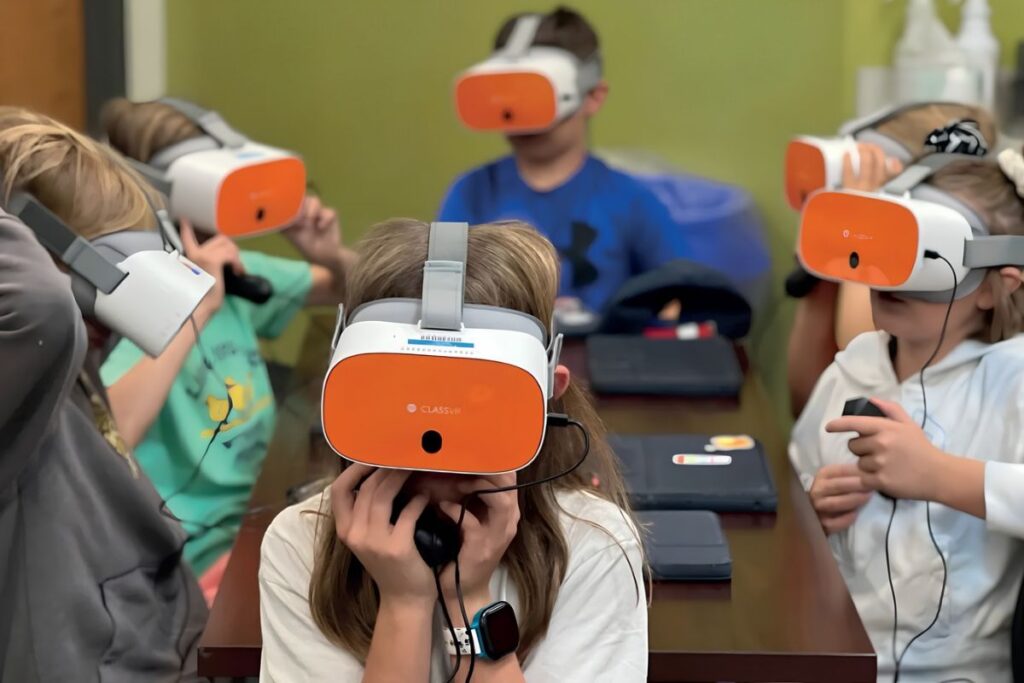
Multi-session VR health education games consume too much instructional time inside standard 40-to-45-minute public school periods once teachers account for headset fitting, calibration, and required between-user disinfection.
Clinical studies show that shifting adolescent health knowledge and refusal skills requires multiple structured sessions rather than a single demonstration. According to Yale University XRPeds Lab’s Community Report on Invite Only VR, completing the middle-school vaping-prevention game on Meta Quest headsets takes 2 to 2.5 hours across multiple class periods.
Inside a typical 40-to-45-minute middle or high school period, teachers must distribute headsets, help students adjust straps and play-area boundaries, manage occasional motion sickness, and collect hardware before the next bell rings.
School infection-control protocols add another delay between consecutive classes. Under Meta Quest headset hygiene guidelines and commercial VR disinfection protocols, shared headsets and replaceable silicone facial interfaces must be wiped down with non-bleach disinfecting wipes and left to dry completely before the next student wears them, while optical lenses require separate dry microfiber cleaning to prevent coating damage.
As documented in a 2026 mixed-methods school VR health-promotion evaluation in Health Promotion International and school-based VR implementation guides, setup friction, device rotations, and educator supervision overhead consume substantial portions of lesson slots whenever teachers lack dedicated technical assistants.
What Do University VR Showcases Leave Out About Classroom Staffing?
University VR health showcases omit the external research assistants, pre-charged hardware fleets, and on-site technical support that keep pilot studies running smoothly inside schools.
Media coverage of gamified health education regularly highlights academic research centers, such as Yale School of Medicine’s XRPeds Lab, and cites trials showing positive shifts in adolescent vaping knowledge and peer-resistance skills. Those stories rarely examine the staffing model behind the pilot.
In Yale XRPeds Lab’s 20-school Connecticut and Massachusetts rollout with roughly 1,300 eighth graders, the research team explicitly supplied external implementation support and teacher training around the trial, resources that end once an academic study concludes.
Why Do School Firewalls, Privacy Laws, and IT Staffing Ratios Block VR Apps?
District IT departments frequently block standalone VR health applications because third-party vendor logins and sensor telemetry violate federal student-privacy laws, while understaffed technicians already manage hundreds of Chromebooks per person.
Consumer and enterprise VR platforms often require individual vendor accounts or transmit behavioral and room-scanning telemetry to external cloud servers. Those data flows conflict with district compliance rules under the Children’s Online Privacy Protection Act (COPPA), whose Federal Trade Commission (FTC) amendments taking effect in April 2026 tightened verifiable parental consent and written vendor-contract rules, alongside the Family Educational Rights and Privacy Act (FERPA) and Children’s Internet Protection Act (CIPA) network filtering mandates.
According to EDUCAUSE’s regulatory analysis of extended reality in education, room-scanning sensors and biometric telemetry create student-privacy liabilities that require formal data-privacy agreements before school deployment.
Ongoing hardware maintenance creates a second bottleneck. According to Consortium for School Networking (CoSN) IT staffing benchmarks, districts scale from roughly 5 IT staff per 1,000 students in small districts down to 0.4 IT staff per 1,000 students in districts with more than 50,000 students. In CoSN’s 2026 survey, 58% of districts reported insufficient staffing for instructional-technology support, leaving technicians little capacity to update VR firmware or troubleshoot spatial tracking errors.
How Does Classroom VR Cart Pricing Compare to Public School Health Budgets?
Outfitting a single classroom with 30 managed VR headsets and a charging cart costs roughly $19,249 to $30,990 upfront, competing against district supply budgets that represent only 8% of total school spending.
Mobile Device Management (MDM) software is an administrative tool IT departments use to remotely configure, update, and lock school-owned devices. According to B&H Photo’s enterprise education listing for the Avantis ClassVR 30-headset bundle with charging cart and RobotLAB’s 30-seat classroom VR kit pricing, equipping one classroom with 30 headsets, a charging cart, controllers, and initial MDM licensing runs between $19,249 and $30,990 before multi-year software renewals.
Public school budgets leave narrow margins for specialized hardware. According to the National Center for Education Statistics (NCES) Public School Expenditures report, 79% to 80% of current public school expenditures pay for staff salaries and benefits, while just 8% covers all supplies combined, from textbooks and heating oil to classroom materials. A 2026 AASA (The School Superintendents Association) survey further found that rising operating costs have forced districts to delay instructional-technology upgrades.
How Are Developers Adapting Health Games to Survive in Public Schools?
To reach public schools without university-supplied staff, developers are porting VR health education games onto flat-screen web browsers and Chromebooks that school districts already own and maintain.
VR health researchers note that controlled clinical trials must first verify whether immersion shifts behavior before developers tackle district-wide logistics, and point out that falling standalone headset prices plus centralized MDM software are gradually easing setup.
Yet outside university-staffed trials, deployment models increasingly drop dedicated VR hardware altogether. In Yale XRPeds Lab’s quasi-experimental evaluation of Invite Only VR, researchers tested the vaping-prevention game on flat-screen iPads alongside VR headsets, while Yale University spinout Playbl, Incorporated distributes its adolescent health-prevention games across schools through standard web browsers and existing district Chromebooks.
Until VR hardware requires no per-student vendor logins, disinfects within a five-minute passing period, and fits inside baseline school IT budgets, most lab-tested VR health education games will remain confined to research pilots rather than daily public school instruction.
Frequently Asked Questions
Why aren’t VR health education games used in regular public school classrooms?
Lab-tested VR health games stall in public schools because multi-session protocols, such as the 2 to 2.5 hours required for Yale’s Invite Only VR, clash with 40-to-45-minute class periods once teachers factor in headset setup and between-class disinfection. Districts also face $19,249 to $30,990 upfront costs per 30-headset classroom kit, COPPA and FERPA student data-privacy blockers, and severe IT staffing shortages.
How much does a 30-headset VR classroom kit cost a school district?
According to enterprise education listings from B&H Photo and RobotLAB, outfitting a single classroom with 30 managed VR headsets, controllers, a mobile charging cart, and initial Mobile Device Management (MDM) licensing costs between $19,249 and $30,990 before recurring annual software renewals.
Why do school IT departments block standalone VR health applications?
Standalone VR platforms often require individual student vendor logins or send room-scanning and behavioral telemetry to external cloud servers, which conflicts with the Children’s Online Privacy Protection Act (COPPA), updated by the Federal Trade Commission in April 2026, as well as FERPA and CIPA web-filtering rules. In addition, Consortium for School Networking (CoSN) data shows large districts operate with as few as 0.4 IT staff per 1,000 students, leaving no capacity to manage VR firmware updates.
How are developers modifying VR health games so public schools can actually use them?
To avoid headset maintenance, disinfection delays, and hardware procurement costs, developers increasingly build flat-screen browser versions that run on school Chromebooks. For example, Yale XRPeds Lab tested Invite Only VR on iPads alongside VR headsets, and Yale spinout Playbl, Incorporated licenses browser-based versions of its prevention games directly to schools.