






For decades, kitchen wisdom held that the highest smoke point guaranteed the safest cooking oil. Home cooks and professional chefs checked reference charts, reached for refined seed oils boasting 450°F ratings, and reserved extra virgin olive oil exclusively for cold dressings. Food science has overturned that assumption.
When oil heats in a skillet, visible smoke marks only the final stage of breakdown. The greater health concern lies in invisible chemical changes: the accumulation of polar compounds, aldehydes, and lipid peroxides. Controlled laboratory trials confirm that an oil’s smoke point does not predict how well it resists degradation under heat. Instead, an oil’s underlying fatty acid structure and antioxidant concentration determine what truly ends up on your plate.
What Happens When Fat Meets High Heat
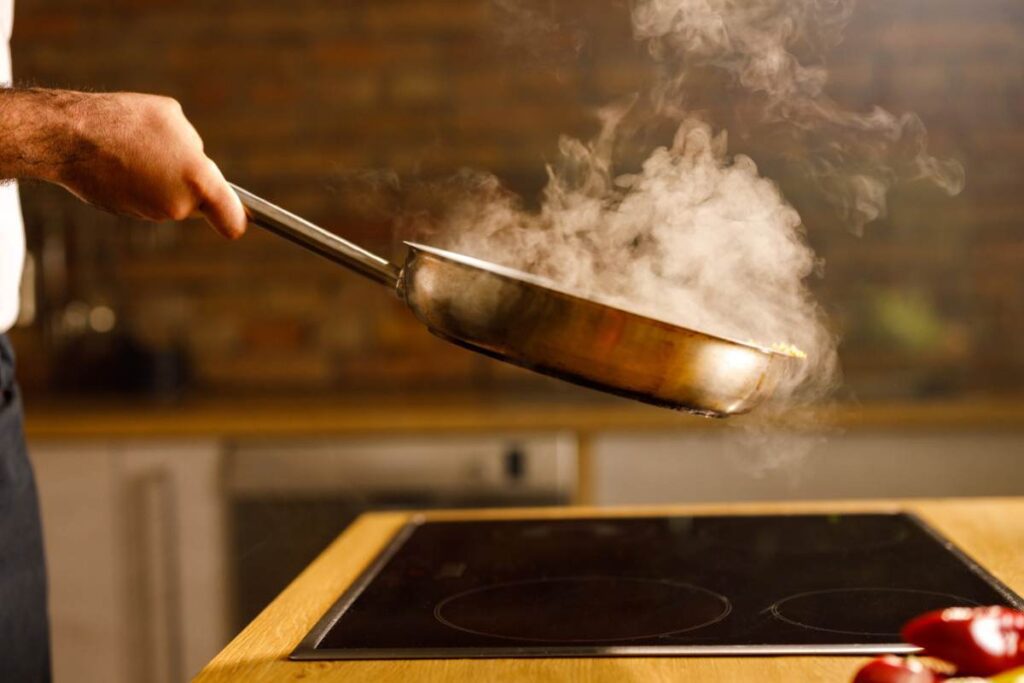
Every cooking fat has a thermal limit. When heat exceeds that threshold, triglyceride molecules break apart into glycerol and individual free fatty acids. Continued heating converts glycerol into acrolein, a pungent, vaporized aldehyde that stings the eyes and irritates the respiratory tract. That acrolein vapor is what forms the bluish haze rising from an overheated skillet.
Beyond airborne smoke, thermal breakdown creates non-volatile byproducts that remain dissolved in the cooking oil. Known as polar compounds and lipid peroxides, these degraded molecules form when oxygen reacts with fragile carbon bonds. Consuming heavily oxidized fats introduces oxidative stress to the digestive tract and vascular system. In commercial kitchens across Europe, health regulations require restaurants to discard cooking oil once total polar compounds exceed 24 to 27 percent.
The Flaw in the Smoke Point Rule
Smoke point measures the exact temperature at which an oil produces continuous visible bluish smoke under laboratory conditions. While useful for avoiding charred food, it tells cooks little about whether an oil is breaking down into harmful compounds before that smoke appears.
A landmark 2018 study led by Modern Olives Laboratory Services and published in Acta Scientific Nutritional Health evaluated ten commercial culinary oils heated up to 464°F (240°C) and held at 356°F (180°C) for six hours. The researchers measured polar compound creation, trans-fat generation, and oxidative byproducts. Extra virgin olive oil produced the lowest concentration of polar compounds and secondary oxidation products of all oils tested, despite having a lower smoke point than canola, grapeseed, or sunflower oils.
Three chemical factors govern thermal resilience far more than smoke point alone:
- Fatty Acid Structure: Polyunsaturated fatty acids (PUFAs), prevalent in soybean, corn, and sunflower oils, contain multiple carbon-carbon double bonds. These double bonds are chemically vulnerable and rupture quickly under heat. Monounsaturated fatty acids (MUFAs, such as oleic acid) contain only one double bond, while saturated fats contain none, making them far more resistant to thermal oxidation.
- Antioxidant Protection: Natural biophenols and tocopherols (vitamin E) actively neutralize free radicals generated during cooking. Extra virgin olive oil carries a dense natural shield of hydroxytyrosol and oleocanthal, protecting its fatty acids even at sustained frying temperatures.
- Refinement Process: Chemical refining strips away free fatty acids to artificially raise an oil’s smoke point. However, this process also strips away protective polyphenols, leaving the refined oil defenseless against rapid oxidation once heat is applied.
Thermal Stability Across Common Kitchen Fats
Selecting the right cooking fat requires balancing fatty acid profiles, natural antioxidant density, and practical heat limits. The following table outlines verified performance benchmarks based on data from the USDA FoodData Central and commercial lipid research:
| Cooking Fat | Smoke Point | Dominant Fatty Acid | Optimal Kitchen Use |
|---|---|---|---|
| Refined Avocado Oil | 520°F (271°C) | Monounsaturated (Oleic ~70%) | High-heat searing, wok stir-frying, grilling |
| Ghee (Clarified Butter) | 485°F (252°C) | Saturated (~65%), Monounsaturated (~30%) | Roasting, pan-searing, high-heat sautéing |
| Refined Light Olive Oil | 465°F (240°C) | Monounsaturated (Oleic ~73%) | Baking, high-heat skillet cooking |
| Refined Coconut Oil | 450°F (232°C) | Medium-Chain Saturated (~90%) | Baking, medium-high stovetop frying |
| Extra Virgin Olive Oil (EVOO) | 375°F–410°F (190°C–210°C) | Monounsaturated (~75%) + Polyphenols | Daily stovetop sautéing, shallow frying, roasting |
| Unsalted Butter | 350°F (177°C) | Saturated (~63%) with milk solids | Gentle baking, pan sauces, low-heat finishing |
| Cold-Pressed Flaxseed Oil | 225°F (107°C) | Polyunsaturated Alpha-Linolenic (~55%) | Raw drizzling only; never apply heat |
Matching Cooking Fats to Culinary Technique
Sear, Char, and Wok Frying (Above 450°F)
Cooking techniques that involve blistering heat—such as searing a cast-iron steak or flash-frying in a carbon steel wok—require fats with both structural stability and high vaporization thresholds. Refined avocado oil serves as the premier choice. Composed of roughly 70 percent monounsaturated oleic acid, it withstands temperatures up to 520°F without scorching or emitting acrolein.
Ghee provides another heat-resilient option. By simmering butter until all moisture evaporates and straining out the milk proteins (casein and lactose), clarifying raises the smoke point from 350°F to 485°F. As detailed in our breakdown of the evidence-based health benefits of ghee, removing those solids also concentrates short-chain fatty acids like butyrate while safeguarding against rapid scorching.
Everyday Stovetop Sautéing and Roasting (325°F to 400°F)
Standard pan frying, vegetable roasting, and stovetop sautéing rarely push past 375°F. At these everyday temperatures, extra virgin olive oil remains one of the safest fats available. Its natural polyphenol content acts as a sacrificial barrier, trapping oxygen free radicals before they can attack the lipid matrix. When managing morning meals, consult our review of how dietary cholesterol and cooking fats interact to understand how different fat choices influence blood lipid markers.
Low-Temperature Cooking and Nutritional Plans
Fats with high concentrations of polyunsaturated omega-3 fatty acids, like cold-pressed flaxseed, walnut, and unrefined hemp oil, oxidize rapidly even under mild warmth. Keep these oils refrigerated in opaque bottles and use them exclusively as cold finishing drizzles.
For individuals tracking macronutrient intake, fat quality takes precedence over sheer quantity. As outlined in our clinical guide on metabolic adaptations during the keto diet, relying heavily on degraded or oxidized fats places unnecessary oxidative burdens on the liver and vascular endothelium.
Practical Rules for Healthier Cooking
Managing cooking oil safely comes down to four fundamental kitchen habits:
- Match the fat to the flame: Save cold-pressed polyunsaturated oils for dressings. Use extra virgin olive oil for daily stovetop cooking up to 400°F, and reserve avocado oil or ghee for intense searing.
- Never let oil hit its smoking threshold: If an oil begins smoking in the pan, discard it, wipe the skillet clean, and start over. Once smoke appears, acrolein and polar compounds form rapidly.
- Avoid repeated reheating: Reusing frying oil across multiple meals accelerates oxidative breakdown exponentially. Each successive heating cycle increases polar compound density and degrades beneficial antioxidants.
- Store oils away from light and heat: Keep everyday oils in dark glass or tin containers stored in a cool cabinet rather than right next to the stovetop. Ambient heat and light initiate oxidation long before the oil ever touches a hot pan.