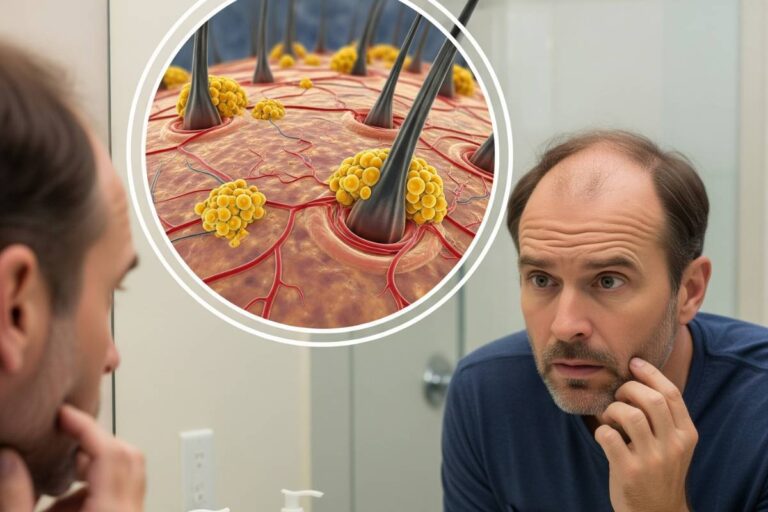








Modern dermatology has shifted the treatment of alopecia from cosmetic concealment to targeted pharmacotherapy rooted in molecular pathways. While pattern hair loss (androgenetic alopecia) stems from progressive follicular miniaturization driven by dihydrotestosterone (DHT), autoimmune hair loss (alopecia areata) involves a distinct collapse of immune privilege around the hair bulb. Treating either condition effectively requires distinguishing between these biological drivers and deploying therapies supported by clinical evidence.
5-Alpha Reductase Inhibitors: Suppressing Dihydrotestosterone
In androgenetic alopecia, hair follicles with genetic sensitivity undergo progressive miniaturization under the influence of dihydrotestosterone (DHT), an androgen converted from testosterone by the enzyme 5-alpha reductase (5-AR). Two oral 5-AR inhibitors form the foundation of clinical treatment for men: finasteride and dutasteride.
Finasteride selectively inhibits the Type II 5-AR isoenzyme. At the standard dosage of 1 mg daily, clinical trials show finasteride decreases serum DHT concentrations by roughly 70% and scalp tissue DHT by 60% to 70%. In landmark five-year clinical studies, finasteride halted hair loss progression in approximately 86% of men and produced visible regrowth in 48%. Dermatologists often discuss dutasteride (0.5 mg daily) as an off-label alternative for patients who do not respond adequately to finasteride. Dutasteride inhibits both Type I and Type II isoenzymes, lowering serum DHT by more than 90% and scalp DHT by over 50%, with comparative trials demonstrating superior increases in hair count.
Both agents require realistic expectation management. Patients should understand that 5-AR inhibitors manage rather than cure genetic hair loss; follicular miniaturization resumes within 3 to 6 months if treatment stops. Controlled clinical trials indicate adverse sexual side effects—including erectile dysfunction and decreased libido—occur in approximately 1.5% to 2% of patients, rates comparable to placebo after long-term follow-up. Additionally, because finasteride approximately halves prostate-specific antigen (PSA) levels, baseline and ongoing PSA monitoring must account for this reduction. A detailed examination of this hormonal cascade is available in our breakdown of androgenetic alopecia biology.
Follicular Vasodilation: Topical vs. Low-Dose Oral Minoxidil
Minoxidil remains the cornerstone non-hormonal treatment for both male and female pattern hair loss. Discovered during trials for systemic hypertension, minoxidil works as an adenosine triphosphate (ATP)-sensitive potassium channel opener. By dilating microvascular networks around the dermal papilla, it stimulates vascular endothelial growth factor (VEGF), shortens the resting telogen phase, and prolongs the active anagen growth phase.
Topical minoxidil is available over the counter as a 2% or 5% solution or 5% foam. For optimal response, the pro-drug minoxidil must be converted into minoxidil sulfate by the enzyme sulfotransferase (SULT1A1) located in the follicular outer root sheath. Topical foam is widely preferred because it eliminates propylene glycol, the primary solvent in liquid formulations responsible for allergic contact dermatitis, scalp scaling, and pruritus.
In recent years, off-label low-dose oral minoxidil (LDOM) has emerged as a preferred alternative among dermatologists for patients with topical intolerance or low scalp sulfotransferase activity. Oral administration utilizes hepatic sulfotransferase enzymes, delivering consistent systemic bioavailability. Typical dosing protocols range from 0.625 mg to 2.5 mg daily for women and 1.25 mg to 5 mg daily for men. Potential side effects include hypertrichosis (unwanted body or facial hair growth), mild ankle edema, and postural lightheadedness. Both topical and oral regimens frequently trigger an initial shedding phase (telogen effluvium) within the first 2 to 8 weeks, reflecting the rapid transition of dormant follicles into anagen growth.
Autoimmune Regulation: The Era of Targeted JAK Inhibitors
Unlike androgenetic alopecia, alopecia areata is an autoimmune disorder characterized by the collapse of hair follicle immune privilege. Cytotoxic CD8+ NKG2D+ T cells infiltrate the peribulbar region, releasing interferon-gamma (IFN-γ) and interleukin-15 (IL-15). These cytokines signal through the Janus kinase-signal transducer and activator of transcription (JAK-STAT) pathway, keeping follicles trapped in a state of dystrophic arrest.
The therapeutic approach shifted dramatically with the regulatory approval of oral JAK inhibitors, moving care beyond the chronic use of broad systemic corticosteroids:
- Baricitinib (Olumiant): Approved in 2022 by the FDA for adults with severe alopecia areata. In the landmark BRAVE-AA1 and BRAVE-AA2 Phase 3 trials published in the New England Journal of Medicine (NEJM), nearly 39% of patients receiving 4 mg daily achieved a Severity of Alopecia Tool (SALT) score of 20 or less (representing 80% or greater scalp hair coverage) at week 36, compared to less than 5% on placebo. Significant eyebrow and eyelash regrowth accompanied scalp responses.
- Ritlecitinib (Litfulo): Approved in 2023 for adults and adolescents aged 12 and older, addressing severe disease in younger demographics. Ritlecitinib selectively inhibits JAK3 and the TEC kinase family. In the key ALLEGRO Phase 2b/3 trial, roughly 23% of patients achieved SALT scores of 20 or less at week 24, with responses strengthening over long-term extension.
Because JAK inhibitors modulate immune signaling, they carry class-wide boxed warnings regarding serious infections, reactivation of latent viruses like herpes zoster and tuberculosis, major adverse cardiovascular events (MACE), venous thromboembolism, and malignancy. Safe administration requires rigorous baseline laboratory screening—including tuberculosis testing, hepatitis serologies, complete blood counts, and lipid profiles—followed by ongoing clinical monitoring every 3 to 6 months.
Localized Suppression: Intralesional Corticosteroid Injections
For localized, patchy alopecia areata involving less than 50% of the scalp, intralesional corticosteroid therapy remains the primary clinical standard. Dermatologists administer triamcinolone acetonide (typically diluted to 2.5 to 10 mg/mL) through multiple micro-injections directly into the mid-dermis of active patches every 4 to 6 weeks.
This targeted approach dampens localized peribulbar lymphocytic infiltration without generating systemic immunosuppression. Visible terminal hair regrowth typically appears after two to three sessions. Dermatologists monitor treatment closely to avoid cutaneous adverse effects, primarily epidermal thinning, dermal atrophy, and localized hypopigmentation. Injecting into the deeper subcutaneous fat can cause reversible or prolonged fat necrosis, underscoring the necessity of precise dermal needle placement.
Procedural Therapies: Platelet-Rich Plasma and Photobiomodulation
Patients seeking adjunctive interventions often evaluate procedural options that complement baseline medical therapy:
- Platelet-Rich Plasma (PRP): Autologous blood is centrifuged to isolate a concentrated fraction of platelets (typically 3 to 5 times whole blood baseline). Upon activation, these platelets release vascular endothelial growth factor (VEGF), platelet-derived growth factor (PDGF), and transforming growth factor-beta (TGF-β) directly into the scalp microenvironment. Randomized trials demonstrate modest improvements in hair density and shaft caliber for androgenetic alopecia when administered across monthly induction sessions followed by quarterly maintenance. However, outcomes vary due to differences in centrifugation protocols, platelet counts, and activation methods across clinics.
- Low-Level Laser Therapy (LLLT): Cleared by the FDA as non-invasive medical devices, red light devices operate at wavelengths between 650 nm and 670 nm. The mechanism centers on photobiomodulation: photons are absorbed by cytochrome c oxidase within follicular mitochondria, increasing ATP synthesis, cellular oxygenation, and nutrient delivery to miniaturizing follicles. LLLT serves as a well-tolerated home adjunct, though clinical response remains modest compared to oral pharmacotherapy.
Nutritional assessments should complement these physical modalities. Correcting underlying deficiencies in serum ferritin, vitamin D, and zinc optimizes the biological conditions for follicular cycling. For an objective review of botanical and dietary claims, review our appraisal of natural remedies and herbs for hair loss.
Clinical Evaluation and Long-Term Treatment Strategy
Selecting an effective hair regrowth protocol depends on definitive clinical differentiation. A thorough dermatological assessment relies on dermoscopy (trichoscopy) to distinguish between miniaturized hairs and peripilar signs in pattern baldness, compared to yellow dots, black dots, and exclamation mark hairs characteristic of active alopecia areata. In atypical presentations or suspected scarring alopecia, a 4 mm punch scalp biopsy provides definitive histopathologic clarity. Patients should consult our diagnostic protocols in diagnosing alopecia and review the classification framework in alopecia types explained before initiating medical interventions.
Because the biological hair cycle operates on a four-to-six-month scale, clinical response to any medical regimen requires patience and sustained compliance. For androgenetic alopecia, medications preserve hair follicles only as long as treatment continues; stopping minoxidil or 5-AR inhibitors causes regrown hair to shed within months. In autoimmune alopecia areata, the emergence of targeted JAK inhibitors provides a realistic path to substantial hair recovery, provided treatment is matched to disease severity and managed with regular safety monitoring.